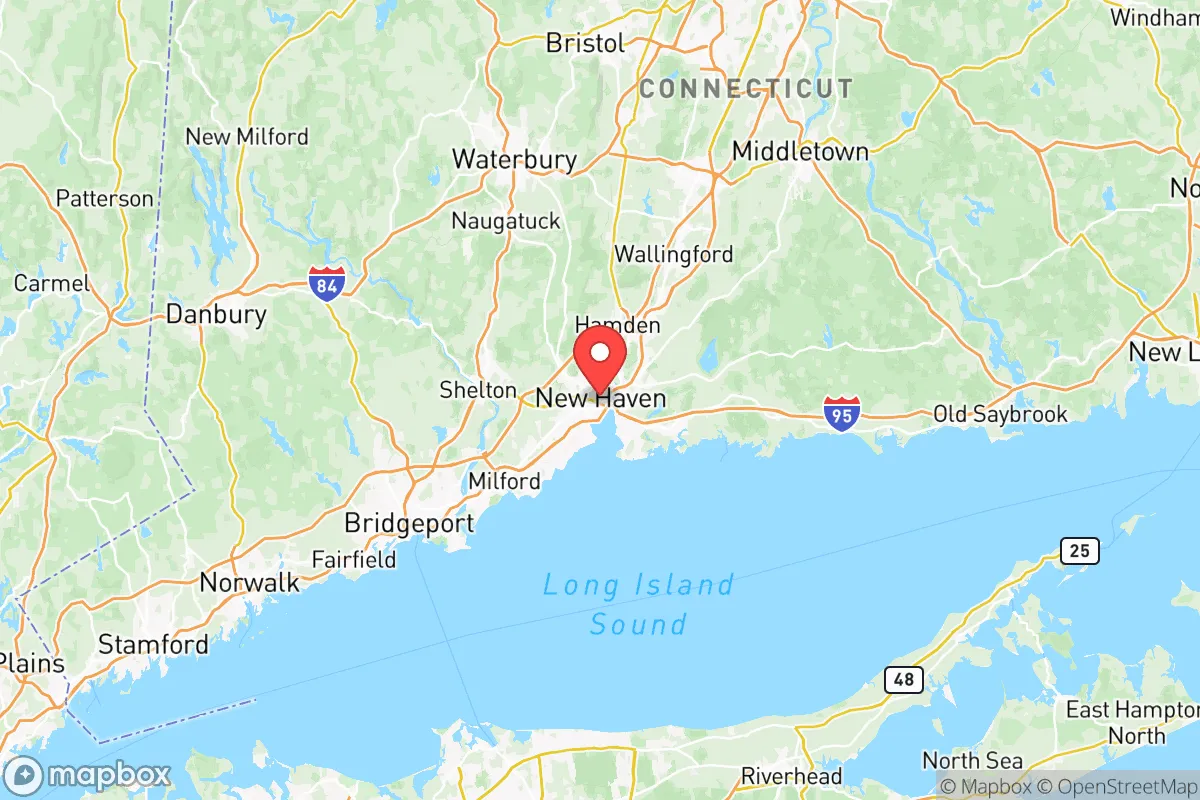
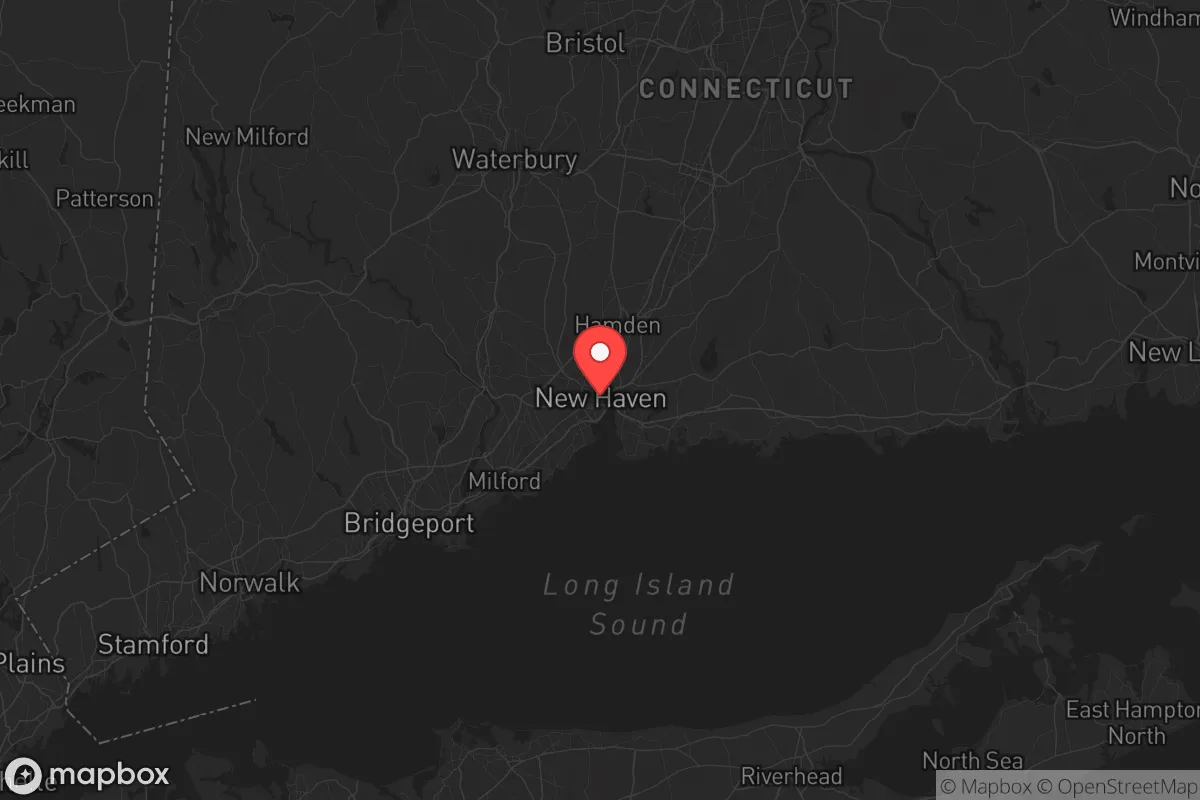
Demographics of South Central Connecticut Planning Region County
Historical data isn't available for South Central Connecticut Planning Region County. Trends shown are for Connecticut.
Affluence Level in South Central Connecticut Planning Region County
A middle-class area roughly in line with national averages across income, home values, education, and employment.
People of South Central Connecticut Planning Region County
South Central Connecticut Planning Region County is a densely settled, historically industrial corridor of 566,803 residents that blends old New England mill towns with modern suburban and urban redevelopment. The county is notably more diverse than much of Connecticut, with a population that is 59.6% white, 19.1% Hispanic, 13.0% Black, 3.1% East and Southeast Asian, and 1.2% Indian subcontinent, while 6.4% of residents are foreign-born. Its identity is shaped by a legacy of manufacturing and immigration, a strong Catholic and Jewish institutional presence, and a recent shift toward knowledge-economy and healthcare employment. The region is politically moderate to liberal, but retains a pragmatic, working-class character that appeals to families seeking good schools and commuter access to New Haven and Hartford.
Settlement & growth (pre-1960)
Before European colonization, the area now comprising South Central Connecticut was home to the Quinnipiac and Mattabesec peoples, Algonquian-speaking tribes who lived in seasonal villages along the Quinnipiac River and the Long Island Sound coast. Dutch traders from New Netherland established a small post near present-day New Haven in the 1630s, but English Puritans from the Massachusetts Bay Colony founded the first permanent settlements in 1638, establishing the New Haven Colony. These early English settlers were Congregationalist farmers and merchants who laid out the famous "Nine Square Plan" for New Haven's downtown, a grid that still defines the city center.
The 19th century brought dramatic demographic change as the Industrial Revolution transformed the region. New Haven became a major manufacturing hub, and Irish immigrants arrived in large numbers during the 1840s and 1850s, fleeing the Great Famine and working on the Farmington Canal, in factories, and as domestic laborers. By 1860, the Irish made up roughly 20% of New Haven's population. German immigrants followed in the 1850s and 1860s, settling in neighborhoods like Fair Haven and establishing breweries, bakeries, and trade guilds. The post-Civil War era saw a wave of Italian immigrants, who by 1900 were the largest foreign-born group in New Haven, concentrated in the Wooster Square and East Haven neighborhoods, working in construction, garment manufacturing, and the city's burgeoning cigar industry.
Eastern European Jews, primarily from Russia and Poland, arrived between 1880 and 1920, settling in New Haven's Westville and Edgewood neighborhoods and building a dense network of synagogues, kosher markets, and mutual aid societies. At the same time, Polish and Lithuanian immigrants established communities in Meriden and Wallingford, drawn by jobs in silverware factories, hardware manufacturing, and the railroad. The early 20th century also brought a smaller but significant wave of African Americans from the rural South during the Great Migration, who settled primarily in New Haven's Dixwell and Newhallville neighborhoods, working in factories and domestic service. By 1950, the county was a mosaic of ethnic white enclaves, with a small but growing Black population and virtually no Hispanic or Asian presence.
Modern era (post-1965)
The 1965 Hart-Cellar Act fundamentally reshaped South Central Connecticut's demographics. The most dramatic shift has been the growth of the Hispanic population, which rose from under 2% in 1970 to 19.1% today. The largest group is Puerto Rican, who began arriving in significant numbers in the 1960s and 1970s, settling in New Haven's Fair Haven and Hill neighborhoods, as well as in Meriden. Since the 1990s, Mexican, Dominican, and Central American immigrants have also arrived, with newer enclaves forming in Hamden and West Haven. The Hispanic community is now the county's fastest-growing demographic segment, driving much of the region's population stability amid an aging white population.
The Black population, at 13.0%, has grown more slowly but has become more suburbanized since the 1980s. While New Haven's Dixwell and Newhallville neighborhoods remain historically significant, middle-class Black families have moved to Hamden, North Haven, and Wallingford, drawn by better schools and housing stock. The county also saw a modest influx of African immigrants, particularly from Ghana and Nigeria, who have established small communities in New Haven and West Haven.
The East and Southeast Asian population, at 3.1%, is a more recent phenomenon. Chinese and Vietnamese immigrants began arriving in the 1980s and 1990s, many drawn to the region's universities and hospitals. A small but visible Chinese community has formed in New Haven's East Rock neighborhood, while Vietnamese families have settled in Meriden and Hamden. The Indian subcontinent population, at 1.2%, is concentrated among professionals working in healthcare and information technology, with clusters in Hamden and Orange. Domestic migration has been relatively modest compared to Sun Belt regions, but the county has attracted some out-of-state professionals from New York and Massachusetts, drawn by lower housing costs and Yale University's gravitational pull.
The future
South Central Connecticut is becoming more diverse, but the pace of change is slower than in many other parts of the Northeast. The white population, which was over 80% as recently as 1990, is projected to continue declining as a share, while the Hispanic population is expected to grow to roughly 25-28% by 2040, driven by both immigration and higher birth rates. The Black population share is likely to remain stable or grow slightly, while East and Southeast Asian and Indian subcontinent populations will continue to grow slowly, primarily through professional migration tied to Yale New Haven Health System and the region's biotech sector.
The most significant demographic trend is the aging of the white population, particularly in the inner-ring suburbs like East Haven and West Haven, where the median age is now over 40. Younger families, both white and non-white, are increasingly choosing towns like Hamden, Wallingford, and North Haven for their school systems and relative affordability. New Haven itself is experiencing a modest revival, with young professionals and empty-nesters moving into downtown apartments and condos, but the city's population has been essentially flat for decades. The county's cultural identity is evolving from a collection of ethnic white enclaves into a more pluralistic, Hispanic-influenced region, though it remains less diverse than neighboring Fairfield County or the Hartford area.
For someone moving in now, South Central Connecticut offers a stable, moderately diverse community with strong institutional anchors in Yale University and the healthcare sector. The region is not experiencing explosive growth or dramatic cultural upheaval, but rather a gradual, generational shift toward greater diversity and suburbanization. New arrivals will find a place where old ethnic traditions still matter—Italian festivals, Polish churches, Jewish delis—but where Hispanic culture is becoming increasingly central to the region's identity. The county is a good fit for families and individuals who want the amenities of a small city and its suburbs without the rapid change or high costs of the major coastal metros.

* Values derived from national, state, county, city and local statistics and may differ in a specific area. Last updated: 2026-07-23T19:46:24.000Z
Narrative content on this page is AI-generated and may contain mistakes. Verify any details that matter before acting on them.
ReloMaps may earn a commission from affiliate links at no extra cost to you.

