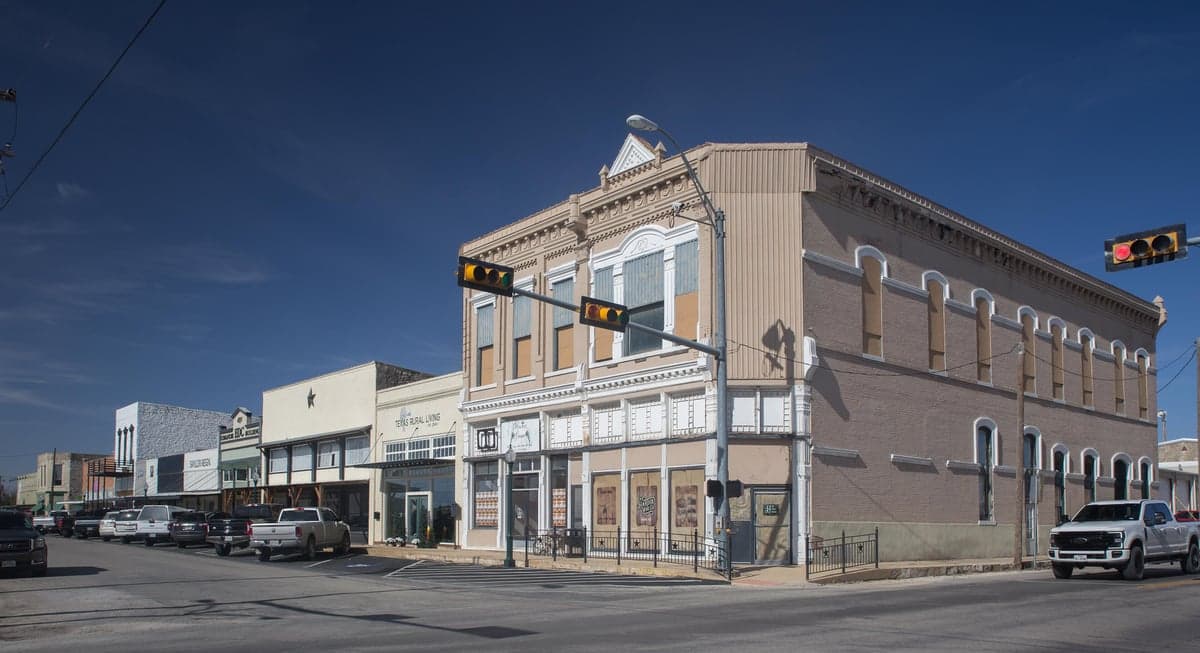
Photo: Wikipedia
Strategic Assessment of Comanche, TX
Workable tactical position. Some exposure to population density or targets, but generally defensible in a crisis.
What does the Strategic Assessment tell us?
Our Strategic Assessment grades tactical survivability of an area. Major population centers, military targets, fallout zones, natural disasters, and border exposure all drive risk — lower exposure means a more defensible position in a crisis.
This is heavily inspired by Joel Skousen's Strategic Relocation book. Highly recommended you checkout the book ($)What does this tell us?
Our Strategic Assessment grades tactical survivability of an area. Major population centers, military targets, fallout zones, natural disasters, and border exposure all drive risk — lower exposure means a more defensible position in a crisis.
This is heavily inspired by Joel Skousen's Strategic Relocation book. Highly recommended you checkout the book ($)Strategic Pillars

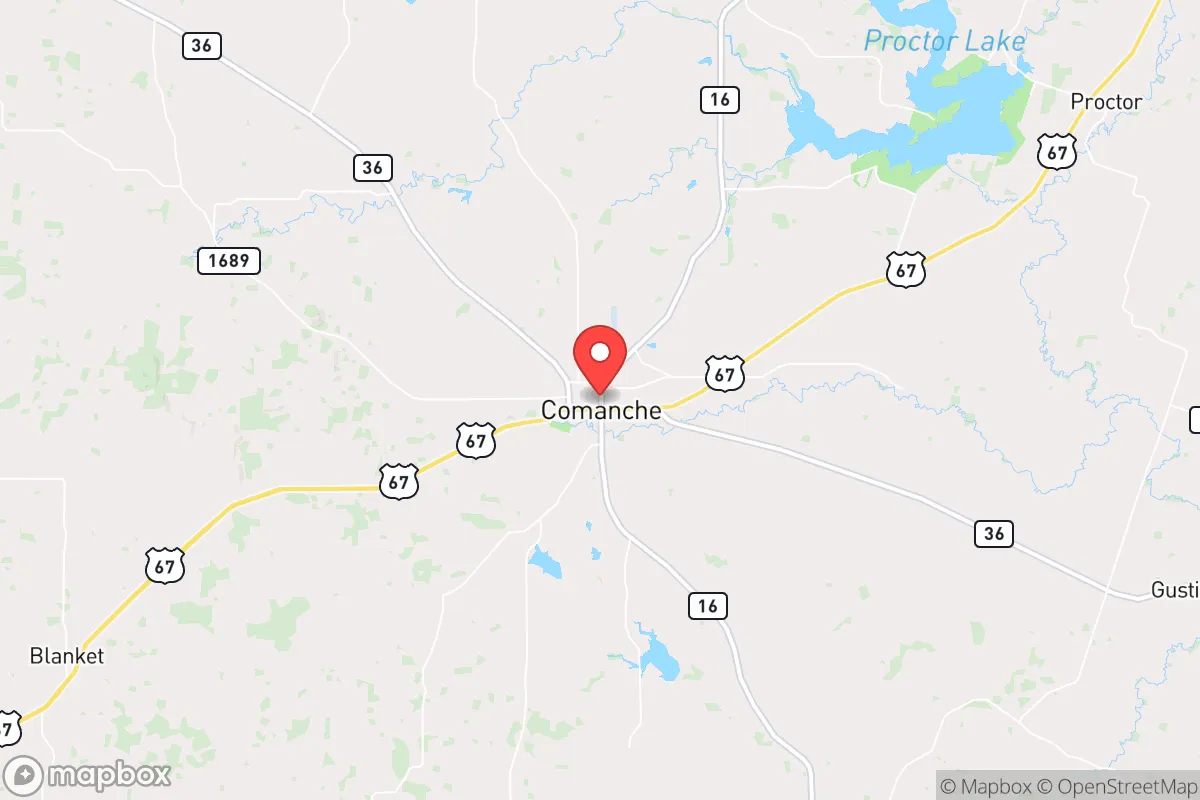
Key Distances
Regional Safe Places
Below is our recommended "safe zones" in Texas and the surrounding area based on our strategic heuristics. For most people, it's unrealistic to live in a “safe zone” full-time due to work, family or other personal reasons. They tend to be more rural. However, many of these areas are perfect for second homes and retreat properties that double as a vacation home or even a short-term rental.

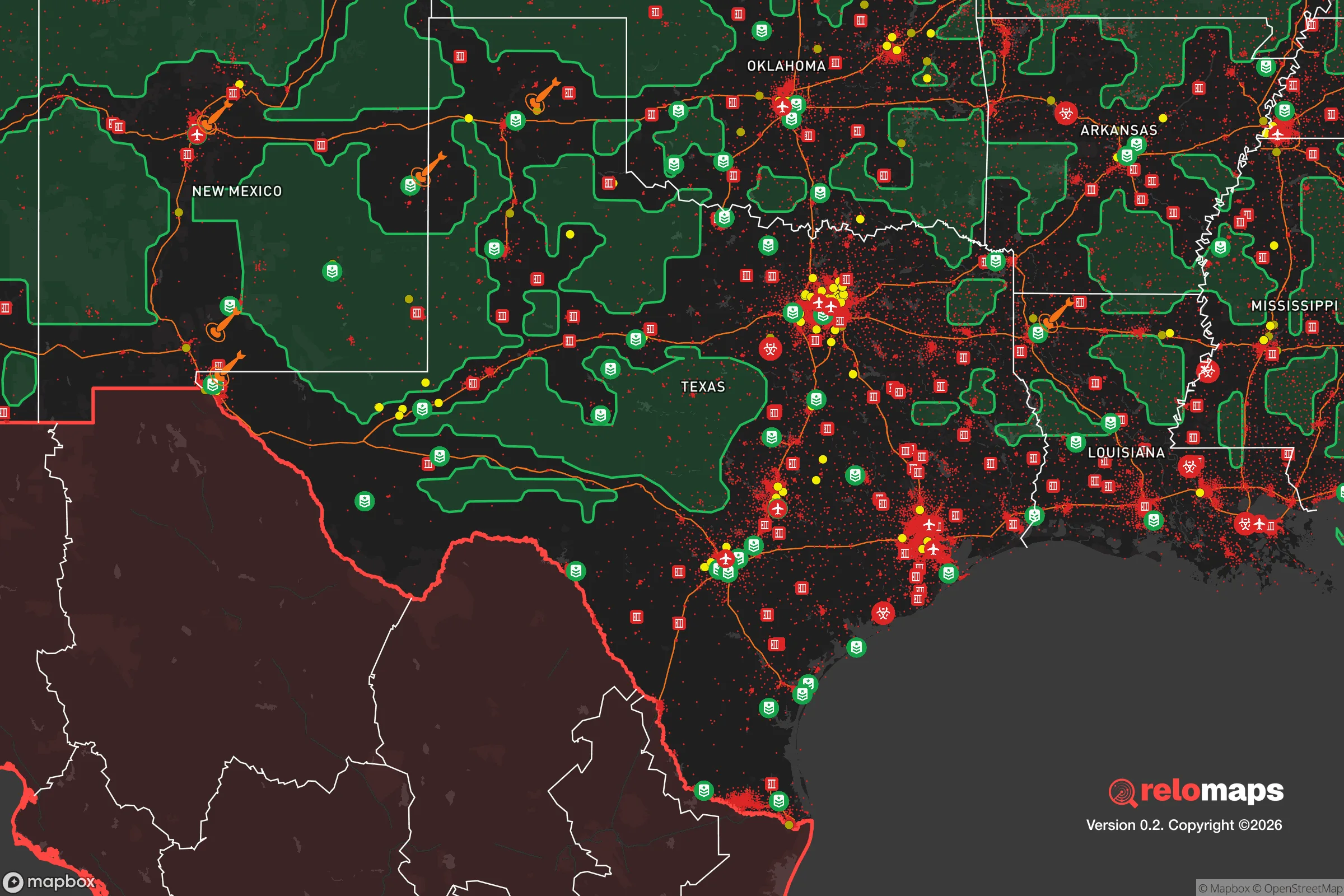


Important Note: For informational purposes only. This does not mean nothing bad ever happens in the green zones. Please use common sense. This is based on public data and modeled with AI. We tried to take a conservative approach but mistakes happen. We update this regularly as new information becomes available.
Solar Generator Recommendations
Backup power matters more here than in safer locations. We've picked three solar generators across budgets and capacity tiers — start with the budget unit if you only need a few essentials, or step up if you want to run a fridge and HVAC for days at a time.

Jackery Portable Power Station Explorer 300
Budget OptionPower on the Go: Weighing only 11 lbs, it's convenient to set up and store with book-sized foldable solar panels

BLUETTI Portable Power Station AC180
Designed for both indoor and outdoor scenarios, AC180 is highly capable as it has a robost capacity and continuous output power.

EF ECOFLOW DELTA Pro Ultra Power Station
Upgraded PickEcoFlow DELTA Pro Ultra is a whole-home energy system designed to grow with your family. Integrated with the Smart Home Panel 2, it scales to meet your evolving energy needs — keeping your home powered, intelligent, and secure through every stage of life.
We earn a commission, at no additional cost to you.
Strategic Assessment Analysis
Comanche, Texas, sits in a sweet spot for those serious about resilience: far enough from major metro areas to avoid the worst of civil unrest or a mass-casualty event, yet close enough to essential supply routes and regional medical care. This town of roughly 4,200 people in Comanche County offers a strategic mix of low population density, strong local agriculture, and a geography that naturally filters out the chaos of urban collapse. For a relocator thinking in terms of decades, not just the next election cycle, Comanche presents a defensible, self-sufficient base that doesn't require living off-grid in a bunker—just smart, conservative preparation.
Geographic position and natural advantages for long-term security
Comanche sits at the intersection of U.S. Highway 67 and U.S. Highway 377, roughly 90 miles southwest of Fort Worth and 100 miles northwest of Austin. That distance is a feature, not a bug. In a scenario where major cities become ungovernable due to unrest or supply chain collapse, Comanche is outside the typical 50-mile "chaos radius" that would see looting, roadblocks, and refugee flows. The surrounding Comanche County is rolling hills and limestone bedrock, with the Leon River running just east of town—a reliable surface water source that doesn't depend on a municipal grid. The area sits atop the Trinity Aquifer, meaning private wells are viable for those who drill deep enough (typically 200–400 feet). The climate is semi-arid but supports dryland farming of cotton, wheat, and hay, plus ample grazing for cattle and goats. This isn't lush farmland, but it's productive enough to sustain a family with modest acreage. The lack of major industrial or military targets within 50 miles means Comanche is unlikely to be a primary fallout zone in a nuclear exchange, though prevailing winds from the west would carry fallout from potential strikes on Dallas-Fort Worth or Abilene—a risk that's manageable with a basic shelter and a few weeks of supplies.
Risks, exposures, and proximity to fallout-relevant landmarks
No location is risk-free, and Comanche has its own vulnerabilities. The biggest exposure is proximity to Interstate 35, about 60 miles east. In a mass evacuation scenario, I-35 would become a parking lot of desperate people heading west. Comanche isn't on that highway, but secondary roads like U.S. 67 and U.S. 377 would see heavy traffic from refugees fleeing Austin and San Antonio. The town's position as a regional crossroads could become a liability if those roads are clogged with vehicles or blocked by checkpoints. Another concern: the Comanche Peak Nuclear Power Plant is about 70 miles north, near Glen Rose. While not close enough for a direct blast zone, a major accident or sabotage there could send a plume across the area depending on wind direction. The plant is a hardened target, but in a worst-case scenario, you'd want to shelter in place for 48–72 hours. On the plus side, there are no major military bases, chemical plants, or rail hubs within 30 miles. The closest significant fallout target would be Dyess Air Force Base in Abilene (80 miles northwest) or the Dallas-Fort Worth metroplex (90 miles northeast). For a relocator, the risk profile is moderate—better than suburban Dallas, worse than the remote Panhandle—but manageable with basic preps like a basement or storm shelter, a water filtration system, and a two-week food reserve.
Practical resilience for a relocator: food, water, energy, and defensibility
Comanche's practical resilience comes down to four pillars: local food production, groundwater access, energy independence, and community defensibility. The town itself has a small but functional grocery store (Brookshire's), a hardware store, and a farm supply co-op, but the real strength is the surrounding rural area. Within a 10-mile radius, you'll find dozens of small farms selling beef, pork, eggs, and produce directly to locals. The Comanche Farmers Market runs seasonally, and there's a strong culture of barter and neighborly trade. For water, the Leon River is perennial but requires treatment; a better bet is drilling a well on your own property. Many existing homes in the county already have wells, and the cost to drill a new one runs $8,000–$15,000—a worthwhile investment for a relocator. Electricity comes from the Oncor grid, which is moderately reliable but prone to outages during ice storms and summer heat waves. Solar is viable here—Comanche averages 230 sunny days per year—and a 5kW system with battery storage can cover basic needs for a family of four. Defensibility is where Comanche shines. The town is laid out on a grid with wide streets and limited choke points. The surrounding countryside offers plenty of rural properties with good sightlines, natural cover from limestone ridges, and multiple egress routes (U.S. 67 east to Stephenville, U.S. 377 south to Brownwood, and numerous county roads). For a single individual or a family, a 5–10 acre parcel with a well, a garden, and a metal roof is a solid foundation for long-term self-sufficiency. The local sheriff's office is small but responsive, and the community is overwhelmingly conservative and armed—a deterrent to any organized threat.
The overall strategic picture for Comanche is one of balanced preparedness without paranoia. It's not a remote survivalist compound, but it's far enough from the major failure points to give you a real buffer. The area's agricultural base, water resources, and conservative social fabric make it a viable destination for someone who wants to be ready for civil unrest, economic collapse, or a major disaster without living in a literal bunker. The trade-offs are real: you're 45 minutes from the nearest hospital (in Stephenville), and the local economy is tied to agriculture and oilfield services, which can be volatile. But for a relocator who values freedom, self-reliance, and a community that shares those values, Comanche offers a solid foundation. The key is to move before the crisis, not during it—and to treat this as a long-term investment in your family's security, not a quick escape hatch.

* Values derived from national, state, county, city and local statistics and may differ in a specific area. Last updated: 2026-05-13T17:09:54.000Z
Narrative content on this page is AI-generated and may contain mistakes. Verify any details that matter before acting on them.
ReloMaps may earn a commission from affiliate links at no extra cost to you.

