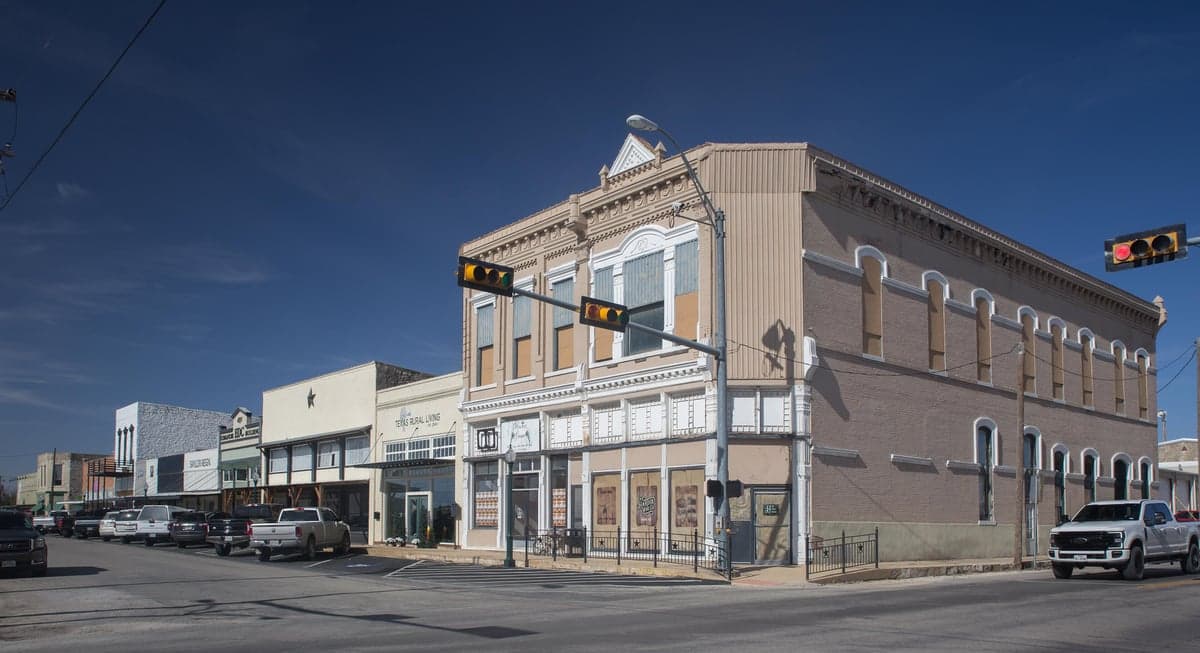
Photo: Wikipedia
Personal Sovereignty in Comanche, TX
Strong independent fundamentals that actively favor personal liberty and low regulation.
What does Personal Sovereignty tell us?
Personal Sovereignty measures your capacity for self-reliance and independence with minimal government friction. Higher scores mean fewer barriers between you and the way you want to live... but it assumes you have the space you need and good neighbors.
What does this tell us?
Personal Sovereignty measures your capacity for self-reliance and independence with minimal government friction. Higher scores mean fewer barriers between you and the way you want to live... but it assumes you have the space you need and good neighbors.
State Policy
Energy independence: Net exporter (220% of energy produced in-state)
Personal Liberty
Homesteading

Personal Liberty Analysis
Comanche, Texas, offers a personal sovereignty environment that is markedly stronger than what most Americans experience in coastal or urban jurisdictions, largely because the state government in Austin has historically taken a hands-off approach to local affairs and the county itself is sparsely populated enough that enforcement of many regulatory schemes is minimal. For a survivalist or prepper evaluating this area, the key takeaway is that Comanche sits in a part of Texas where the default assumption is still that a person can manage their own affairs without constant interference from code enforcement, zoning boards, or state police. The combination of a low tax burden, permissive gun laws, and a county culture that values self-reliance makes this a place where an individual can exercise a high degree of autonomy, though it is not a lawless frontier—the sheriff’s office is active, and property rights are enforced through the courts, not through anarchy.
Tax burden and regulatory posture: what it costs to be left alone
The financial cost of personal sovereignty in Comanche is low, which is a primary draw for those seeking to minimize government dependency. Texas has no state income tax, so the primary tax burden falls on property and sales. Comanche County’s property tax rate is roughly 0.78% of assessed value, which is below the Texas average of about 1.1%, meaning a $200,000 home carries an annual tax bill of roughly $1,560. Sales tax in Comanche city is 8.25%, which is standard for the region. There is no local income tax, no business inventory tax, and no state-level estate tax. The regulatory posture is equally light: Comanche County has no county-wide zoning for unincorporated areas, and the city of Comanche itself has only basic subdivision regulations. This means that building a workshop, storing supplies, or keeping livestock on your property is generally not subject to the kind of permit battles common in suburban counties like Williamson or Collin. The Texas Department of Licensing and Regulation does not impose occupational licensing on most trades, so a person can perform their own electrical or plumbing work on their own property without a contractor’s license. For a prepper, this translates into the ability to modify your land and structures without bureaucratic delays.
Self-defense and gun law specifics: carrying, storing, and using firearms
Comanche sits in a state with some of the most permissive firearm laws in the country, and local enforcement reflects that culture. Texas is a permitless carry state, meaning any law-abiding adult 21 or older can carry a handgun openly or concealed without a license. There is no state-level registry, no waiting period for purchase, and no ban on standard-capacity magazines. The Castle Doctrine is codified in Texas Penal Code §9.32, which presumes that a person has a reasonable fear of death or serious injury if an intruder unlawfully enters their home, vehicle, or workplace—no duty to retreat applies. For those storing firearms for long-term preparedness, there are no state restrictions on the quantity of ammunition or firearms you may possess, and there is no requirement to register them. The Comanche County Sheriff’s Office is known for being supportive of Second Amendment rights; they issue License to Carry (LTC) permits for reciprocity with other states, but it is not required for in-state carry. The nearest gun ranges are in Brownwood (about 25 miles west) and Stephenville (about 30 miles east), both of which offer public access. For a prepper, the legal environment here allows for a robust personal defense posture without fear of prosecution for standard defensive actions.
Self-reliance and homesteading viability: lot sizes, zoning, and off-grid feasibility
The viability of a self-reliant lifestyle in Comanche is high, driven by affordable land and minimal land-use restrictions. In the unincorporated areas of Comanche County, minimum lot sizes are not set by county ordinance, so you can purchase a 1-acre parcel or a 100-acre ranch without needing a variance. The city of Comanche has a minimum lot size of 7,500 square feet for residential, but most preppers will be looking outside city limits. Off-grid living is legally feasible: there is no county requirement to connect to municipal water or sewer, and rainwater catchment is unregulated. Solar panels and wind turbines are not subject to permitting beyond standard electrical code, and the county does not enforce any aesthetic restrictions on exterior modifications. Raising livestock—chickens, goats, cattle—is allowed on any parcel over one acre in the county, with no limit on the number of animals. Gardening and food storage are unrestricted. The only significant regulatory hurdle is the Texas Commission on Environmental Quality (TCEQ) for septic systems, which requires a permit for installation, but this is a one-time cost of roughly $500. For a prepper, this means you can establish a fully functional homestead with water independence, food production, and energy generation without fighting a zoning board or homeowners association.
Personal liberties: parental rights, medical autonomy, speech, and property
Comanche’s legal and cultural environment strongly supports parental rights and medical autonomy, though it operates within the broader Texas framework. Texas law gives parents the right to direct the education of their children, including homeschooling without state oversight beyond a basic curriculum requirement. The Comanche Independent School District is small (about 1,200 students) and generally responsive to parental concerns, but many prepper families opt for homeschooling or private religious schools in the area. Medical autonomy is protected by Texas’s lack of a state-level vaccine mandate for adults and the absence of any emergency powers that allow indefinite quarantine without due process. The Texas Medical Board is active, but there is no state-run health insurance mandate, and alternative medicine practitioners operate with minimal interference. Free speech is protected under the Texas Constitution, which has its own free speech clause that is often interpreted more broadly than the First Amendment. Property rights are strongly protected: Texas has no state-level eminent domain for economic development, and the county does not enforce any form of rent control or landlord licensing. For a prepper concerned about government overreach, the key protections are the Texas Property Code’s strong protections against warrantless searches and the state’s refusal to implement any form of digital ID or vaccine passport system. The local sheriff’s office has publicly stated they will not enforce federal gun laws they deem unconstitutional, which is a practical demonstration of local sovereignty.
Overall, Comanche offers a level of personal sovereignty that is rare in the United States today, comparable to other rural Texas counties like Mason or San Saba, but with slightly better access to supplies via Highway 377. The combination of no income tax, permitless carry, minimal zoning, and strong property rights creates an environment where a survivalist or prepper can operate with a high degree of autonomy. The trade-offs are real: emergency services are slower, medical care is limited to a small county hospital, and the nearest major city (Fort Worth) is two hours away. But for those who value being left alone to manage their own security, food production, and family affairs, Comanche represents a stronghold of personal liberty in a state that still largely respects the individual’s right to self-determination. The county’s political culture leans heavily conservative, with Comanche County voting +68 for Trump in 2020, and the local government is generally hostile to federal overreach. If your priority is minimizing government interference in your daily life, this area deserves serious consideration.

* Values derived from national, state, county, city and local statistics and may differ in a specific area. Last updated: 2026-05-13T17:09:54.000Z
Narrative content on this page is AI-generated and may contain mistakes. Verify any details that matter before acting on them.
ReloMaps may earn a commission from affiliate links at no extra cost to you.

