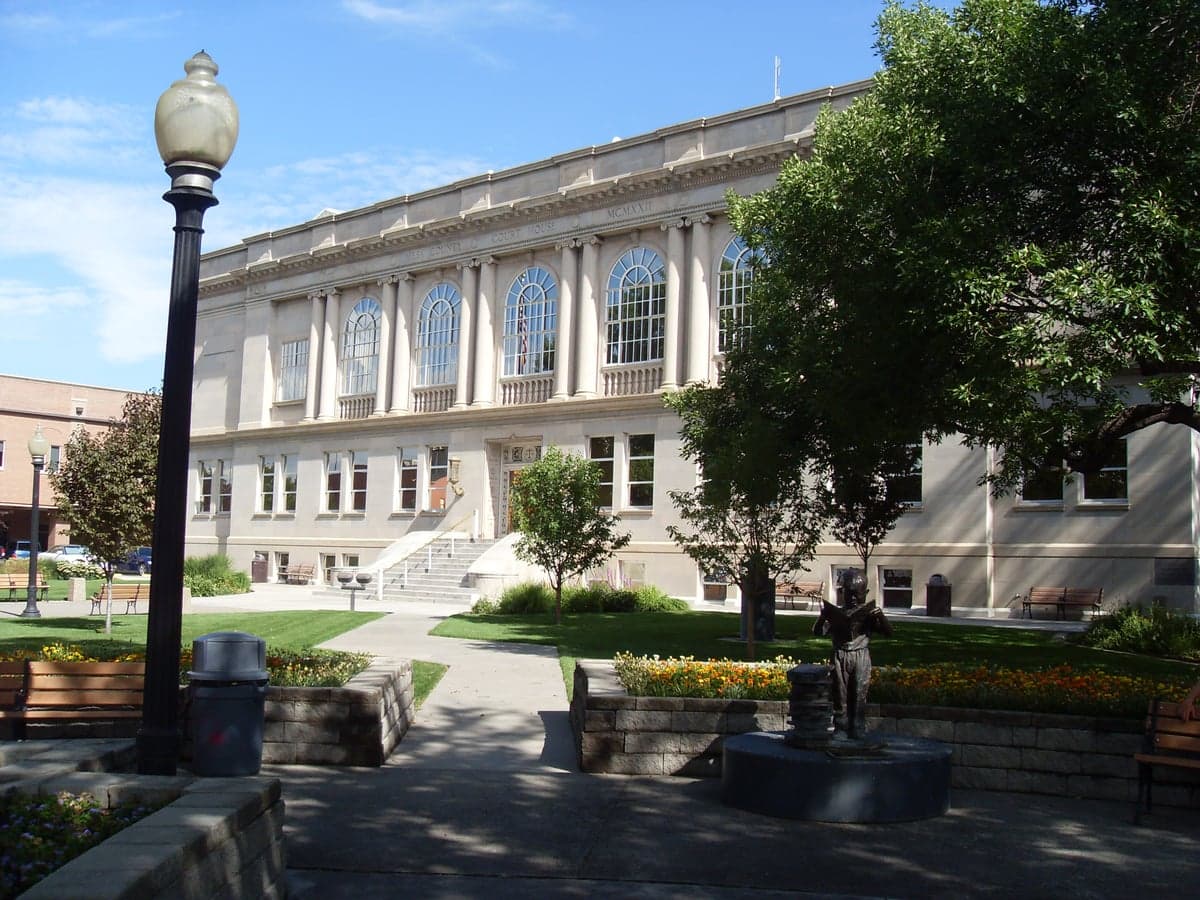
Photo: Wikipedia
Demographics of Mesa County
Affluence Level in Mesa County
A middle-class area roughly in line with national averages across income, home values, education, and employment.
People of Mesa County
Mesa County’s 157,316 residents form a predominantly white, politically conservative community anchored by the city of Grand Junction, with a growing Hispanic minority that now accounts for 15.2% of the population. The county is notably less diverse than Colorado as a whole, with a foreign-born share of just 2.6% and a population that skews older than the state median. The dominant cultural identity remains rooted in Western ranching, energy extraction, and a self-reliant, small-government ethos, though the county’s role as a regional healthcare and retail hub has begun to attract a more educated, professional class.
Settlement & growth (pre-1960)
The Ute people, specifically the Tabeguache band, occupied the Grand Valley for centuries before European contact, using the Colorado River corridor for seasonal hunting and gathering. Spanish explorers passed through as early as the 1770s, but no permanent European settlement occurred until after the Ute were forcibly removed to reservations in Utah following the 1879 Meeker Massacre. The federal government opened the land to Anglo-American homesteaders in the 1880s, and the arrival of the Denver & Rio Grande Western Railroad in 1882 transformed the valley almost overnight.
The first major wave of settlers were Anglo-American farmers from the Midwest and Great Plains, drawn by the promise of irrigated farmland along the Grand (now Colorado) and Gunnison rivers. Grand Junction, founded in 1881 as the railroad’s division point, became the commercial and administrative center. These early settlers were overwhelmingly of English, German, and Scots-Irish stock, and they established a conservative, Protestant, agrarian society that remains the county’s demographic and cultural bedrock. Smaller settlements like Fruita (founded 1884) and Palisade (founded 1890) grew as fruit-growing colonies, with Palisade’s orchards and vineyards becoming a lasting economic and identity marker.
A second wave arrived during the 1910s and 1920s, when the federal government’s Grand Valley Project expanded irrigation canals, bringing in more homesteaders and a modest number of Mexican laborers who worked the sugar beet fields and fruit orchards. This early Hispanic presence was small—perhaps a few hundred families—but it established the foundation for the county’s later Latino growth. The Great Depression and Dust Bowl drove a third wave of migrants from Oklahoma, Texas, and Kansas in the 1930s and 1940s, many of them “Okies” seeking agricultural work. These newcomers settled in Grand Junction’s lower-income neighborhoods and in rural pockets around Clifton and Orchard Mesa, reinforcing the county’s conservative, rural character.
World War II brought a brief but significant demographic jolt: the U.S. Army established Camp Hale near Leadville and used the Grand Valley for training, and after the war, some veterans returned to settle. The uranium boom of the 1950s, centered on the Colorado Plateau, pulled in a small number of miners and prospectors, many of whom lived in Grand Junction or the tiny community of Gateway. By 1960, Mesa County was 97% white, overwhelmingly native-born, and politically dominated by ranchers, farmers, and small-business owners.
Modern era (post-1965)
The 1965 Hart-Cellar Act had a muted effect on Mesa County compared to coastal or urban Colorado. The county’s foreign-born population remains just 2.6%, far below the state average of 10.3%. The most significant post-1965 demographic shift has been the growth of the Hispanic population, which rose from roughly 5% in 1980 to 15.2% today. This growth has been driven primarily by domestic migration from New Mexico and Texas, as well as some immigration from Mexico, with families drawn to agricultural work in Palisade’s orchards and to construction and service jobs in Grand Junction. The Hispanic community is concentrated in Grand Junction’s Lincoln Park and Orchard Mesa neighborhoods, as well as in the unincorporated community of Fruitvale.
Domestic migration has reshaped the county more than immigration. Beginning in the 1970s, retirees and lifestyle migrants from California, the Pacific Northwest, and the Front Range began moving to Mesa County, attracted by lower housing costs, dry climate, and outdoor recreation. This “amenity migration” accelerated after 2000, with Grand Junction’s population growing from 41,986 in 2000 to 68,000 in 2024. The newcomers tend to be older, whiter, and more affluent than the existing population, and they have concentrated in newer subdivisions on Grand Junction’s Redlands and in the Mesa community south of the Colorado River. A smaller but notable wave of remote workers arrived during and after the COVID-19 pandemic, drawn by the county’s relatively low cost of living and high quality of life.
The county’s Asian and Black populations remain tiny—0.8% and 0.6%, respectively—and are almost entirely concentrated in Grand Junction. The East/Southeast Asian community includes a small number of Vietnamese and Filipino families, many of whom arrived as medical professionals working at St. Mary’s Medical Center or as small-business owners. The Indian-subcontinent population is negligible at 0.1%. There is no significant Arab or Middle Eastern community. Mesa County remains one of the least ethnically diverse counties in Colorado, and its social and political culture reflects that homogeneity.
The future
Mesa County is projected to grow modestly over the next 10-20 years, with the state demography office estimating a population of roughly 170,000 by 2040. The Hispanic share will continue to rise, likely reaching 20-22% by 2040, driven by higher birth rates and continued domestic migration from the Southwest. The white non-Hispanic share will decline slowly but will remain the overwhelming majority. The county is unlikely to see significant growth in Asian, Black, or other minority populations, as there are no major employers or institutions attracting those groups in large numbers.
The most consequential demographic trend is the aging of the population. Mesa County’s median age of 40.5 is already above the state median of 37.0, and the retiree influx from California and the Front Range will push it higher. This will increase demand for healthcare, senior housing, and age-restricted communities, particularly in Grand Junction’s Redlands and in the town of Fruita, which has become a popular retirement destination. Younger families are more likely to settle in Clifton and Orchard Mesa, where housing is more affordable, but the county’s limited job diversity—healthcare, government, and retail dominate—may push some college-educated young adults to the Front Range.
Culturally, Mesa County will remain conservative and Western in character, but the growing Hispanic population and the influx of remote workers may gradually moderate its political edge. The county voted 62% for Donald Trump in 2020, but the city of Grand Junction has shown signs of becoming more politically mixed, particularly among younger and college-educated voters. The tension between the old ranching and energy economy and the new amenity-and-healthcare economy will define the county’s social and political landscape for the next decade.
For someone moving in now, Mesa County offers a stable, safe, and culturally cohesive community with a strong sense of place, but it is not a place of rapid demographic change or ethnic diversity. The population is aging, the Hispanic share is growing steadily, and the economy is shifting from extraction to services. New arrivals will find a community that values self-reliance, outdoor recreation, and traditional family structures, with a political and social environment that leans heavily conservative. Those seeking a rapidly diversifying, cosmopolitan environment should look elsewhere; those seeking a predictable, family-oriented Western community will find Mesa County a comfortable fit.

* Values derived from national, state, county, city and local statistics and may differ in a specific area. Last updated: 2026-06-29T14:17:33.000Z
Narrative content on this page is AI-generated and may contain mistakes. Verify any details that matter before acting on them.
ReloMaps may earn a commission from affiliate links at no extra cost to you.

