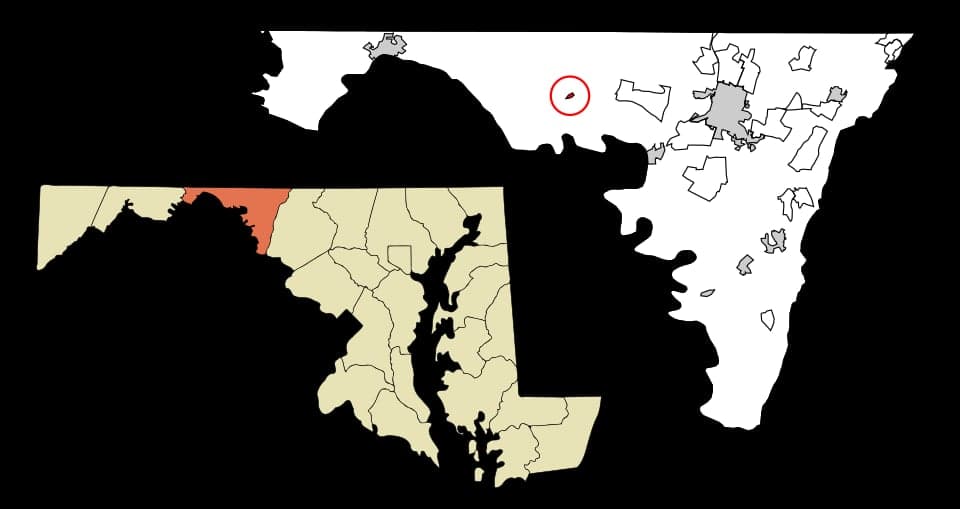
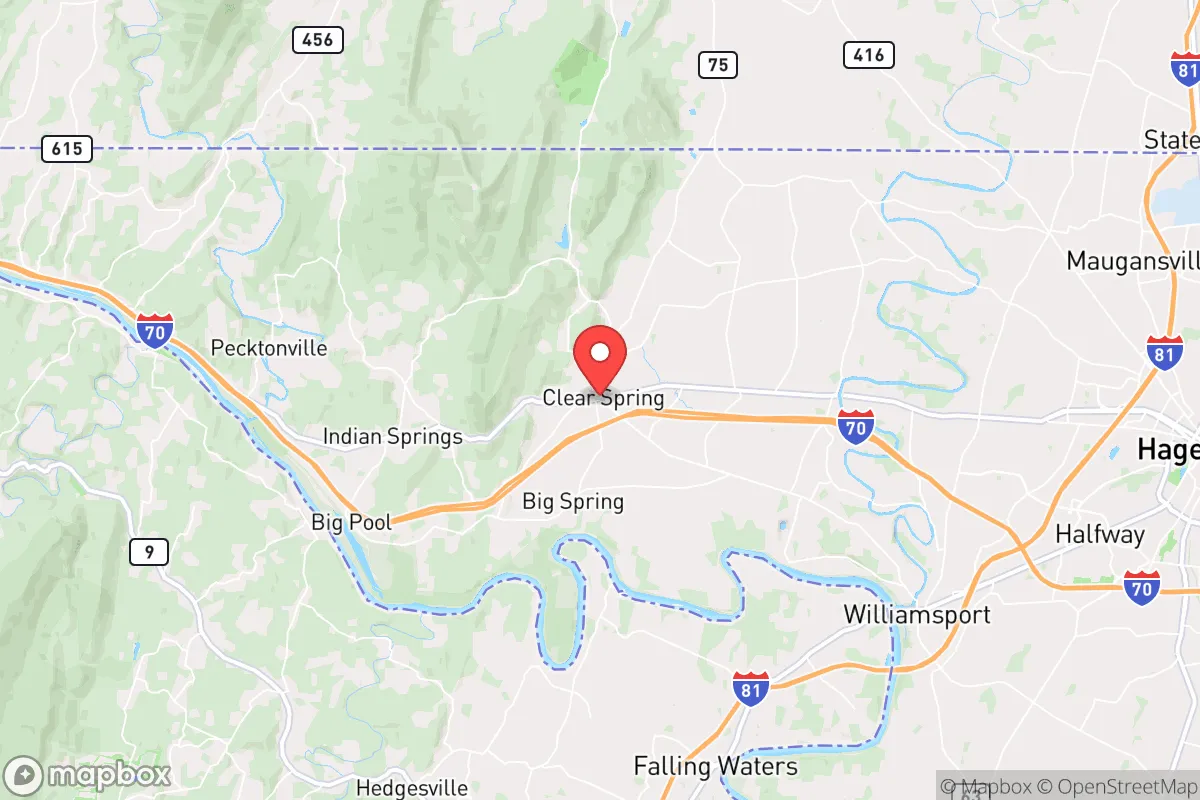
Photo: Wikipedia
Political ClimatePolitical Climate in Clear Spring, MD
District shown is the primary district for this city’s centroid. Cities may span multiple districts.
Local Political AnalysisPolitical Analysis of Clear Spring, MD
Clear Spring, Maryland, sits in a political pocket that feels noticeably different from the rest of the state. While Maryland as a whole carries a Cook PVI of D+17 — one of the most reliably Democratic states in the country — Clear Spring’s own PVI of D+3 places it much closer to a toss-up. That gap of 14 points is the kind of split you can feel on the ground. In practice, this means Clear Spring leans Democratic on paper, but in a way that leaves room for plenty of Republican representation and conservative voices. It’s not unusual to see a Trump sign next to a Biden sign in the same neighborhood, and local elections here are often genuinely competitive.
How it compares
To understand Clear Spring’s political climate, you have to look at its neighbors. Drive 15 minutes east to Hagerstown, and you’ll find a more reliably Democratic stronghold, reflecting Washington County’s urban core. Head west toward Hancock or south toward Berkeley Springs, West Virginia, and the political landscape shifts sharply red. Clear Spring sits in the middle of that spectrum. Its D+3 rating means it’s one of the more conservative-leaning areas in a deeply blue state. For context, while Maryland’s statewide elections are rarely in doubt — Democrats have held the governorship for most of the last two decades and control both legislative chambers — Clear Spring’s voters have historically split tickets more often. You’ll find local officials here who are registered Democrats but hold socially conservative views, and Republican candidates who can win on a platform of fiscal restraint and Second Amendment rights without being written off as unelectable.
What this means for residents
For conservative residents, Clear Spring offers a rare sense of political breathing room in Maryland. You can attend a county commission meeting and hear your views represented without feeling like a minority voice. Gun laws, school funding, and land-use regulations are debated with a more balanced perspective than in places like Montgomery County or Baltimore City. For liberal residents, the trade-off is that progressive policies — like stricter environmental regulations or expanded public transit — often face tougher headwinds here. But the upside is a community where political conversations are less polarized. People know their neighbors across the aisle, and local issues like road maintenance, school budgets, and emergency services tend to unite rather than divide. The trajectory over the past decade has been a slow drift leftward, mirroring national trends, but Clear Spring’s rural character and independent streak have kept it from swinging as hard as the rest of the state.
Culturally, Clear Spring stands apart from much of Maryland in its small-town, agrarian identity. You won’t find the same emphasis on tech industry growth or urban transit projects that dominate policy discussions in Baltimore or the D.C. suburbs. Instead, local politics revolve around farming, small business support, and maintaining the town’s historic character. The policy distinction that matters most to residents here is probably land use: Clear Spring has fought to preserve its rural zoning, resisting the kind of suburban sprawl that has transformed other parts of Washington County. Whether you lean left or right, that shared commitment to keeping the town’s character intact is something most people can agree on.

State Political ClimatePolitical Climate in Maryland
State Political AnalysisPolitical Environment in the State
Maryland is one of the most reliably Democratic states in the country, with a Cook Partisan Voting Index of D+17, meaning it votes about 17 points more Democratic than the national average in presidential elections. The state hasn't voted for a Republican presidential candidate since George H.W. Bush in 1988, and the Democratic grip on state government has been unbroken for decades — the GOP hasn't held the governorship since 2007 or the state legislature since the 1920s. Over the last 10-20 years, the trend has been a slow but steady consolidation of Democratic power, driven by explosive growth in the Washington, D.C. suburbs and the Baltimore metro area, while rural and exurban counties have grown more Republican in response.
Urban vs. rural divide
The political map of Maryland is a textbook case of the urban-rural split. The entire state's Democratic majority is generated by two metro areas: the Washington, D.C. suburbs (Montgomery County, Prince George's County, and increasingly Howard County) and Baltimore City. Montgomery County alone, with over a million residents, delivers a Democratic margin larger than the entire state's population of the Eastern Shore. Prince George's County is the wealthiest majority-Black county in the U.S. and votes over 80% Democratic. Baltimore City, despite shrinking population, remains a Democratic stronghold. Meanwhile, the rest of the state is deeply red. Western Maryland — Garrett, Allegany, and Washington counties — votes like West Virginia, with Trump winning some precincts by 70 points. The Eastern Shore (Worcester, Wicomico, Queen Anne's counties) is reliably Republican, and even parts of Anne Arundel County outside Annapolis lean right. The key swing counties that used to be competitive — like Baltimore County and Harford County — have been trending blue and red respectively. Baltimore County, once a bellwether, now leans Democratic thanks to its inner suburbs, while Harford County has become a GOP stronghold. Frederick County is the most interesting battleground: it was reliably red a generation ago but has been trending purple-to-blue as D.C. commuters push west along I-270.
Policy environment
Maryland's policy environment is shaped by one-party Democratic control in Annapolis, and the results are predictable for a deep-blue state. The state has a progressive income tax structure with rates from 2% to 5.75%, plus local piggyback taxes that can push the top combined rate over 8%. Property taxes are set at the county level and vary widely — Montgomery County's are among the highest in the nation, while Garrett County's are much lower. Sales tax is 6%, with no tax on groceries or prescription drugs. The regulatory posture is generally business-friendly in the D.C. suburbs (where defense contractors and biotech firms thrive) but restrictive on energy, land use, and firearms. Education spending is among the highest per pupil in the country, driven by the Blueprint for Maryland's Future law, which pours billions into public schools. Healthcare is heavily regulated, with a state-based insurance exchange and expanded Medicaid. Election laws are among the most accessible in the country: same-day voter registration, no-excuse mail-in voting, early voting for two weeks, and automatic voter registration at the MVA. For a conservative relocator, the policy environment will feel like a foreign country — but the trade-off is high-quality public services and infrastructure in the areas that have the tax base to support them.
Recent policy direction
Maryland's recent legislative sessions have pushed the state further left on nearly every axis a relocator might care about. On gun and self-defense law, the state passed the Firearm Safety Act of 2013 (banning assault weapons and limiting magazine capacity) and has since added a handgun permit requirement that effectively ended "shall issue" carry — though a 2022 Supreme Court ruling (NYSRPA v. Bruen) forced the state to loosen its carry restrictions. In 2024, the legislature passed a ban on carrying firearms in "sensitive places" like hospitals and public transit, which is being litigated. On parental and education rights, the state has moved toward centralization: the Blueprint for Maryland's Future mandates statewide pre-K, increases teacher pay, and reduces the role of local school boards in curriculum decisions. The state also passed a law requiring all public schools to adopt a LGBTQ-inclusive curriculum. On speech and privacy, Maryland passed the Online Data Privacy Act in 2024, one of the strongest consumer privacy laws in the country, but has also expanded surveillance powers for law enforcement, including a law allowing police to use drones without a warrant in certain circumstances. On medical and bodily autonomy, Maryland has codified abortion rights into state law, passed shield laws protecting providers who treat out-of-state patients, and expanded gender-affirming care access for minors. On property rights, the state has tightened rent control in Montgomery County and Prince George's County, and passed laws making it harder for landlords to evict tenants. On taxation, the trend is upward: the 2024 legislative session considered a wealth tax on high-income earners (it didn't pass, but the conversation continues), and the gas tax is indexed to inflation. On voting and ballot access, the state has made it easier to vote than almost anywhere else, with automatic registration, same-day registration, and no-excuse mail voting all permanent since 2020. For a conservative relocator, the direction is clear: the state is becoming more regulated, more taxed, and more socially liberal every year.
Civil unrest & political movements
Maryland has a history of political activism that ranges from the organized to the chaotic. Baltimore saw major protests and civil unrest after the death of Freddie Gray in 2015, including riots that led to a state of emergency and National Guard deployment. The city has since seen ongoing but smaller-scale protests around policing and housing. In the D.C. suburbs, activism tends to be more institutional: well-funded advocacy groups on both sides, with the left dominating in Montgomery and Prince George's and the right organizing in places like Frederick and Harford. Immigration politics are a flashpoint: Maryland is a sanctuary state, with a 2023 law (the Maryland DREAM Act) that extends in-state tuition to undocumented students and a 2024 law that limits cooperation between local law enforcement and ICE. This has led to tension in more conservative counties — Frederick County's sheriff has publicly resisted some provisions. Election integrity controversies have been relatively muted compared to swing states, but there was a contested 2022 gubernatorial primary in the GOP where some candidates questioned mail-in voting procedures. Secession or nullification rhetoric is rare but not unheard of: there have been periodic calls for Western Maryland to join West Virginia, and the Eastern Shore has a weak but persistent "Free State" separatist sentiment. For a new resident, the most visible political flashpoint will be the stark contrast between the D.C. suburbs and the rest of the state — you'll see Biden-Harris signs in Bethesda and Trump flags in Hagerstown, and both groups tend to keep to themselves.
Projection
Over the next 5-10 years, Maryland's political trajectory is likely to continue its slow march leftward, but with important caveats. The D.C. suburbs are still growing, fueled by federal jobs and defense contracting, and they are getting younger and more diverse. Montgomery County's Asian-American population is now over 20%, and this demographic tends to vote Democratic. Baltimore City will continue to shrink, but its political weight is already baked in. The wild card is Frederick County: if it flips fully blue, the GOP will have almost no path to winning statewide office. However, there are countervailing trends. The cost of living in the D.C. suburbs is driving some families to exurban and rural counties, which could slow the blue shift in places like Carroll and Frederick. The GOP has also made inroads with working-class voters in Baltimore County's older suburbs, though not enough to flip the county. On policy, expect more of the same: higher taxes, more regulation, and expanded social services. A conservative relocator moving to Maryland in 2026 should expect to live in a state where their vote for president and Senate will almost certainly be in the minority, but where local control in counties like Carroll, Harford, and Garrett means they can still have a say in school boards, zoning, and sheriff's offices. The state is not going to become purple — but it may become a more internally diverse shade of blue.
For a new resident, the bottom line is this: Maryland is a great place to live if you value high-quality public services, strong schools, and proximity to D.C. and Baltimore, and you're comfortable living in a state where Democrats control every lever of power. If you're a conservative, you'll find like-minded communities in the rural counties and exurbs, but you'll be voting against the grain in statewide elections. The practical takeaway is to choose your county carefully — your experience in Garrett County will be completely different from your experience in Montgomery County, and both are valid options depending on what you're looking for. Just don't move here expecting to change the state's politics anytime soon.
* Values derived from national, state, county, city and local statistics and may differ in a specific area. Last updated: 2026-07-21T20:10:46.000Z
Narrative content on this page is AI-generated and may contain mistakes. Verify any details that matter before acting on them.
ReloMaps may earn a commission from affiliate links at no extra cost to you.

