Photo: Wikipedia
Demographics of Clear Spring, MD
Affluence Level in Clear Spring, MD
A middle-class area roughly in line with national averages across income, home values, education, and employment.
People of Clear Spring, MD
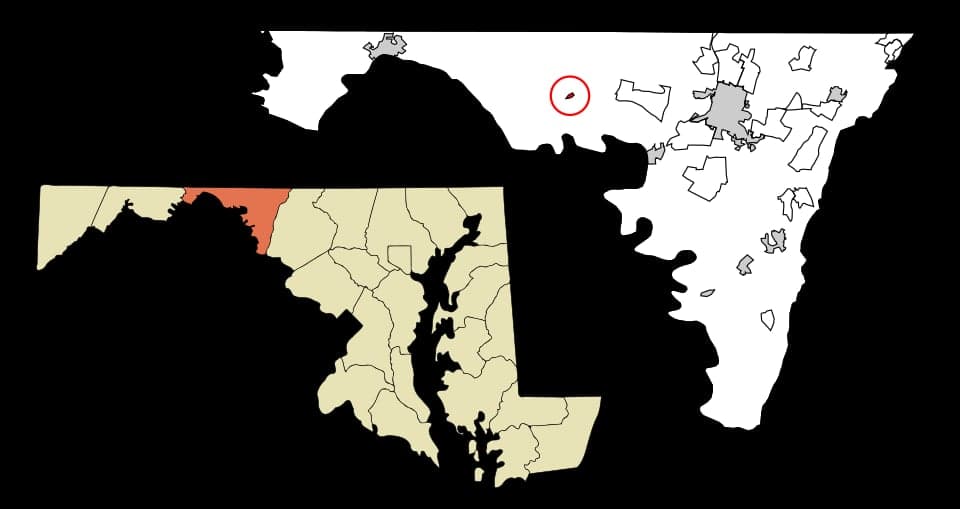
Clear Spring, Maryland, is a small, tight-knit community of 394 residents where the population is overwhelmingly White (77.7%) and notably includes an East/Southeast Asian community of 9.9%, a distinctive feature for a rural Washington County town. With no foreign-born population and a low college attainment rate of 15.3%, the town reflects a deeply rooted, locally employed workforce. Its character is defined by historic single-family homes along the main corridor and a quiet, family-oriented pace of life that has changed little over the past century.
How the city was settled and grew
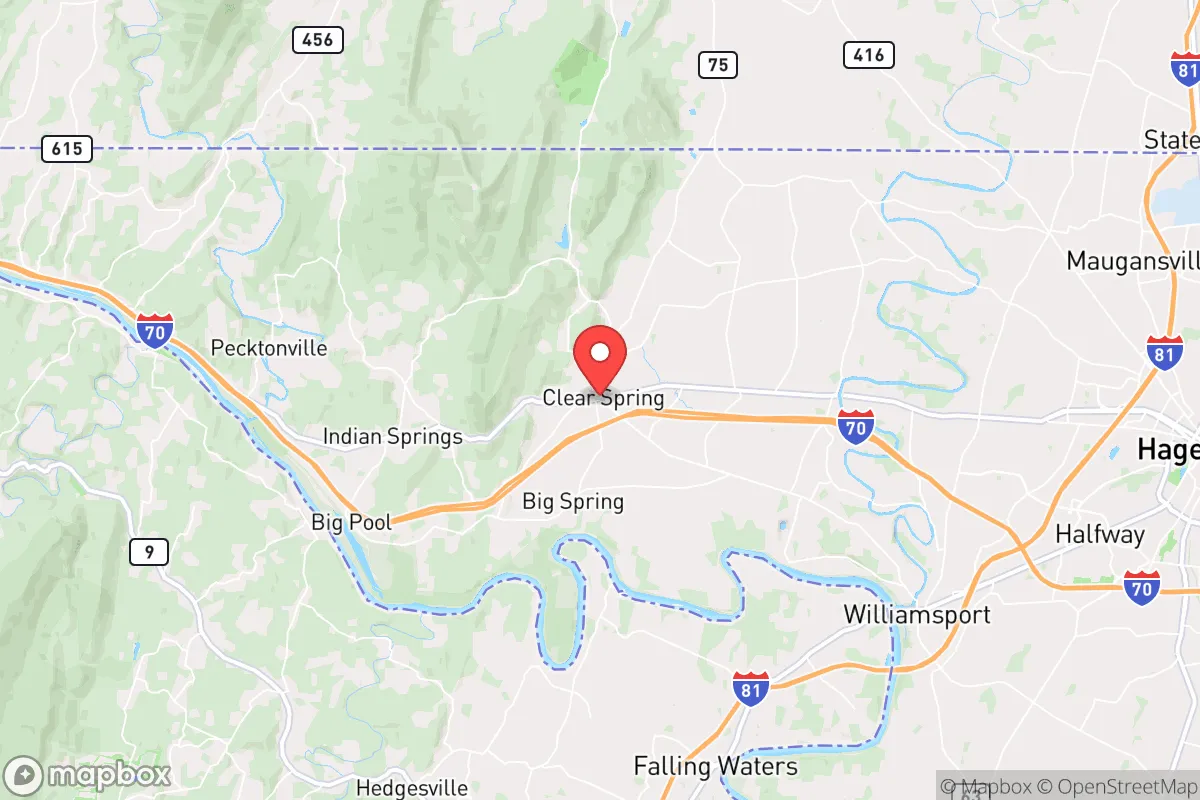
Clear Spring was originally settled in the mid-18th century by German and Scots-Irish farmers drawn to the fertile limestone valleys along the Conococheague Creek. The town was formally platted in 1820 and grew as a stop on the National Pike (now U.S. Route 40), serving as a trading post for surrounding agricultural communities. The original settlers clustered around what is now Main Street and the Conococheague Creek corridor, building stone houses and churches that still stand today. The arrival of the Western Maryland Railroad in the late 19th century brought a second wave of laborers, including a small number of Irish and German immigrants who settled in the Railroad District near the depot. By 1900, Clear Spring was a stable farming and milling center, with families like the Stotlers and the Bowers operating the grist mills and general stores that anchored the local economy. The town's population remained overwhelmingly White and native-born through the mid-20th century, with growth limited by the small land area and the dominance of nearby Hagerstown as a commercial hub.
Modern era (post-1965)
After the 1965 Immigration and Nationality Act, Clear Spring saw almost no foreign-born in-migration, and its White population remained above 95% through the 1990s. The most significant demographic shift occurred in the 2000s and 2010s, when a small but visible East/Southeast Asian community — primarily families of Chinese and Korean heritage — began settling in the Mountain Laurel Estates subdivision, a newer development on the town's eastern edge. This group, now comprising 9.9% of the population, was drawn by affordable housing and proximity to employment at the Fort Detrick military base and the Johns Hopkins Applied Physics Laboratory in nearby Frederick County. The Historic District along Main Street has retained its White, multigenerational character, with many homes still occupied by descendants of the original German and Scots-Irish families. The Black and Hispanic populations remain at 0.0%, reflecting the town's lack of rental housing stock and limited public transit connections to more diverse employment centers. The college-educated share of 15.3% is well below the Maryland state average of 40%, indicating that most residents work in trades, manufacturing, or service roles rather than professional or tech sectors.
The future
Clear Spring's population is projected to remain small and stable, with modest growth driven by spillover from Hagerstown and Frederick rather than new immigration. The East/Southeast Asian community is likely to grow incrementally as more families seek affordable single-family homes in the Clear Spring Meadows development, a planned subdivision approved for 40 lots on the town's western boundary. The White population will continue to age in place, with younger families priced out by rising home values in Frederick County moving into Mill Pond Estates, a newer pocket of homes near the elementary school. The town's cultural identity will remain rooted in its agricultural and railroad history, with the annual Clear Spring Heritage Festival and the volunteer fire company serving as central community institutions. The foreign-born population is expected to stay near zero, as the town lacks the rental housing, public transit, and ethnic grocery stores that attract immigrant communities to larger Maryland towns. Over the next 10-20 years, Clear Spring will likely become slightly more diverse in terms of Asian representation but will remain a predominantly White, native-born, working-class community.
Clear Spring is becoming a quiet, affordable alternative for families priced out of Frederick and Hagerstown, with a small but growing East/Southeast Asian community adding a new layer to its historic German and Scots-Irish foundation. For someone moving in now, the town offers a stable, low-crime environment with strong local schools and a clear sense of place, but little ethnic or economic diversity beyond the Asian cohort. It is a place where roots run deep and change comes slowly, appealing to those who value tradition and space over urban amenities.

* Values derived from national, state, county, city and local statistics and may differ in a specific area. Last updated: 2026-07-21T20:10:46.000Z
Narrative content on this page is AI-generated and may contain mistakes. Verify any details that matter before acting on them.
ReloMaps may earn a commission from affiliate links at no extra cost to you.

