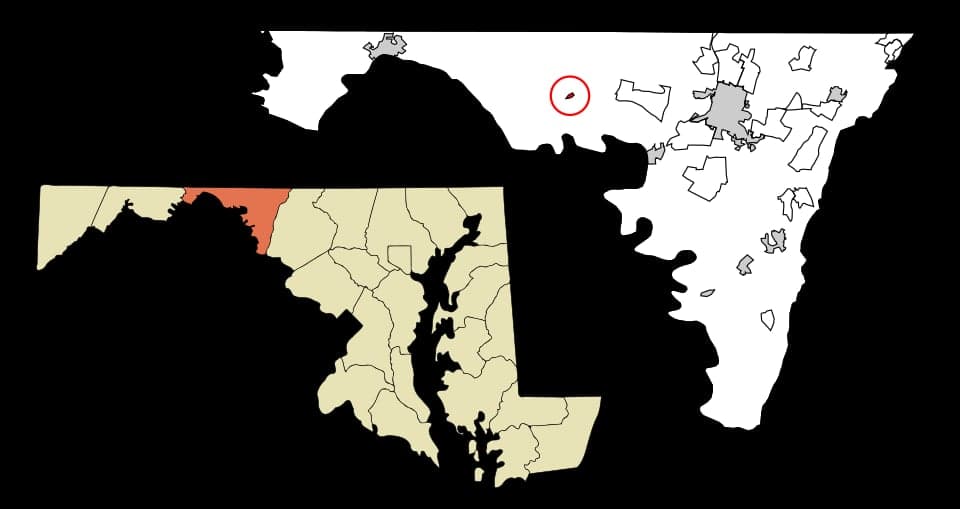
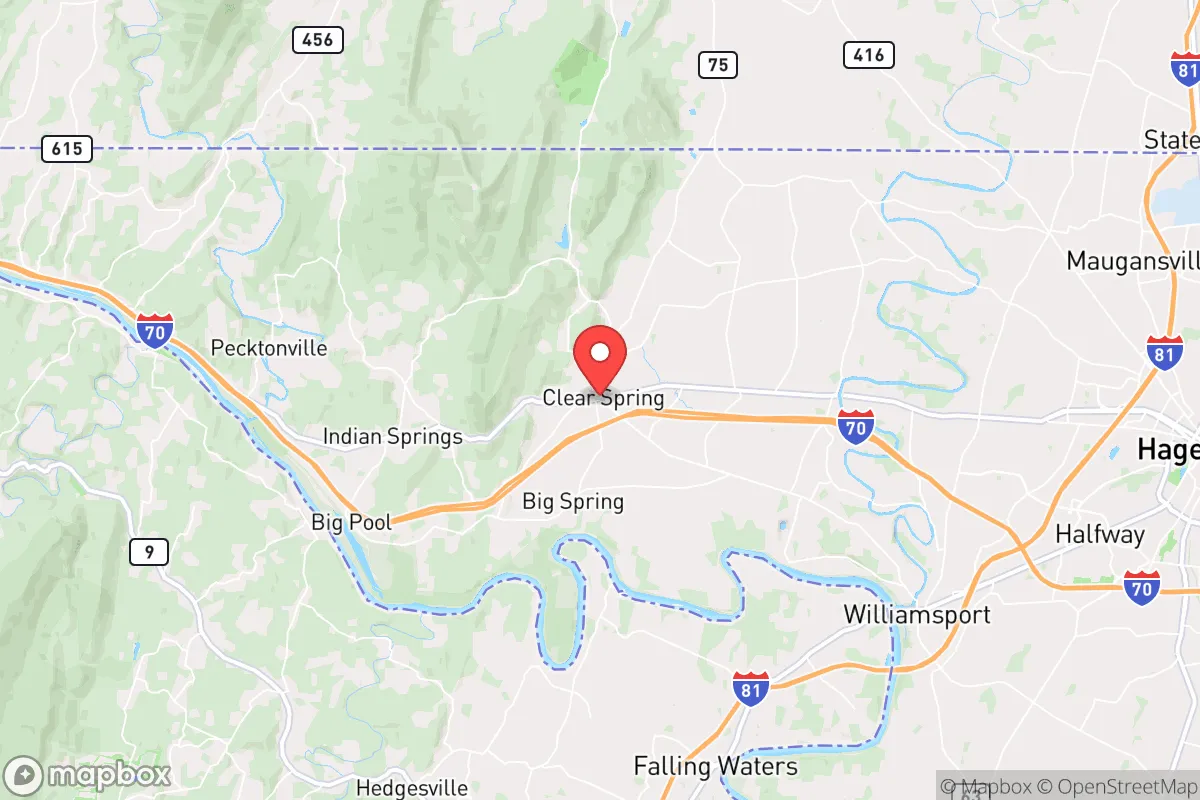
Photo: Wikipedia
Personal Sovereignty in Clear Spring, MD
Viable for self-reliance. Generally workable, though some barriers may limit total independence.
What does Personal Sovereignty tell us?
Personal Sovereignty measures your capacity for self-reliance and independence with minimal government friction. Higher scores mean fewer barriers between you and the way you want to live... but it assumes you have the space you need and good neighbors.
What does this tell us?
Personal Sovereignty measures your capacity for self-reliance and independence with minimal government friction. Higher scores mean fewer barriers between you and the way you want to live... but it assumes you have the space you need and good neighbors.
State Policy
Energy independence: Importer (8% of energy produced in-state)
Personal Liberty
Homesteading

Personal Liberty Analysis
Clear Spring, Maryland, offers a notably higher degree of personal sovereignty than most of the Washington D.C. exurbs or the heavily regulated Baltimore corridor, largely due to its rural Washington County setting and the state's unique "home rule" dynamics. While residents must contend with Maryland's state-level tax burden and some of the nation's strictest gun laws, the day-to-day autonomy in Clear Spring is defined by a light local regulatory touch, a strong tradition of self-reliance, and a community culture that values personal responsibility over government oversight. For a single individual or family prioritizing freedom from overbearing municipal codes and neighborhood covenants, Clear Spring represents a strategic compromise: you accept state-level constraints in exchange for significant local liberty, lower population density, and a landscape where your property and time are largely your own.
Tax burden and regulatory posture in Washington County
Maryland carries a reputation for high taxation, and Clear Spring residents are not exempt from the state's progressive income tax structure (ranging from 2% to 5.75%) and a state sales tax of 6%. However, the effective burden is mitigated by Washington County's relatively moderate property tax rate. The county levies approximately $0.948 per $100 of assessed value, which, combined with the Clear Spring town tax (roughly $0.20 per $100), keeps annual property taxes on a median home well below what you would pay in Montgomery or Howard counties. There is no local income tax surcharge in Clear Spring itself, though Washington County imposes a modest 2.8% county income tax — lower than the 3.2% ceiling seen in some neighboring jurisdictions. The regulatory posture at the county level is notably pro-property-rights compared to the D.C. suburbs. Washington County's zoning code is less prescriptive, and the Clear Spring town government maintains a light administrative footprint. Permitting for home renovations, sheds, or agricultural structures is straightforward, with no overlay districts or historic preservation boards dictating paint colors or fence materials. For a reader accustomed to the permitting gauntlet of more urbanized Maryland counties, Clear Spring feels like a regulatory release valve.
Self-defense rights and Maryland's firearm legal landscape
This is the area where personal sovereignty faces its most significant state-level friction. Maryland is a "may issue" state for concealed carry permits, though the 2023 Bruen decision forced the state to adopt a more objective permitting standard. As of 2026, applicants must still complete a 16-hour training course, pass a background check, and demonstrate "good and substantial reason" — a standard that remains more restrictive than the constitutional carry regimes of neighboring West Virginia and Pennsylvania. Handgun purchases require a seven-day waiting period and a Handgun Qualification License (HQL), which involves fingerprinting and a separate training class. The state also bans a list of "assault weapons" and limits magazine capacity to 10 rounds for long guns. In practice, law-abiding residents in Clear Spring can and do obtain permits, but the process is costly and time-consuming. The local sheriff's office in Washington County is generally supportive of Second Amendment rights and processes permits without the hostility reported in more urban jurisdictions. For the sovereignty-minded reader, the key takeaway is that Clear Spring is the best you can do within Maryland's state framework — the local culture is pro-self-defense, but you cannot escape the state's legislative constraints without crossing the Potomac into West Virginia.
Self-reliance and homesteading viability: lot sizes, zoning, and off-grid feasibility
Clear Spring's rural character is its strongest asset for the self-reliant individual. The town and surrounding unincorporated areas of Washington County offer residential lot sizes ranging from one to five acres as a baseline, with larger parcels of 10 to 50 acres commonly available within a 10-minute drive of the town center. Zoning in the Agricultural (A) and Rural Residential (RR) districts explicitly permits livestock, poultry, beekeeping, and roadside farm stands without special exception permits. Chickens are allowed on lots as small as one acre, and goats or a family cow are permitted on two acres or more. Off-grid feasibility is moderate: the county does not require connection to municipal water or sewer on parcels larger than one acre, and private well and septic systems are standard. Solar panel installation is permitted by right, though net metering with the local utility (Potomac Edison) requires interconnection approval. Rainwater collection for non-potable use is unrestricted. The primary limitation on full off-grid living is Maryland's building code, which mandates compliance with the International Residential Code (IRC) even for remote structures. However, the county's inspection process is pragmatic, and many residents successfully operate with a mix of grid-tied solar, propane, and wood heat. For a family wanting to grow food, keep animals, and reduce dependence on supply chains, Clear Spring offers a viable path without the zoning hostility found in more suburbanized counties.
Personal liberties: parental rights, medical autonomy, speech, and property
Washington County's school board and local government have maintained a strong posture on parental rights, with the board adopting policies that require parental notification for any changes to a student's health or wellness plan and allowing parents to opt their children out of specific instructional materials. The county's public schools do not enforce mask or vaccine mandates as of 2026, reflecting the broader community sentiment that medical decisions rest with families. Medical autonomy is further supported by the presence of independent healthcare providers in Hagerstown (15 minutes north) who offer direct primary care models, avoiding the insurance bureaucracy. Speech and assembly rights are robust; Clear Spring is a community where political expression — even on contentious issues — is met with civility rather than censorship. Property rights are the crown jewel of local sovereignty. Washington County's comprehensive plan explicitly prioritizes "protection of private property rights" and resists downzoning or spot zoning that would restrict land use. There is no county-wide rental registration or occupancy limit for single-family homes, and short-term rentals (Airbnb/VRBO) are permitted without special permitting in most rural zones. For the reader who values the ability to use their land as they see fit — within basic health and safety codes — Clear Spring's property regime is among the most permissive in Maryland.
In the broader context of the Mid-Atlantic region, Clear Spring occupies a distinct sovereignty tier. It is significantly more autonomous than any community inside the Capital Beltway or the I-95 corridor, where zoning, taxation, and permitting are far more intrusive. It is roughly comparable to rural areas in Pennsylvania's Franklin County to the north, though with a higher state tax burden. It falls short of the near-total personal sovereignty found in West Virginia's Eastern Panhandle (just 20 minutes west), where there is no state income tax on retirement income, constitutional carry is law, and building codes are optional in unincorporated areas. For the reader who must remain in Maryland for employment, family, or other ties, Clear Spring represents the optimal balance: you accept the state's structural constraints on firearms and taxation, but you gain a community where local government stays out of your way, your property rights are respected, and the expectation of self-reliance is the cultural norm rather than an exception.

* Values derived from national, state, county, city and local statistics and may differ in a specific area. Last updated: 2026-07-21T20:10:46.000Z
Narrative content on this page is AI-generated and may contain mistakes. Verify any details that matter before acting on them.
ReloMaps may earn a commission from affiliate links at no extra cost to you.

