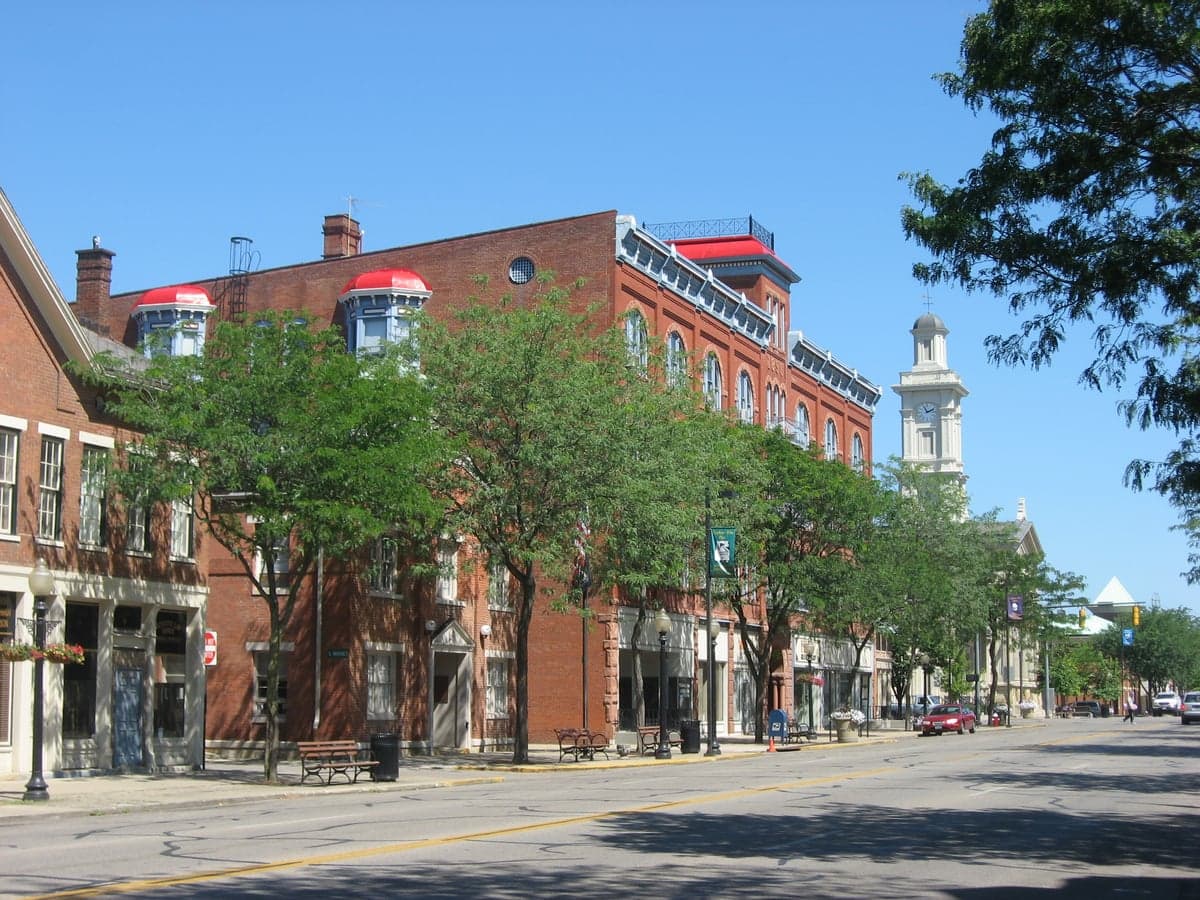
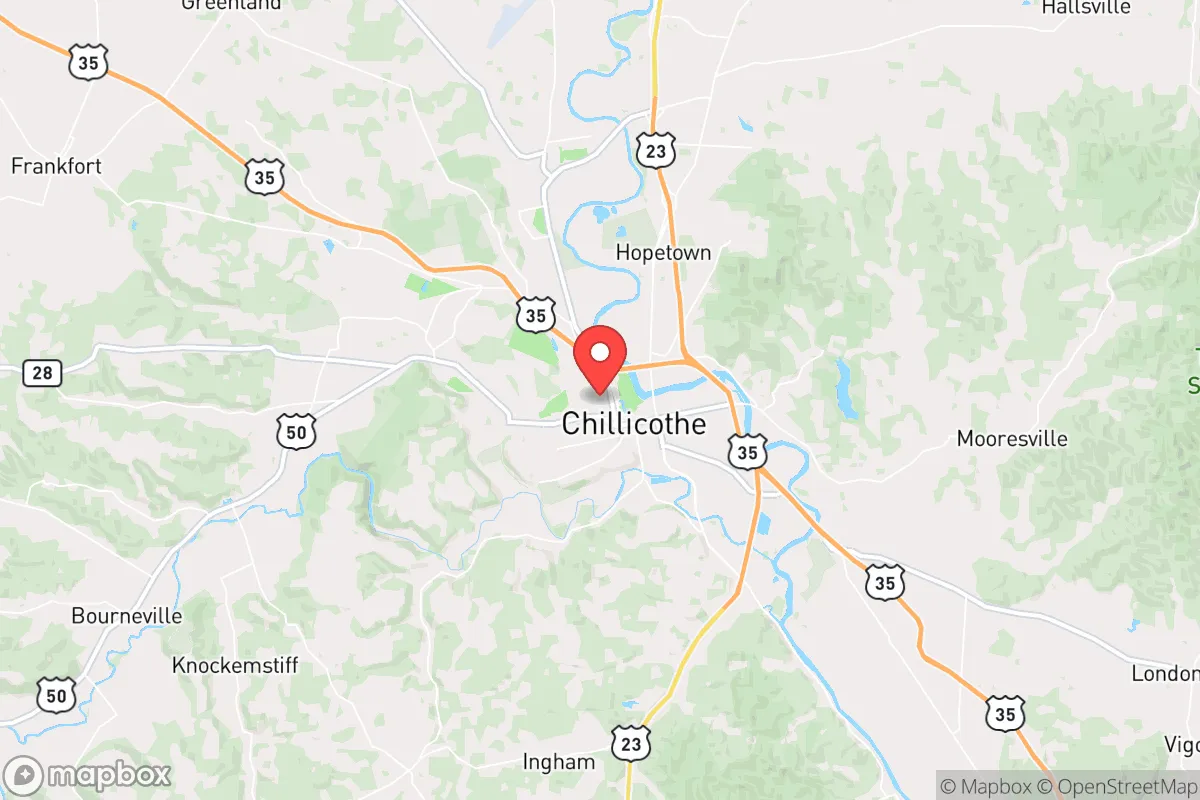
Photo: Wikipedia
Political ClimatePolitical Climate in Chillicothe, OH
District shown is the primary district for this city’s centroid. Cities may span multiple districts.
Inherited from parent county — no local data available.
* Lean and PVI are calculated from the surrounding county’s 2020 and 2024 presidential results, Cook-style — a finer measure here than its congressional district (OH-2).
Political rankings in Ohio
- Most Conservative Cities in Ohio
- Most Liberal Cities in Ohio
- Best Liberal-Leaning Towns in the Midwest
- Safest Liberal-Leaning Towns in the Midwest
- Safest Conservative-Leaning Towns in the Midwest
- Affordable Small Towns for Conservatives
- Most Affordable Liberal-Leaning Small Towns in the U.S.
- Safest Conservative-Leaning Cities in the U.S.
- Most Conservative Counties in Ohio
- Most Liberal Counties in Ohio
Local Political AnalysisPolitical Analysis of Chillicothe, OH
Chillicothe leans heavily Republican, with a Cook Partisan Voting Index of R+20 that makes it one of the most conservative pockets in Ohio. That’s a full 15 points redder than the state’s overall R+5 rating, and it’s not a fluke—Ross County has voted for the GOP presidential candidate by double digits in every election since 2000, with margins widening from about 12 points in 2008 to over 30 points in 2020. If you’re looking at the political trajectory here, it’s been a steady march rightward, mirroring the broader rural shift across southern Ohio, but Chillicothe’s tilt is more pronounced than places like Columbus (D+18) or even nearby Lancaster (R+14).
How it compares
Chillicothe’s R+20 PVI puts it in a different league from Ohio’s statewide R+5. The city sits in Ross County, where registered Republicans outnumber Democrats roughly 2-to-1, while Ohio as a whole is more evenly split—about 47% Republican, 46% Democratic in recent voter registration. For context, neighboring towns like Circleville (R+16) and Waverly (R+22) are similarly conservative, but drive 45 minutes north to Columbus and you hit Franklin County, which is D+18 and a world apart politically. Chillicothe’s lean isn’t just about presidential races; local offices are almost entirely held by Republicans, from the county commission to the school board, whereas Ohio’s state government has seen more back-and-forth, with a GOP trifecta currently but Democratic governors as recently as 2018. The gap is starkest on cultural issues: Chillicothe’s voters consistently back conservative stances on gun rights and abortion, while Ohio’s 2023 Issue 1 abortion amendment passed statewide with 57% support—but failed in Ross County with only 44% in favor.
What this means for residents
For conservative residents, Chillicothe’s political climate means their values are reflected in local policy without much friction. The city council and county officials tend to keep taxes low, support Second Amendment rights, and prioritize economic development like the recent expansion of the Kenworth Truck plant, which added 500 jobs. Liberal residents, on the other hand, will find themselves in a clear minority. There’s no active Democratic Party presence to speak of—the local party office closed years ago—and progressive candidates rarely get above 35% in countywide races. That said, the city itself is slightly more moderate than the surrounding rural areas; Chillicothe’s small downtown core, with its historic buildings and growing arts scene, attracts some younger, left-leaning residents who find common ground with conservatives on local issues like preserving the Scioto River corridor or supporting small businesses. It’s not hostile, but it’s undeniably one-sided—you won’t see many Biden signs in yards, and political conversations at coffee shops like The Pour House at Machinery Hall tend to stay polite but guarded.
Culturally, Chillicothe feels more like a Southern Ohio town than a Midwestern one—think church potlucks, hunting season as a major calendar event, and a strong sense of local pride tied to its history as Ohio’s first capital. Policy-wise, the area’s conservative lean means lower property taxes (around 1.2% effective rate vs. Ohio’s 1.5% average) and fewer zoning restrictions, but also less public transit and a heavier reliance on sales tax for services. The trajectory looks like more of the same: as Ohio’s rural areas continue to redden and urban centers blue, Chillicothe will likely stay R+20 or even nudge toward R+25 by 2030, driven by out-migration of younger liberals to Columbus and in-migration of retirees from other conservative areas. For anyone moving here, the political reality is straightforward: if you’re conservative, you’ll feel at home; if you’re liberal, you’ll find a small but resilient community of like-minded folks, but you’ll be swimming against a strong current.

State Political ClimatePolitical Climate in Ohio
State Political AnalysisPolitical Environment in the State
Ohio has shifted from a quintessential swing state to a solidly Republican-leaning one, carrying a Cook PVI of R+5. Over the past 20 years, the state has moved roughly 10 points to the right in presidential elections, driven by the collapse of union Democratic strength in the industrial north and the rapid growth of conservative exurban and rural populations. While Democrats can still win statewide in favorable years (like Sherrod Brown’s 2018 Senate win), the GOP now controls every statewide executive office, both legislative chambers, and the Ohio Supreme Court. For a relocator, this means the state’s political center of gravity is firmly conservative, but with notable blue islands in the major metros.
Urban vs. rural divide
The political map of Ohio is a textbook study in the urban-rural chasm. The three Cs — Cleveland, Columbus, and Cincinnati — are Democratic strongholds, with Cuyahoga County (Cleveland) delivering a 30-point margin for Biden in 2020. Columbus, the fastest-growing major city in the Midwest, has become increasingly blue as its tech and education sectors expand. In contrast, the vast rural and small-town landscape — from the Appalachian counties in the southeast to the farmlands of western Ohio — votes overwhelmingly Republican. The real battlegrounds are the suburban and exurban rings. Delaware County (north of Columbus) flipped from purple to deep red over the past decade, while Warren County (north of Cincinnati) is now one of the most Republican counties in the nation. Hamilton County (Cincinnati) itself has trended blue, but the surrounding counties more than cancel it out. The net effect: Democrats win the cities by large margins, but Republicans dominate the landmass and the exurbs, giving them a durable statewide advantage.
Policy environment
Ohio’s policy environment is broadly conservative, with a few notable exceptions. The state has a flat income tax rate of 3.5% (phased down from 4% in 2023), and no estate tax. Sales tax is 5.75% at the state level, with local add-ons. Property taxes are moderate, but there is no homestead exemption for owner-occupied homes. The state is a right-to-work state in practice (though not by law), with union membership declining. Education policy is a flashpoint: Ohio has one of the largest school voucher programs in the country (the EdChoice program), which has expanded significantly under GOP leadership. The state also passed a “Parents’ Bill of Rights” in 2023, requiring schools to notify parents about curriculum changes and medical services. On healthcare, Ohio expanded Medicaid under the Affordable Care Act in 2014, and that expansion remains in place. Election laws have been tightened: voter ID is now required (with limited acceptable forms), and early voting hours have been standardized. The state also purges inactive voters regularly, a practice upheld by the Supreme Court.
Recent policy direction
Recent legislation in Ohio reflects a clear conservative trajectory, but with some bipartisan compromises. On gun rights, Ohio became a permitless carry state in 2022, allowing any adult who can legally own a firearm to carry it concealed without a license. Self-defense law was also strengthened with a “stand your ground” provision in 2021. On parental and education rights, the state passed a law in 2023 requiring schools to adopt policies on student use of restrooms and locker rooms based on biological sex, and another law banning transgender girls from female sports. Speech protections are strong, with no state-level hate speech laws that restrict expression. On privacy and surveillance, Ohio has no comprehensive data privacy law, though a bill is pending. Medical and bodily autonomy is a mixed bag: abortion is banned after a fetal heartbeat is detected (around 6 weeks), with no exceptions for rape or incest, following the 2022 trigger law. However, a 2023 ballot initiative to enshrine abortion rights in the state constitution passed with 57% of the vote, showing a disconnect between the legislature and the electorate. Property rights are generally strong, with no statewide rent control and limited eminent domain abuse. Taxation is trending downward: the income tax rate is scheduled to drop to 2.75% by 2026 if revenue targets are met. Voting and ballot access has been restricted: the 2023 law shortened the absentee ballot application window and eliminated same-day voter registration.
Civil unrest & political movements
Ohio has seen its share of political flashpoints. The 2020 protests in Columbus and Cincinnati over George Floyd’s death were large but largely peaceful, though there were isolated incidents of property damage. The state has a strong organized labor movement, particularly in the auto and steel sectors, which occasionally clashes with the GOP’s right-to-work agenda. On the right, the “Ohio Freedom Alliance” and local Tea Party groups remain active, pushing for school board transparency and election integrity. Immigration politics are relatively muted compared to border states, but there have been controversies over sanctuary city policies in Cleveland and Columbus, both of which have “welcoming city” ordinances that limit cooperation with federal immigration enforcement. The state legislature has repeatedly tried to preempt these policies with a statewide ban, but it hasn’t passed yet. Election integrity remains a hot-button issue: the 2020 election in Ohio was widely seen as smooth, but some rural counties have pushed for hand-counting ballots, and the Secretary of State has launched several voter roll purges that drew lawsuits. A new resident would notice the political divide most acutely in the suburbs: a Dublin or Mason neighborhood might have yard signs for both parties, while a Lima or Zanesville street would be solidly red.
Projection
Over the next 5-10 years, Ohio is likely to become more Republican, but not dramatically so. The in-migration pattern is mixed: the state is losing population overall, but the Columbus metro is growing, attracting younger, more diverse, and slightly more Democratic residents. The exurban and rural areas are aging and shrinking, which could eventually reduce the GOP’s raw vote advantage. However, the state’s political map is likely to remain R+5 to R+7, with Democrats needing a perfect storm to win statewide. The abortion rights ballot initiative showed that voters are willing to buck the legislature on social issues, but that doesn’t translate to electoral wins for Democrats in down-ballot races. The biggest wildcard is the state’s economic transformation: if the Intel semiconductor plant in Licking County and the Honda EV battery plant in Fayette County bring a wave of new, well-paid workers, those voters could tilt the suburbs back toward the center. But for now, the trajectory is a slow, steady rightward drift, with the GOP’s grip on the legislature and courts likely to persist.
For a new resident, the bottom line is this: Ohio is a conservative state in practice, but with enough blue in the cities to make it feel like a real political community rather than a monolith. If you’re conservative, you’ll find your values reflected in state law and local governance in most places outside the urban cores. If you’re liberal, you’ll find like-minded neighbors in Cleveland, Columbus, Cincinnati, and their inner suburbs, but you’ll need to accept that state policy will often run against your preferences. The cost of living is low, the schools are decent in the suburbs, and the political climate is stable — no one is predicting Ohio becoming a flashpoint for civil unrest. Just know that the state’s politics are increasingly sorted by geography, and your experience will depend heavily on which county you choose to call home.
* Values derived from national, state, county, city and local statistics and may differ in a specific area. Last updated: 2026-11-27T15:04:31.000Z
Narrative content on this page is AI-generated and may contain mistakes. Verify any details that matter before acting on them.
ReloMaps may earn a commission from affiliate links at no extra cost to you.

