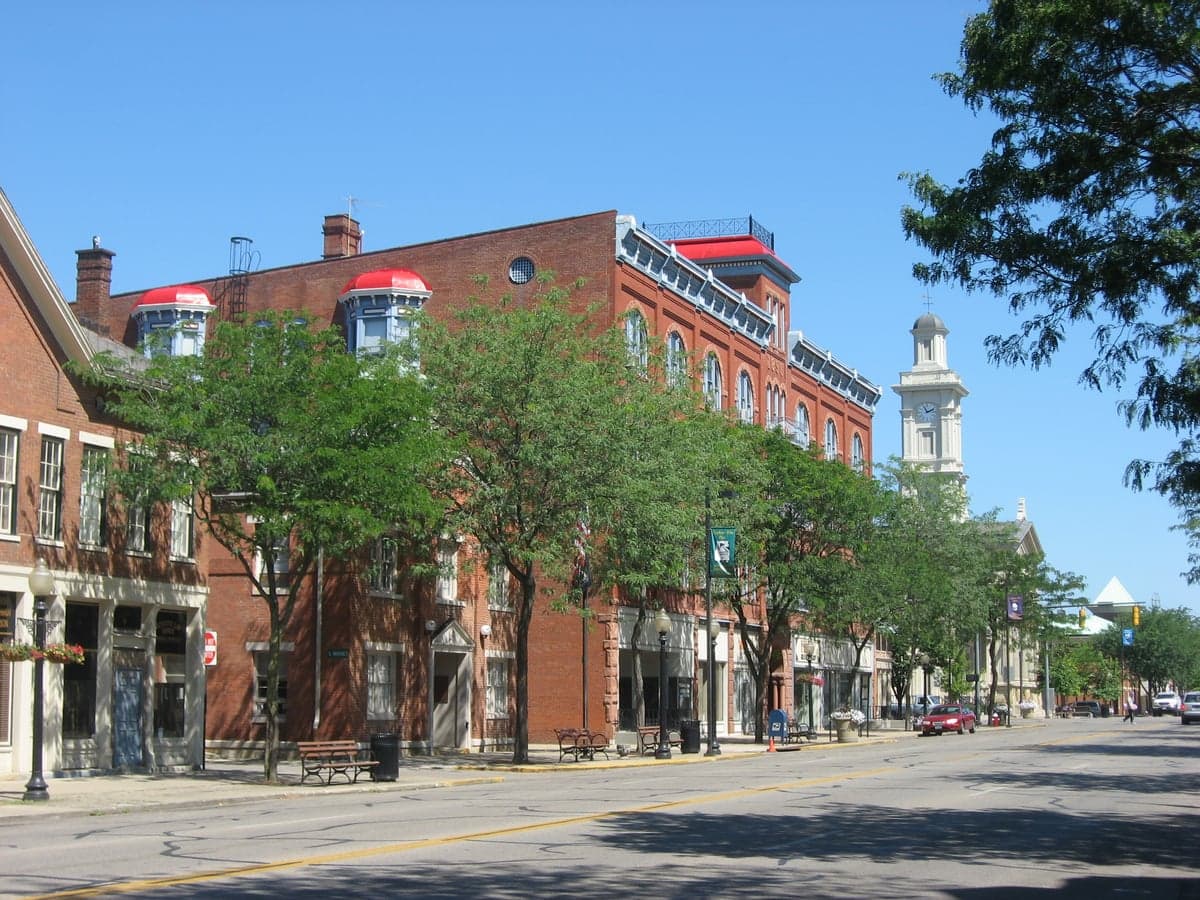
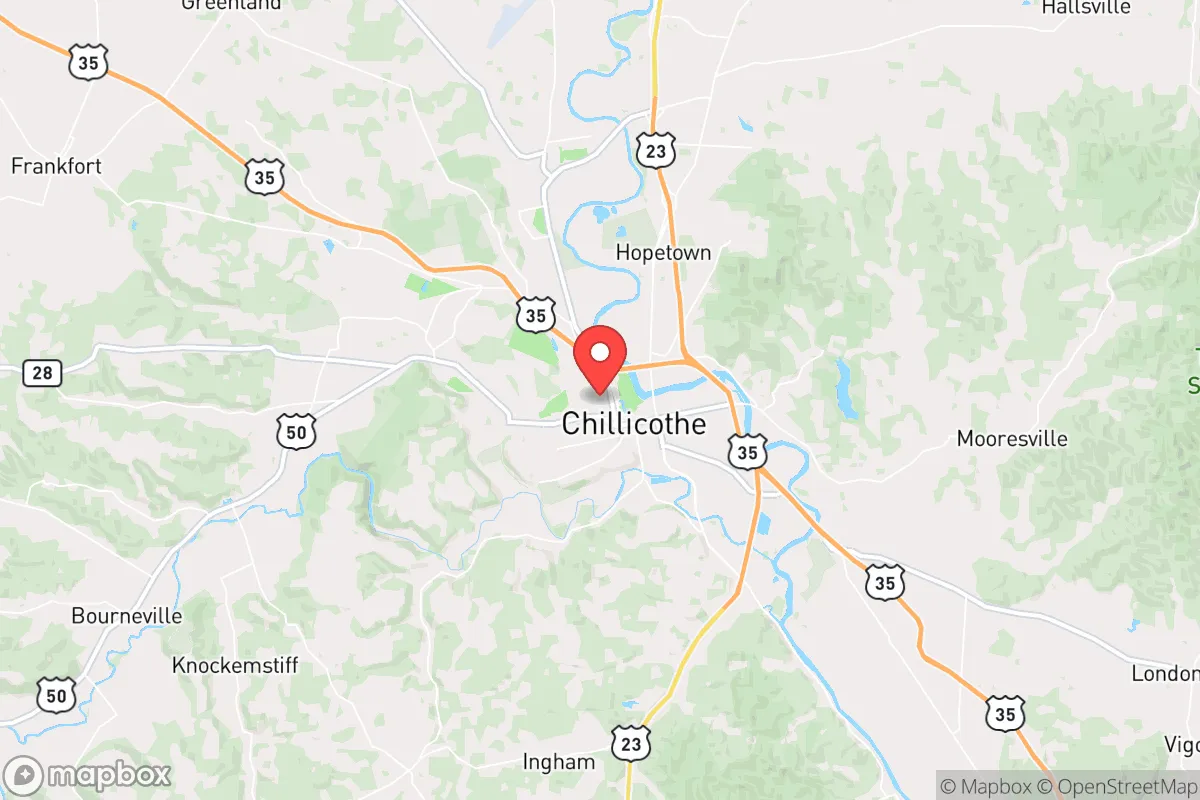
Photo: Wikipedia
Demographics of Chillicothe, OH
Affluence Level in Chillicothe, OH
A low-income area with significant economic hardship. Household wealth and educational attainment are well below national averages.
People of Chillicothe, OH
The people of Chillicothe, Ohio, today form a predominantly white, working-to-middle-class community of roughly 21,958 residents, with a density and character shaped by its historic role as Ohio's first capital and a regional manufacturing hub. The city is notably less diverse than the national average, with 84.0% of residents identifying as white, 8.3% as Black, and negligible shares of Hispanic (0.6%), East/Southeast Asian (0.5%), and Indian-subcontinent (0.1%) populations. A distinctive identity marker is the city's strong connection to its Native American and early American frontier history, reflected in place names and local festivals, alongside a palpable sense of pride in its small-town, family-oriented atmosphere. The foreign-born population is virtually nonexistent at 0.1%, making Chillicothe one of the least internationally diverse cities in Ohio.
How the city was settled and grew
Chillicothe's population history begins with the Scioto Valley's original inhabitants, the Shawnee and other Native American groups, for whom "Chillicothe" meant "principal town." European-American settlement exploded after the American Revolution, with the city founded in 1796 by Virginia-born surveyor Nathaniel Massie. The first major wave of settlers were Scotch-Irish and English pioneers from Virginia and Kentucky, drawn by fertile bottomlands and the promise of land grants for Revolutionary War veterans. These early families built the core of what is now the Historic Downtown District, centered around Paint Street and Water Street, where Federal-style brick homes and the 1800s-era Ross County Courthouse still stand. By 1803, Chillicothe became Ohio's first state capital, attracting lawyers, politicians, and merchants who established the West End neighborhood with its grand Victorian homes.
The second major wave came with the Ohio and Erie Canal (1830s) and later the railroads, which transformed Chillicothe into a manufacturing and paper-milling center. German and Irish immigrants arrived in large numbers during the 1840s–1880s, settling in the North End near the paper mills and railroad yards, where St. Mary's Catholic Church (founded 1842) became a community anchor. The 20th century brought Appalachian migrants from eastern Kentucky and West Virginia during the 1940s–1960s, drawn by jobs at the Mead Paper Company (now Pixelle Specialty Solutions) and the Kenworth Truck plant. These families concentrated in the East End and South Side neighborhoods, areas that remain predominantly white and working-class today. The Black population, which grew slowly after the Civil War, historically clustered near the West Side around the intersection of West 4th Street and Mulberry Street, where the First Baptist Church (founded 1865) served as a social hub.
Modern era (post-1965)
After the 1965 Hart-Cellar Act, Chillicothe saw virtually no new international immigration—the foreign-born share remains 0.1%—so its demographic changes have been driven entirely by domestic migration and natural population shifts. The most significant trend has been white flight to the suburbs, with many middle-class families moving to outlying towns like Frankfort, Bainbridge, and Greenfield, as well as to newer subdivisions within Chillicothe's northern and western fringe (e.g., the Stone Ridge area). This has left the city's core neighborhoods—the Historic Downtown, North End, and East End—with an older, poorer, and more racially mixed population than the surrounding county. The Black population, which was roughly 12% in 1970, has declined to 8.3% today, partly due to out-migration of younger Black families seeking better job markets in Columbus (45 miles north) or Cincinnati. The Hispanic and Asian populations remain negligible, with no concentrated ethnic enclaves forming; the few East/Southeast Asian residents (0.5%) are mostly professionals associated with the local hospital (Adena Regional Medical Center) or Ohio University-Chillicothe campus, and they live dispersed across the city. The Indian-subcontinent population (0.1%) is virtually invisible.
The future
Chillicothe's population is slowly aging and shrinking—down from 22,187 in 2010—and projections suggest continued gradual decline unless new economic drivers emerge. The city is becoming slightly more diverse at the margins: the Hispanic share, while still tiny (0.6%), has doubled since 2010, driven by a few families working in agriculture and food processing in Ross County. The Black share is stable but not growing, and the Asian and Indian populations are likely to remain minimal. The most notable future trend is the dispersal of younger families to the outer ring of Ross County, where land is cheaper and schools are perceived as safer, while the city's historic neighborhoods—especially the East End and South Side—continue to see an influx of lower-income renters, many from Appalachian backgrounds. The cultural identity is evolving slowly: the old manufacturing-era solidarity is fading, replaced by a more service-oriented economy (healthcare, retail, tourism) and a growing emphasis on outdoor recreation (Scioto Trail State Park, the Hopewell Culture National Historical Park). For a new resident, Chillicothe offers a stable, low-cost, and historically rooted community, but one with limited diversity and a population that is unlikely to grow significantly in the next decade.
For someone moving in now, Chillicothe is a place where the past is still very present—a predominantly white, working-class city with deep Appalachian and early American roots, a shrinking population, and a quiet, family-oriented pace. The lack of international diversity and the slow out-migration of younger adults mean the city's character will remain largely unchanged in the near term, though the gradual shift toward a service-and-tourism economy may attract a slightly more educated and diverse cohort over the next 20 years. It is a solid choice for those seeking affordability, safety, and a strong sense of local history, but not for those seeking rapid growth or a multicultural environment.

* Values derived from national, state, county, city and local statistics and may differ in a specific area. Last updated: 2026-11-27T15:04:31.000Z
Narrative content on this page is AI-generated and may contain mistakes. Verify any details that matter before acting on them.
ReloMaps may earn a commission from affiliate links at no extra cost to you.

