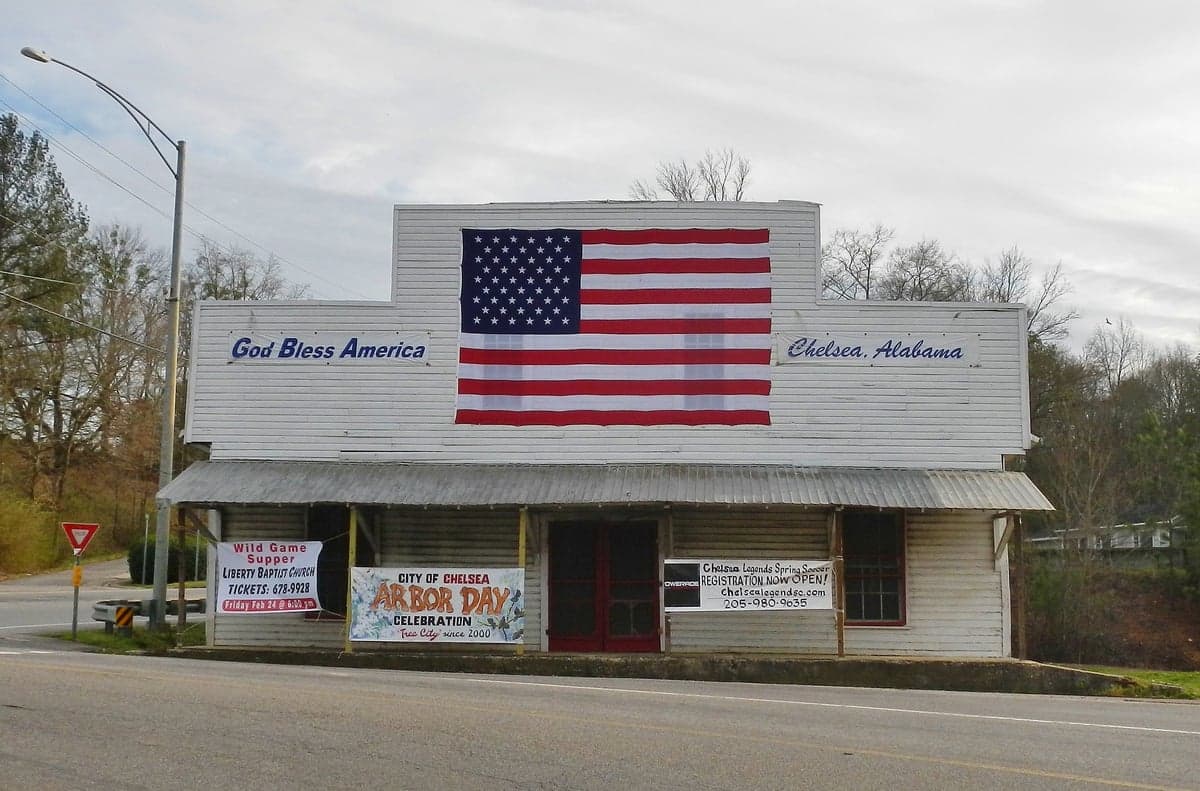
Photo: Wikipedia
Political ClimatePolitical Climate in Chelsea, AL
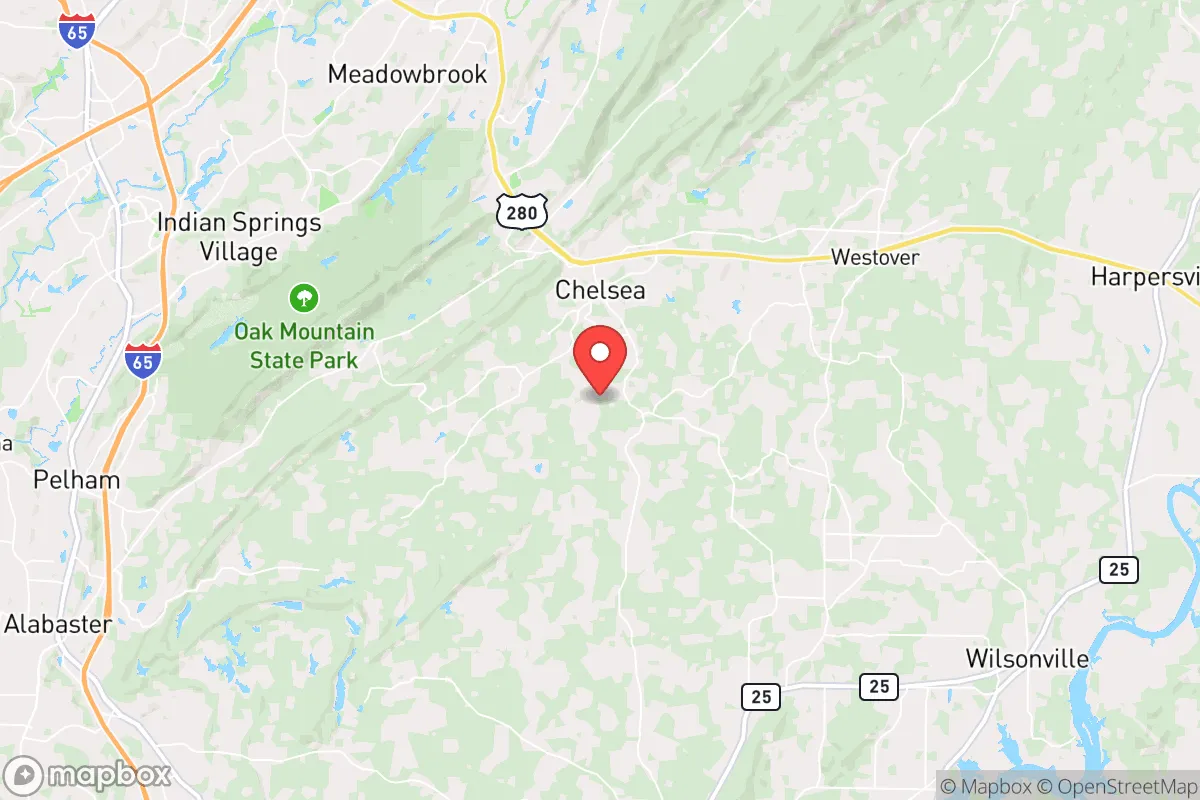
District shown is the primary district for this city’s centroid. Cities may span multiple districts.
Local Political AnalysisPolitical Analysis of Chelsea, AL
Chelsea, Alabama, sits firmly in deep-red territory, with a Cook Partisan Voting Index of R+20 that makes it one of the most reliably Republican communities in the greater Birmingham area. That number means the town votes about 20 percentage points more Republican than the national average, and in practice, you’ll find that reflected in nearly every local race, from city council to school board. The political trajectory here has been steady for years—Chelsea has grown fast, drawing families from more liberal-leaning spots like Birmingham and Hoover, and those newcomers have largely reinforced, not diluted, the conservative tilt. If you’re looking for a place where the political needle has swung left over the past decade, this isn’t it.
How it compares
Compared to Alabama as a whole, Chelsea is noticeably more conservative. The state itself has a Cook PVI that’s also Republican-leaning, but it’s not as extreme as Chelsea’s R+20—Alabama statewide is roughly R+15 to R+16, depending on the cycle. That difference matters: Chelsea’s politics are closer to what you’d find in neighboring Pelham or Alabaster, where Republican candidates routinely win by 70-80% margins. Drive 20 minutes west into Birmingham proper, and you’re in a Democratic stronghold where the political conversation flips entirely. The contrast is stark—Chelsea’s voters consistently back candidates like Kay Ivey and Tommy Tuberville by wide margins, while Birmingham’s precincts often go 80%+ for Democrats. For context, in the 2024 presidential race, Shelby County (where Chelsea sits) voted about 62% Republican, but Chelsea itself likely pushed closer to 75-80% Republican based on precinct-level trends.
What this means for residents
For conservative residents, Chelsea’s political climate is a comfortable fit. Local government tends to prioritize low taxes, limited regulation, and a strong law-and-order stance—things like zoning changes or school funding debates usually lean toward fiscal caution. You’ll see plenty of Trump signs in yards during election season, and the local Republican Party chapter is active. For liberal residents, the reality is more about finding your niche. There’s no organized progressive presence in Chelsea itself, but Birmingham’s more diverse political scene is a short drive away. In practice, most day-to-day life isn’t overtly political—neighbors help each other regardless of party, and the schools and parks are well-funded enough that partisan fights rarely dominate local news. The biggest practical effect is probably on local policy: Chelsea has resisted some of the more progressive zoning and housing initiatives seen in Birmingham, keeping development more suburban and single-family oriented.
Culturally, Chelsea leans into its identity as a family-friendly, church-going community. You’ll find more Southern Baptist and nondenominational evangelical churches per capita than in the state’s urban cores, and local events often have a faith-based or patriotic theme. The city’s growth has brought in some newcomers from out of state, but they’ve mostly assimilated into the existing conservative culture rather than shifting it. Looking ahead, I’d expect Chelsea to stay solidly red for the foreseeable future—the demographics (mostly white, married, homeowners with kids) are a recipe for continued Republican dominance. If anything, the political gap between Chelsea and Birmingham will widen as each area doubles down on its own trajectory. For anyone moving here, the takeaway is simple: if you’re conservative, you’ll feel right at home; if you’re liberal, you’ll find your people in the city, but you’ll be in the minority locally.

State Political ClimatePolitical Climate in Alabama
State Political AnalysisPolitical Environment in the State
Alabama is one of the most reliably Republican states in the country, with a deep-red lean that has only solidified over the past two decades. The state hasn’t voted for a Democratic presidential candidate since 1976, and in 2024, Donald Trump carried it by roughly 30 points. The dominant coalition is a blend of rural and suburban conservatives, evangelical Christians, and a growing number of working-class voters who have shifted right since the 2000s. The Democratic Party’s strength is now almost entirely confined to the Black Belt, a crescent of majority-Black counties stretching from the Georgia line to the Mississippi Delta, and to a few urban pockets in Birmingham and Montgomery.
Urban vs. rural divide
The political map of Alabama is starkly divided. The state’s largest metro, the Birmingham-Hoover area, is a mix: Jefferson County (Birmingham) leans Democratic, driven by a large Black population and a growing white liberal cohort in neighborhoods like Avondale and Crestline. But the surrounding suburbs—Shelby County, home to Hoover and Vestavia Hills—are among the most Republican in the nation, routinely voting 75-80% for GOP candidates. The state capital, Montgomery, is similarly split: the city itself is majority-Black and Democratic, while the surrounding Elmore and Autauga counties are deep red. Huntsville, in the northern part of the state, is a unique case—a fast-growing, high-education hub anchored by the Redstone Arsenal and NASA’s Marshall Space Flight Center. It leans Republican but is more moderate and libertarian-leaning than the rest of the state, with a significant number of white-collar professionals who vote for fiscal conservatives but are less engaged on social issues. Mobile and Baldwin counties on the Gulf Coast are reliably Republican, with Baldwin County (Fairhope, Daphne) being one of the fastest-growing and most conservative areas in the state. The Black Belt counties—like Greene, Sumter, and Lowndes—are overwhelmingly Democratic, but their populations are small and shrinking, giving them little statewide influence.
Policy environment
Alabama’s policy environment is shaped by a low-tax, low-regulation philosophy. There is no state income tax on Social Security benefits, and the state’s income tax rate tops out at 5%, one of the lowest in the Southeast. Property taxes are famously low—among the lowest in the nation—which is a major draw for relocators. The state has a right-to-work law, meaning union membership is voluntary, and it consistently ranks as one of the most business-friendly states in the country. Education policy is a mixed bag: the state has a school choice program (the Alabama Accountability Act) that provides tax credits for private school tuition and allows students in failing public schools to transfer, but public school funding per pupil remains near the bottom nationally. Healthcare is a contentious issue: Alabama has not expanded Medicaid under the Affordable Care Act, leaving a coverage gap for roughly 200,000 low-income adults. The state has some of the strictest abortion laws in the country, with a near-total ban in effect since 2022, and no exceptions for rape or incest. Election laws are moderately restrictive: voter ID is required, and early voting is limited to absentee ballots with an excuse, though no-excuse absentee voting was expanded temporarily during the pandemic and then rolled back.
Recent policy direction
The last five years have seen Alabama move aggressively to the right on a range of issues. In 2022, the state passed the Alabama Human Life Protection Act, which bans nearly all abortions, with no exceptions for rape or incest. On gun rights, Alabama became a permitless carry state in 2022, meaning anyone 21 or older who can legally own a firearm can carry it concealed without a permit. The state also passed a law in 2023 prohibiting the enforcement of federal gun laws that conflict with state law—a direct challenge to federal authority. On education, the state passed the Alabama CHOOSE Act in 2024, creating a universal school choice program that allows families to use state funds for private school tuition, homeschooling expenses, or other educational services. Parental rights in education were strengthened with a 2022 law requiring schools to notify parents of any curriculum involving sexual orientation or gender identity, and a 2023 law banning transgender girls from participating in female sports. On voting, the state passed a law in 2021 that criminalizes the distribution of absentee ballot applications to voters who haven’t requested them, and it banned curbside voting. Property rights were bolstered by a 2023 law limiting the ability of local governments to regulate short-term rentals like Airbnb. On privacy and surveillance, the state has been slower to act, but a 2024 law restricts the use of facial recognition technology by law enforcement without a warrant.
Civil unrest & political movements
Alabama has a history of civil rights activism that continues to shape its politics. The state was a flashpoint in the 2020 Black Lives Matter protests, with significant demonstrations in Birmingham, Montgomery, and Mobile. The protests were largely peaceful, but there were clashes with police in Birmingham, leading to the removal of a Confederate monument in Linn Park. On the right, the state has seen a rise in grassroots conservative activism, particularly around school board meetings and library boards, where parents have organized to challenge books and curricula they deem inappropriate. Immigration politics are less visible here than in border states, but the state passed a strict immigration law in 2011 (HB 56) that was largely gutted by federal courts; a 2024 law requires law enforcement to check the immigration status of anyone arrested for a felony. There is no sanctuary city movement in Alabama; in fact, the state passed a law in 2023 banning any local government from adopting sanctuary policies. Election integrity remains a hot-button issue: the 2020 election was not contested in Alabama, but the state’s Republican legislature has passed laws tightening absentee voting and banning ballot drop boxes. Secession rhetoric is largely confined to fringe groups, though the state’s attorney general has joined multi-state lawsuits challenging federal authority on issues like gun control and environmental regulation.
Projection
Over the next five to ten years, Alabama is likely to remain deeply Republican, but the nature of that conservatism may shift. The biggest demographic trend is the growth of the Huntsville metro, which is attracting a younger, more educated, and slightly more moderate population from other states. This could create a more libertarian-leaning Republican Party in the northern part of the state, focused on economic growth and tech policy rather than social issues. The Gulf Coast, particularly Baldwin County, is also growing fast, driven by retirees and remote workers from Florida and the Northeast, which could reinforce the state’s conservative bent but with a more suburban, less rural flavor. The Black Belt will continue to lose population, further weakening the Democratic base. The state’s political trajectory will likely be shaped by national trends—if the GOP moves further right on cultural issues, Alabama will follow; if the party moderates, the state’s more pragmatic conservatives may gain influence. One wild card is the potential for a Democratic governor in the next decade: the state has a history of electing moderate Democrats at the state level (like Don Siegelman in the 1990s), but that seems unlikely given the current partisan alignment.
For a new resident, the bottom line is this: Alabama offers a low-tax, low-regulation environment with strong protections for gun rights and parental control over education. If you’re a conservative, you’ll find a state that largely aligns with your values, especially outside of Birmingham and Montgomery. If you’re a liberal, you’ll find a state where your vote carries little weight in statewide elections, but where you can still find like-minded communities in the cities and college towns. The state’s politics are stable and predictable, but the growing influence of Huntsville and the Gulf Coast means the flavor of conservatism may become more suburban and less rural over time. Just be prepared for the summer heat and the fact that your property taxes will be the envy of your friends up north.
* Values derived from national, state, county, city and local statistics and may differ in a specific area. Last updated: 2026-09-27T14:20:49.000Z
Narrative content on this page is AI-generated and may contain mistakes. Verify any details that matter before acting on them.
ReloMaps may earn a commission from affiliate links at no extra cost to you.

