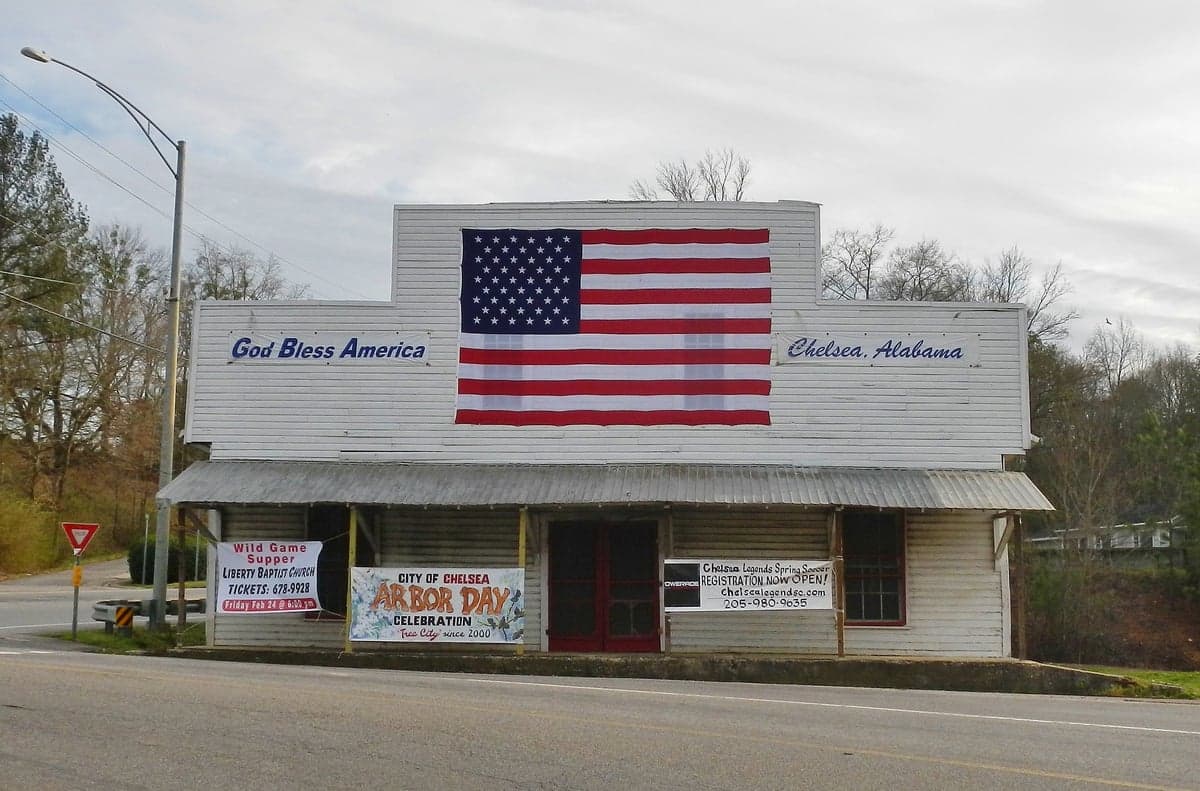
Photo: Wikipedia
Personal Sovereignty in Chelsea, AL
Viable for self-reliance. Generally workable, though some barriers may limit total independence.
What does Personal Sovereignty tell us?
Personal Sovereignty measures your capacity for self-reliance and independence with minimal government friction. Higher scores mean fewer barriers between you and the way you want to live... but it assumes you have the space you need and good neighbors.
What does this tell us?
Personal Sovereignty measures your capacity for self-reliance and independence with minimal government friction. Higher scores mean fewer barriers between you and the way you want to live... but it assumes you have the space you need and good neighbors.
State Policy
Energy independence: Importer (45% of energy produced in-state)
Personal Liberty
Homesteading

Personal Liberty Analysis
Chelsea, Alabama, offers a personal sovereignty environment that is heavily shaped by the state’s broad preemption laws and a local culture of self-reliance, making it a strong candidate for those prioritizing autonomy. As a small city in Shelby County, Chelsea benefits from Alabama’s consistently low-tax, low-regulation state posture while maintaining a distinctly rural-suburban character that supports independent living. For a relocation researcher focused on freedom, the key question is not whether Chelsea is free—it is—but how that freedom is structured and where the practical limits lie for daily life, property use, and personal defense.
Tax burden and regulatory posture in Chelsea
Alabama’s state-level tax burden is among the lightest in the nation, and Chelsea residents experience that directly. There is no state income tax on wages—Alabama taxes income but at a flat rate of 2% on the first $500 and 5% on everything above that, which is still lower than most states. Property taxes in Shelby County are very low, typically around 0.4% of assessed value, meaning a $300,000 home carries an annual tax bill of roughly $1,200. Sales tax in Chelsea is 9%, which is on the higher side for the state, but this is the primary local revenue source and keeps property taxes suppressed. The regulatory environment at the city level is light-touch. Chelsea has zoning ordinances, but they are not aggressively enforced for standard residential uses. There are no county-level building codes in unincorporated areas, though Chelsea itself requires permits for new construction and major renovations. The state’s right-to-work laws and absence of onerous occupational licensing for most trades mean starting a small business or working as an independent contractor is straightforward. For a family or individual seeking to minimize government friction in daily finances, Chelsea ranks favorably against most of the Southeast.
Self-defense and gun law specifics in Chelsea
Alabama is a constitutional carry state, and Chelsea residents enjoy the full scope of that law. As of 2022, no permit is required to carry a concealed handgun, either for residents or for non-residents who are legally eligible. Open carry is also legal without a permit. The state preempts all local firearm ordinances, meaning Chelsea’s city council cannot pass its own gun restrictions—what applies in Birmingham applies identically in Chelsea. Stand-your-ground and castle doctrine laws are fully in effect, with no duty to retreat in any place where a person is lawfully present. Alabama’s firearm laws are among the most protective of individual rights in the country, and Chelsea’s low crime rate (violent crime is roughly half the national average) means that defensive firearm use is rare but legally well-supported. The only notable restriction is that private firearm sales between individuals do not require a background check, though federal law applies to licensed dealers. For a reader prioritizing self-defense autonomy, Chelsea offers maximum legal latitude with minimal local interference.
Self-reliance and homesteading viability in Chelsea
Chelsea’s residential lots are typically larger than in suburban sprawl areas, with many homes sitting on half-acre to two-acre parcels. This makes small-scale homesteading—gardens, chickens, beekeeping—entirely feasible and common. The city’s zoning code permits keeping chickens and other small livestock on residential lots, though there are restrictions on roosters and the number of animals. Larger livestock like goats or horses require a minimum lot size of one acre per animal, which is achievable on many properties. Off-grid living is legally possible but practically limited by utility easements and subdivision covenants. Chelsea is served by Shelby Electric Cooperative and natural gas is widely available, but there is no legal barrier to installing solar panels, rainwater collection, or composting toilets. The main constraint is homeowners’ associations (HOAs), which cover many newer subdivisions and often restrict visible solar arrays, clotheslines, or livestock. Buyers seeking maximum homesteading freedom should target older neighborhoods or unincorporated areas just outside city limits, where no HOA applies. The growing season is long (roughly 220 frost-free days), and soil quality in the region is good for gardens. Water rights are governed by Alabama’s reasonable-use doctrine, meaning well water is available for domestic use without a permit, though irrigation wells require registration. For a family wanting to produce a meaningful portion of their own food, Chelsea’s regulatory environment is permissive enough to make it practical.
Personal liberties in Chelsea: parental rights, medical autonomy, speech, and property
Alabama law strongly protects parental rights in education and healthcare. Parents have the legal right to opt their children out of any school curriculum or activity they find objectionable, and the state’s Parents’ Bill of Rights (enacted in 2022) codifies that parental authority is the default in medical decisions, including vaccination choices. Homeschooling is straightforward: parents register with a local church school or file a notice of intent with the county superintendent, and there are no state-mandated curriculum requirements or testing. Chelsea is served by Shelby County Schools, which is one of the highest-rated districts in Alabama, but the homeschooling community is large and well-organized. Medical autonomy is less protected than in some Western states—Alabama does not have a right-to-try law for terminally ill patients, and the state’s certificate-of-need laws restrict the opening of new medical facilities, which limits healthcare competition. However, for routine care, Chelsea is within 30 minutes of Birmingham’s world-class medical centers. Free speech is fully protected under the First Amendment, and Alabama has no hate-speech laws that criminalize expression. Property rights are strong: Alabama is a non-disclosure state for real estate transactions, meaning sale prices are not publicly recorded, which some residents value for privacy. Eminent domain is limited to public use, and the state’s property rights laws are generally favorable to landowners. For a reader who values the ability to make independent decisions about family, health, and property without government overreach, Chelsea’s legal framework is supportive.
Overall, Chelsea, Alabama, offers a personal sovereignty profile that is among the strongest in the Southeast for a suburban-rural setting. The combination of constitutional carry, low property taxes, light zoning, strong parental rights, and a culture of self-reliance places it well ahead of most Texas or Florida suburbs of similar size. The main trade-offs are the higher sales tax, the presence of HOAs in newer developments, and the state’s limited medical autonomy protections. For a single individual or family who wants maximum freedom in daily life—to carry a firearm, homeschool children, keep chickens, or minimize tax burden—Chelsea delivers a practical, low-friction environment that respects personal independence without requiring a remote off-grid existence.

* Values derived from national, state, county, city and local statistics and may differ in a specific area. Last updated: 2026-09-27T14:20:49.000Z
Narrative content on this page is AI-generated and may contain mistakes. Verify any details that matter before acting on them.
ReloMaps may earn a commission from affiliate links at no extra cost to you.

