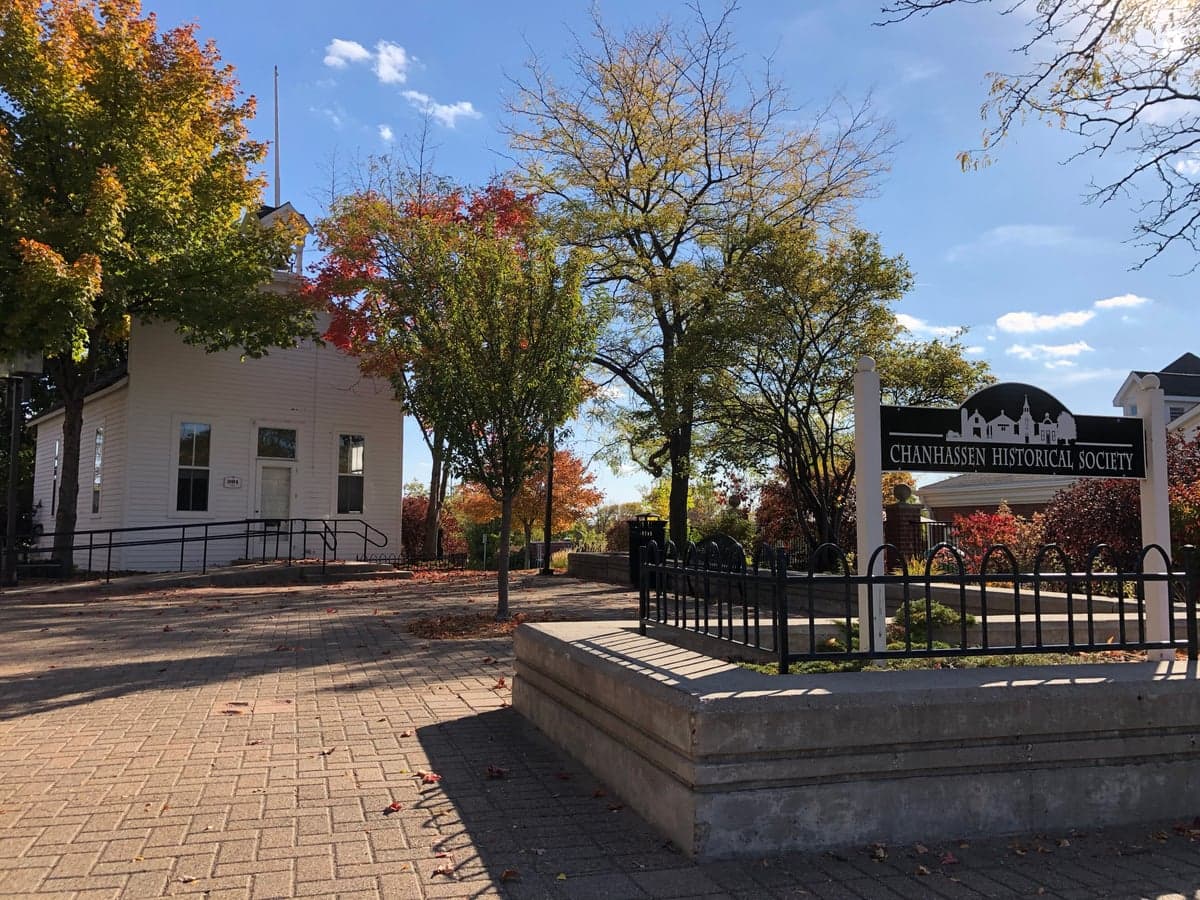
Photo: Wikipedia
Demographics of Chanhassen, MN
Affluence Level in Chanhassen, MN
An upper-middle-class area. Household wealth, education levels, and homeownership run ahead of national benchmarks.
People of Chanhassen, MN
The people of Chanhassen, Minnesota, today number roughly 26,000, forming a predominantly white, highly educated, and family-oriented suburb on the southwest edge of the Twin Cities metro. With a median household income well above the state average and 64.4% of adults holding a bachelor’s degree or higher, the city’s character is defined by professional households, large-lot subdivisions, and a strong sense of local identity distinct from neighboring Chaska and Eden Prairie. The population is notably less diverse than the metro average—83.1% white, with the largest minority groups being East/Southeast Asian (3.5%), Indian subcontinent (3.0%), and Hispanic (3.3%)—and foreign-born residents make up just 3.3% of the total, reflecting a community shaped more by domestic in-migration than international immigration.
How the city was settled and grew
Chanhassen’s original population was drawn by the land itself. The area was first settled in the 1850s by European-American farmers, primarily of German and Scandinavian stock, who took advantage of the fertile prairie and the Minnesota River valley’s timber resources. The city’s name, derived from the Dakota word for “sugar maple,” hints at the early economy of maple sugaring and small-scale agriculture. Unlike older river towns, Chanhassen remained a sparsely populated farming township through the early 20th century; the 1950 census recorded fewer than 1,500 residents. The first real neighborhood cluster formed around the intersection of what is now Highway 5 and Great Plains Boulevard, an area still referred to as Old Town Chanhassen, where a handful of general stores, a creamery, and a church served the dispersed farm families. No major immigrant wave or industrial boom drove growth here—instead, the city’s population remained small and homogeneous until the post-war suburban expansion of the 1960s.
Modern era (post-1965)
The 1965 opening of the Chanhassen Dinner Theatre—a regional entertainment landmark—coincided with the first wave of suburban development, but the real population surge came after 1970. The city annexed land along the Highway 5 corridor and began approving large-lot subdivisions aimed at white-collar commuters working in Minneapolis and the emerging southwest suburban job centers. The Lake Ann and Lake Lucy neighborhoods, built in the 1970s and 1980s, attracted families seeking lake access and acreage, while the Clover Ridge area (developed in the 1990s and 2000s) became the city’s largest master-planned community, with a mix of single-family homes and townhomes. These developments drew almost entirely domestic migrants—Minnesotans moving outward from Minneapolis and first-ring suburbs—reinforcing the city’s white, middle-to-upper-class profile. The small East/Southeast Asian and Indian subcontinent populations (3.5% and 3.0%, respectively) are a recent phenomenon, concentrated in the newer Lynwood and Westwood subdivisions built after 2010, where tech and medical professionals from the nearby UnitedHealth Group and Medtronic campuses have settled. The Hispanic and Black populations remain very small (3.3% and 1.4%), with no single neighborhood concentration, reflecting a pattern of dispersal rather than ethnic enclave formation.
The future
Chanhassen’s population is projected to grow slowly—perhaps reaching 28,000–30,000 by 2040—as developable land within city limits becomes scarce. The city’s 2040 comprehensive plan designates the Highway 5 and Powers Boulevard corridor for higher-density mixed-use development, which may attract younger professionals and empty-nesters, but the dominant housing type will remain large single-family homes on half-acre lots, limiting demographic turnover. The East/Southeast Asian and Indian subcontinent shares are likely to increase modestly as the southwest metro’s tech and healthcare employment base expands, but Chanhassen is unlikely to become a majority-minority suburb; its high housing costs and low rental inventory act as a filter. The white population share will probably decline gradually from 83% toward 75–78% by 2040, driven by aging-in-place Boomers and the slow in-migration of non-white professionals. The city’s cultural identity will remain that of an affluent, family-centric, politically moderate-to-conservative suburb—more like Edina than Brooklyn Park—with a strong emphasis on schools, parks, and low crime.
For someone moving in now, Chanhassen offers a stable, low-diversity, high-amenity environment where the population is aging slightly but still anchored by school-age families. The city is not becoming a melting pot; it is becoming a slightly more varied version of its current self, with the same fundamental character of professional-class homogeneity. New residents will find a community that values privacy, property, and proximity to nature, and where the people—overwhelmingly white, college-educated, and Minnesota-born—reflect the suburb’s deliberate, gradual growth rather than any sudden demographic shift.

* Values derived from national, state, county, city and local statistics and may differ in a specific area. Last updated: 2026-07-25T13:31:54.000Z
Narrative content on this page is AI-generated and may contain mistakes. Verify any details that matter before acting on them.
ReloMaps may earn a commission from affiliate links at no extra cost to you.

