Photo: Wikipedia
Personal Sovereignty in Challis, ID
Moderate friction. Expect trade-offs in some aspect of personal liberty and independence.
What does Personal Sovereignty tell us?
Personal Sovereignty measures your capacity for self-reliance and independence with minimal government friction. Higher scores mean fewer barriers between you and the way you want to live... but it assumes you have the space you need and good neighbors.
What does this tell us?
Personal Sovereignty measures your capacity for self-reliance and independence with minimal government friction. Higher scores mean fewer barriers between you and the way you want to live... but it assumes you have the space you need and good neighbors.
State Policy
Energy independence: Importer (25% of energy produced in-state)
Personal Liberty
Homesteading

Personal Liberty Analysis
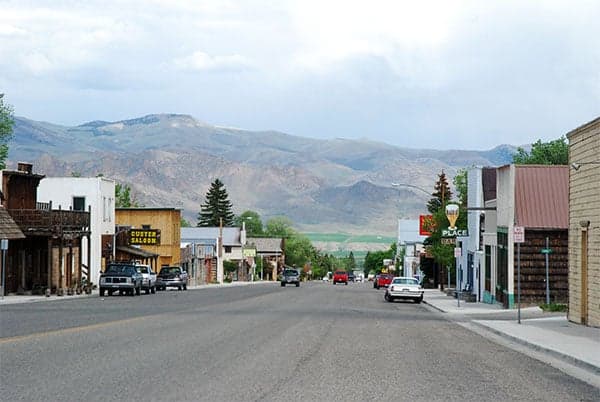
In Challis, Idaho, personal sovereignty is less an abstract ideal and more the daily operating system. Tucked into the Salmon River corridor with a population hovering around 1,000, this remote Custer County seat sits far enough from Boise’s political gravity that state-level freedoms—already robust—play out with near-zero local friction. For anyone serious about minimizing government overreach into their life, Challis offers a rare blend of isolation, natural resources, and a legal climate that prizes individual decision-making over regulatory convenience. The area’s autonomy environment is shaped directly by Idaho’s broader posture, but the town’s ranch-and-mine character gives it a self-reliant texture that feels more like the 19th century than the 21st.
How Idaho’s tax burden and regulatory climate affect freedom in Challis
Idaho imposes a flat 5.8% income tax on all earnings—no progressive brackets, no city-level income taxes—which keeps the state’s take predictable and comparatively modest. Property taxes in Custer County run well below national averages; the typical effective rate hovers around 0.5% of market value, meaning a $250,000 home costs roughly $1,250 annually. Sales tax sits at 6%, but groceries and prescription drugs are exempt. More important than the raw numbers is the regulatory philosophy: Idaho has no corporate inventory tax, no personal property tax on vehicles or household goods, and no estate or inheritance tax. The state’s business climate is consistently ranked among the top ten for regulatory freedom by groups like the Tax Foundation, and local zoning in Challis is minimal. You will not find building permits required for small sheds or chicken coops, and the county planning office rarely enforces aesthetic restrictions. For the prepper mindset, what matters most is that the state does not actively look for ways to tax or license your self-sufficiency—rain barrels, vegetable gardens, and home workshops are presumed legal until proven otherwise.
Self-defense laws and gun rights specific to Challis and Idaho
Idaho is a constitutional carry state: any adult legally allowed to possess a firearm may carry it openly or concealed without a permit. No training requirement, no fee, no government permission slip. The state also has a robust Stand Your Ground law at Idaho Code § 19-202A, which removes any duty to retreat before using deadly force in any place where you are lawfully present. Magazine restrictions do not exist; you can own and carry standard-capacity rifles and handguns. There is no state-level red flag law or firearm registration. In Challis itself, the sheriff’s office is small, well-known in the community, and generally pro-2A in practice—no local ordinances undermine state preemption of firearms regulation. For a survivalist, this means you can gear up, train, and defend your home or campsite without worrying about stepping on a legal landmine. The nearest metro area (Twin Falls) is two hours away, so law enforcement response times to outlying properties can exceed 30 minutes; the legal environment effectively assumes you are your own first responder.
Self-reliance and homesteading options in Challis (lot sizes, zoning, off-grid feasibility)
Rural parcels around Challis typically start at one acre and commonly extend to 20, 40, or even 160 acres through BLM land-adjacent sales and county subdivisions. Zoning is overwhelmingly residential or agricultural, with no minimum square footage requirements for dwellings and no prohibition on mobile homes, tiny houses, or RVs used as primary residences. Off-grid living is not just tolerated—it is the norm. Wells and septic systems are permitted by the state, but the county does not require an electrical connection to the grid; solar panels, propane generators, and wood stoves are standard. There are no building codes that mandate specific insulation values or energy efficiency standards for owner-built homes, provided the structure is not for public occupancy. For a prepper seeking food sovereignty, Challis sits in a short-season valley (Zone 4-5) but produces excellent hay, cattle, and garden crops with irrigation. The local feed store stocks seed, fencing, and tools, and there is a thriving barter economy for livestock and firewood. The only real constraint is water rights: any new well must be permitted through the Idaho Department of Water Resources, but domestic use exemptions are generous (up to 13,000 gallons per day without a water right). You can grow your own food, collect rainwater (Idaho explicitly protects rainwater harvesting), and generate your own power with near-zero government interference.
Parental rights, medical autonomy, and legal protections for personal liberties
Idaho’s legal framework strongly favors parental authority. Under Idaho Code § 32-1005, parents have the fundamental right to direct the upbringing, education, and medical care of their children, and the state has passed laws prohibiting school districts from requiring masking or vaccination without parental consent. Medical autonomy is further protected by Idaho’s medical freedom law (enacted in 2022), which prohibits discrimination against individuals who decline vaccination or use off-label treatments, including ivermectin and hydroxychloroquine. The state also bans government-mandated vaccine passports. Property rights are well-protected by the Private Property Rights Protection Act, which requires the government to justify any regulatory taking and to pay compensation if a land-use restriction diminishes value by more than 20%. For speech, the Idaho Constitution provides explicit protection for “the free exercise and enjoyment of religious profession and worship,” and local culture in Challis is one of live-and-let-live—protest, preaching, and political expression pass without harassment. Combined, these protections mean a family can homeschool, choose alternative medicine, refuse government mandates, and speak freely without legal jeopardy. This is not a place where the state second-guesses your private decisions.
Compared to the coastal states or even the Front Range of Colorado, Challis represents a drastically higher degree of personal sovereignty. The trade-offs are real—limited healthcare, few specialized services, harsh winters, and a two-hour drive to any big-box retailer—but for someone whose primary concern is autonomy over family, property, and self-defense, the bargain is straightforward. Idaho has deliberately constructed a legal and cultural environment that de-prioritizes government compulsion, and Challis sits at the quiet, conservative heart of that experiment. It is not a prepper’s paradise on paper only; the daily reality matches the legal structure. If you want to live under as few external rules as possible while still being inside the United States, Challis earns serious consideration.

* Values derived from national, state, county, city and local statistics and may differ in a specific area. Last updated: 2026-06-01T23:49:26.000Z
Narrative content on this page is AI-generated and may contain mistakes. Verify any details that matter before acting on them.
ReloMaps may earn a commission from affiliate links at no extra cost to you.

