Photo: Wikipedia
Demographics of Challis, ID
Affluence Level in Challis, ID
A middle-class area roughly in line with national averages across income, home values, education, and employment.
People of Challis, ID
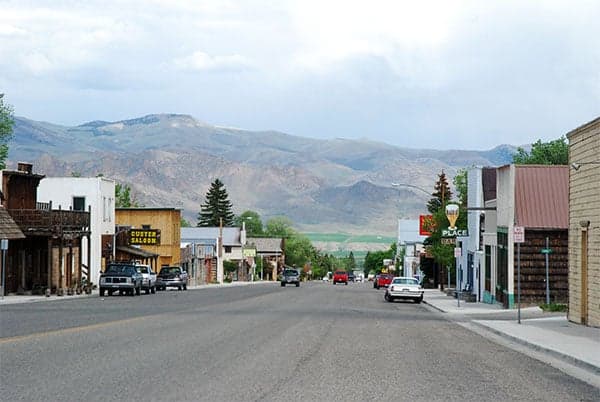
Challis, Idaho, is a small, tight-knit community of 794 residents where a strong ranching and mining heritage defines the local character. The population is predominantly White (80.9%) with a notable Hispanic minority (8.1%), reflecting a history of Basque and Mexican labor in the region’s extractive industries. The foreign-born population is minimal at 2.4%, and the town remains one of the most ethnically homogeneous in Custer County, with a distinctive Western independence and self-reliance that appeals to conservative-leaning individuals seeking a quiet, rural lifestyle.
How the city was settled and grew
Challis was founded in 1878 as a supply hub for the nearby Bayhorse and Ramshorn silver mines. The first permanent settlers were Anglo-American prospectors and merchants from the eastern United States, drawn by the 1870s mining boom. They built the original town core along Main Street, an area still referred to as Old Town Challis, where the earliest frame houses and false-front stores date to the 1880s. A second wave arrived in the 1890s: Basque sheepherders and Mexican laborers recruited to work the region’s expanding ranches and smelters. These groups settled in what locals call the West Side, a neighborhood along the Salmon River where modest worker cottages and small livestock pens once stood. The town’s population peaked near 1,200 in the 1910s, then declined as mining waned, leaving a stable core of ranching families who intermarried and consolidated land holdings through the mid-20th century.
Modern era (post-1965)
After the 1965 Immigration and Nationality Act, Challis saw little direct immigration; the foreign-born share has never exceeded 3%. Instead, the modern era has been defined by domestic in-migration of retirees and outdoor recreationists. Beginning in the 1990s, a small wave of newcomers from California and the Pacific Northwest bought second homes and cabins in the East Fork district, a subdivision along the East Fork of the Salmon River. These arrivals are predominantly White, college-educated (22.9% of the town holds a bachelor’s degree or higher), and tend to be politically conservative or libertarian. The Hispanic population, concentrated in the River Road area south of town, has grown modestly from 5.4% in 2000 to 8.1% today, driven by ranch labor and seasonal work at the nearby Challis National Forest. No Black, Asian (East/Southeast Asian), or Indian-subcontinent communities have established a measurable presence; the town’s Black and Asian shares remain at 0.0% and 0.1%, respectively.
The future
Challis is likely to remain a demographically stable, predominantly White community over the next 10–20 years. The Hispanic population is growing slowly through natural increase and continued ranch employment, but it is not forming a distinct enclave; instead, families are dispersing across the North Challis neighborhood, a newer subdivision of manufactured homes and ranch-style houses. The town’s population has hovered between 750 and 850 since 2010, and the lack of major employers or affordable housing stock limits in-migration. The biggest demographic shift may be an aging population: the median age is 47.3, well above the national average, as younger adults leave for Boise or Twin Falls. No significant immigrant communities are expected to emerge, and the town will likely homogenize further as older Anglo residents age in place and few new families arrive.
For a conservative-leaning mover today, Challis offers a stable, culturally homogeneous environment where ranching traditions and outdoor recreation define daily life. The population is not diversifying rapidly, and the town’s future is one of slow decline or steady stasis, not growth. New arrivals will find a community that values self-sufficiency, low crime, and minimal government—a place where the human history is written in the names of old mining families and the Basque sheep camps that still dot the surrounding hills.

* Values derived from national, state, county, city and local statistics and may differ in a specific area. Last updated: 2026-06-01T23:49:26.000Z
Narrative content on this page is AI-generated and may contain mistakes. Verify any details that matter before acting on them.
ReloMaps may earn a commission from affiliate links at no extra cost to you.

