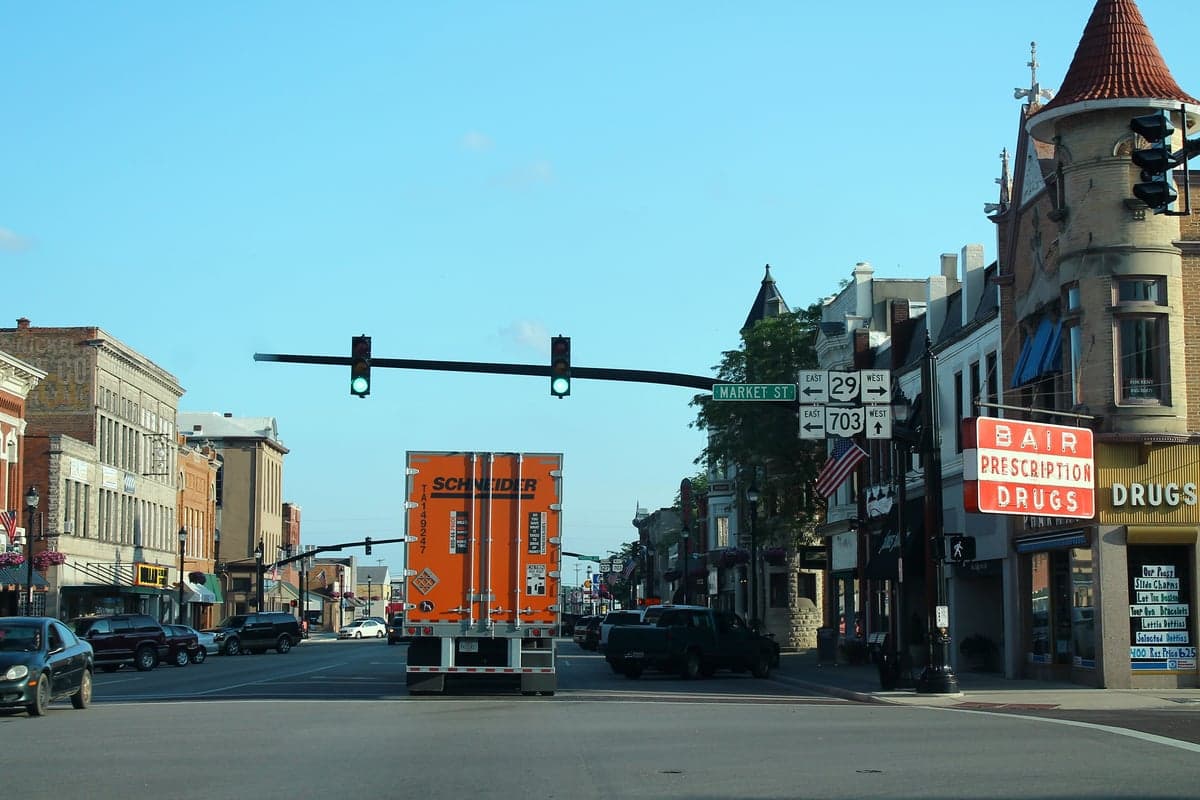
Photo: Wikipedia
Political ClimatePolitical Climate in Celina, OH
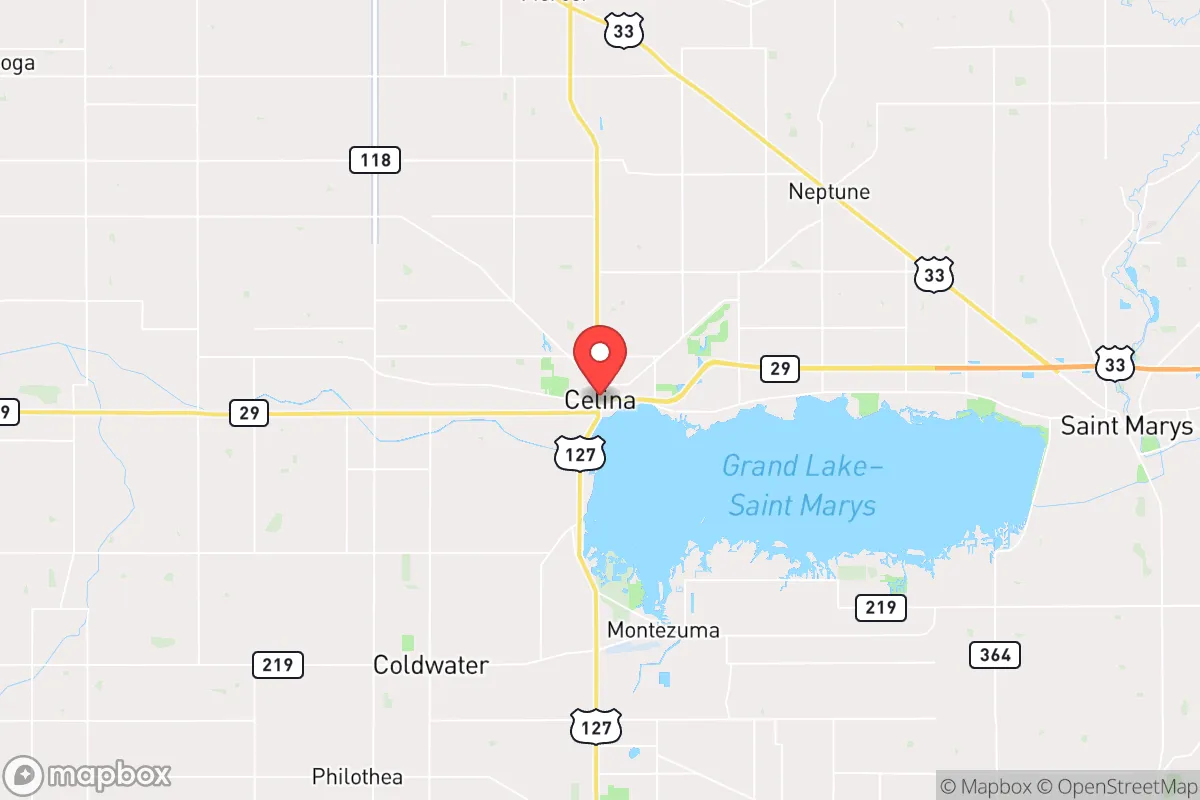
District shown is the primary district for this city’s centroid. Cities may span multiple districts.
Local Political AnalysisPolitical Analysis of Celina, OH
Celina, Ohio, is a reliably conservative stronghold, and it’s been that way for as long as anyone can remember. The Cook PVI of R+18 tells the story bluntly—this isn’t a swing town. In the 2024 presidential race, Mercer County, where Celina sits, went for the Republican candidate by a margin closer to 40 points, far outpacing the state’s already red R+5 rating. You don’t see many yard signs for Democrats here, and the local GOP has a lock on county offices. The trajectory is steady: if anything, the area has gotten a bit more Republican over the last decade, mirroring the broader rural shift away from the Democratic Party that used to have a foothold in union-heavy manufacturing towns.
How it compares
The difference between Celina and the rest of Ohio is stark. The state as a whole is a purple-ish red, with a Cook PVI of R+5, meaning it leans Republican but still has competitive races in places like Columbus, Cincinnati, and the Cleveland suburbs. Celina, by contrast, is deep red. Drive 40 miles east to Lima (R+16) and you’ll find a similar vibe, but head 50 miles south to Dayton (R+3) or 60 miles northeast to Toledo (D+3) and the political landscape flips entirely. Those cities have Democratic mayors and more diverse electorates. Even within Mercer County, the village of Coldwater (R+20) is even more conservative than Celina, while the tiny town of St. Henry (R+22) is about as red as it gets in the state. For a liberal resident, Celina can feel isolating—there’s no real progressive infrastructure, and local news coverage tends to reflect the majority’s views. For a conservative, it’s a comfortable place where your values are the default, and you rarely have to defend them.
What this means for residents
In practice, Celina’s political lean shapes everything from school board meetings to zoning debates. The local government is uniformly Republican, so tax policy tends to favor low rates and limited spending—property taxes here are about 15% below the state average. Social issues like abortion and gun rights are non-issues locally; the county is solidly pro-life and a Second Amendment sanctuary. For a liberal resident, this means you’ll likely keep your political opinions to yourself in public, and you might drive to Lima or even Dayton for more progressive social events or healthcare options. For a conservative, it means your vote really counts in local primaries, not general elections—the real political fights are between moderate and MAGA-aligned Republicans. The biggest cultural distinction from the rest of Ohio is the strong German Catholic heritage, which gives local politics a more socially conservative, family-first flavor than you’d find in, say, the Baptist-heavy southern part of the state.
Looking ahead, I don’t see Celina changing much. The population is stable, the economy is tied to agriculture and manufacturing (Crown Equipment and Huffy are big employers), and there’s no influx of out-of-state transplants to shift the balance. If anything, the rural-urban divide will keep widening. The state might drift a bit more red as Columbus and Cincinnati grow, but Celina will stay right where it is—a reliable, predictable conservative anchor in a state that’s still figuring out its political identity. For anyone moving here, the takeaway is simple: if you’re conservative, you’ll feel at home. If you’re liberal, you’ll need to find your community in nearby cities or online. Either way, the politics here are honest, consistent, and deeply rooted in local tradition.

State Political ClimatePolitical Climate in Ohio
State Political AnalysisPolitical Environment in the State
Ohio is a classic swing state that has shifted decisively rightward over the past decade, now carrying a Cook PVI of R+5. The state voted for Donald Trump by 8 points in both 2016 and 2020, then by 11 points in 2024, cementing a trajectory that began with the collapse of the old Democratic coalition in the industrial Midwest. The dominant coalition is now a mix of ex-urban and rural conservatives, working-class voters who abandoned the Democratic Party over trade, cultural issues, and energy policy, and a shrinking but still potent Republican establishment in the suburbs. The 10-20 year arc is unmistakable: Ohio was a true battleground in 2000 and 2004, but by 2024 it was treated as a safe red state, with both parties spending minimal resources here.
Urban vs. rural divide
The political map of Ohio is a textbook case of the urban-rural split. The three big C's — Cleveland, Columbus, and Cincinnati — are deep blue islands in a red sea. Cuyahoga County (Cleveland) delivered 66% for Biden in 2020, while Franklin County (Columbus) hit 62% and Hamilton County (Cincinnati) went 57% blue. But outside these metros, the landscape is overwhelmingly Republican. The rural counties along the Appalachian spine in the southeast — places like Meigs, Vinton, and Monroe — routinely vote 75-80% Republican. The western and northwestern farm counties, such as Mercer and Auglaize, are even redder. The real story is the suburbs: places like Delaware County (north of Columbus) and Warren County (north of Cincinnati) have become reliably red, while inner-ring suburbs like Lakewood (Cleveland) and Upper Arlington (Columbus) have trended blue. The divide isn't just geographic — it's cultural. A resident of Steubenville in the Ohio Valley lives in a different political universe than someone in Yellow Springs near Dayton.
Policy environment
Ohio's policy environment is a mixed bag that reflects its recent rightward shift but also its pragmatic, deal-making tradition. The state income tax was cut from a top rate of 4.75% to 3.5% under Governor Mike DeWine, with a flat tax proposal gaining traction. Sales tax is 5.75% but local add-ons push it higher in cities. Property taxes are moderate but vary wildly by district. The regulatory posture is generally business-friendly, with right-to-work laws not passed but prevailing wage repealed for school construction. Education policy is a battleground: school choice is robust, with a universal voucher program passed in 2023 that lets any family use state funds for private or homeschool expenses. Healthcare is a mixed picture — Medicaid expansion was accepted under John Kasich and remains, but the state has a 6-week abortion ban (enacted in 2019, blocked by courts, then effectively reinstated after the 2022 Dobbs decision). Election laws have tightened: voter ID is now required, drop boxes are limited to one per county, and early voting hours were standardized. The state also passed a constitutional amendment in 2023 enshrining the right to abortion, which voters approved by 57%, showing a libertarian streak that cuts against the legislature's conservative bent.
Recent policy direction
The last five years have seen Ohio lurch rightward on most fronts, but with notable exceptions driven by ballot initiatives. On gun and self-defense law, Ohio became a permitless carry state in 2022, allowing any adult to carry a concealed firearm without a license. Stand-your-ground laws were expanded in 2021. On parental and education rights, the state passed the "Parents Bill of Rights" in 2023, requiring schools to notify parents of curriculum changes and allowing them to opt children out of sex-ed. The "Save Women's Sports Act" bans transgender athletes from female sports. On speech and privacy, Ohio has no broad surveillance law, but local police use of license plate readers and drones is common. On medical and bodily autonomy, the 2023 abortion rights amendment overrode the legislature's near-total ban, but the state still has a 24-hour waiting period and mandatory counseling. Medical marijuana is legal (since 2016), but recreational use remains illegal despite growing public support. On property rights, Ohio is a "Dillon's Rule" state, meaning local governments have only powers granted by the state, which limits local rent control and zoning restrictions. On taxation, the trend is toward lower income taxes and higher sales taxes, with a push to eliminate the income tax entirely. On voting and ballot access, the 2023 law requiring photo ID and limiting drop boxes was a clear tightening, but early voting remains generous at 28 days.
Civil unrest & political movements
Ohio has seen its share of political flashpoints. The 2020 protests in Columbus and Cincinnati over George Floyd's death were large but mostly peaceful, though looting occurred in downtown Columbus. The 2023 East Palestine train derailment in Columbiana County sparked a populist backlash against both the Biden administration and Norfolk Southern, with local residents organizing around environmental safety. Immigration politics are less heated than in border states, but the 2024 controversy over Haitian migrants in Springfield (amplified by national figures) showed how quickly local issues can explode. There is no sanctuary city policy in Ohio; most major cities have "welcoming" ordinances but cooperate with ICE. Election integrity controversies flared after 2020, with Republican legislators holding hearings and passing the voter ID law, but no major fraud was found. The most visible political movement is the "Ohio Freedom Alliance" and similar groups pushing for constitutional carry and school choice, while on the left, the "Ohio Organizing Collaborative" focuses on voting rights and criminal justice reform. A new resident would notice the prevalence of Trump flags in rural areas and the occasional "Fuck Biden" bumper sticker, but actual political violence is rare.
Projection
Over the next 5-10 years, Ohio will likely become more Republican at the state level, but with a persistent libertarian streak that complicates the picture. The demographic trends are clear: the rural population is aging and shrinking, while the suburbs of Columbus and Cincinnati are growing and diversifying. Delaware County is projected to add 100,000 residents by 2035, many of them young families from blue states who may not vote as Republican as the current base. The in-migration from the Northeast and California is modest but real, and these newcomers tend to be moderate on social issues and conservative on taxes. The abortion rights amendment showed that even in a red state, voters will reject extreme positions. Expect continued fights over school funding (the state's system was ruled unconstitutional in 1997 and still hasn't been fixed), marijuana legalization (likely by 2028 via ballot initiative), and income tax elimination. The wild card is the economy: if manufacturing continues to decline and the fentanyl crisis persists, the populist anger that fueled Trump could turn against the Republican establishment. A new resident moving in now should expect a state that is reliably red in presidential elections but unpredictable on specific policy questions, with a legislature that is more conservative than the electorate.
For someone relocating to Ohio, the bottom line is this: you'll find a state where conservative values dominate state government, but where local politics vary enormously — from the progressive bubble of Yellow Springs to the deep red of Van Wert. Your experience will depend heavily on which county you choose. The tax burden is moderate and falling, the regulatory environment is business-friendly, and the school choice system is one of the most generous in the country. But you'll also contend with a polarized media environment, a legislature that often overrides local control, and a political culture that can feel like a perpetual culture war. If you're conservative, you'll feel at home in most of the state. If you're liberal, you'll find your tribe in the cities and college towns, but you'll be outvoted at the state level. Either way, Ohio offers a front-row seat to the American political experiment.
* Values derived from national, state, county, city and local statistics and may differ in a specific area. Last updated: 2026-10-15T00:57:02.000Z
Narrative content on this page is AI-generated and may contain mistakes. Verify any details that matter before acting on them.
ReloMaps may earn a commission from affiliate links at no extra cost to you.

