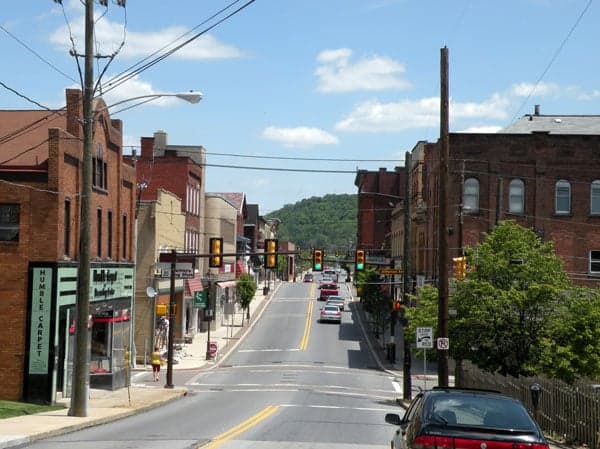
Photo: Wikipedia
Political ClimatePolitical Climate in Canonsburg, PA
District shown is the primary district for this city’s centroid. Cities may span multiple districts.
Local Political AnalysisPolitical Analysis of Canonsburg, PA
Canonsburg, Pennsylvania, is a reliably conservative stronghold in Washington County, with a Cook Partisan Voting Index (PVI) of R+17, meaning it votes about 17 points more Republican than the national average. That’s a stark contrast to the state of Pennsylvania as a whole, which sits at a Cook PVI of EVEN—a pure swing state that flipped from Trump in 2016 to Biden in 2020 by just over 80,000 votes. In Canonsburg, you’re looking at a place where Republican presidential candidates routinely win by double digits, and local offices—from county commissioner to school board—tend to lean red. But it wasn’t always this way. Back in the 1990s, this was a union-heavy, blue-collar Democratic town, part of the old “Steel Valley” coalition. The shift started in the 2000s, accelerated by the decline of manufacturing and the rise of social issues, and by 2016, Canonsburg had become a poster child for the region’s rightward realignment. Today, it’s solidly Republican, and I don’t see that changing anytime soon—the demographics and economic base just don’t support a flip back.
How it compares
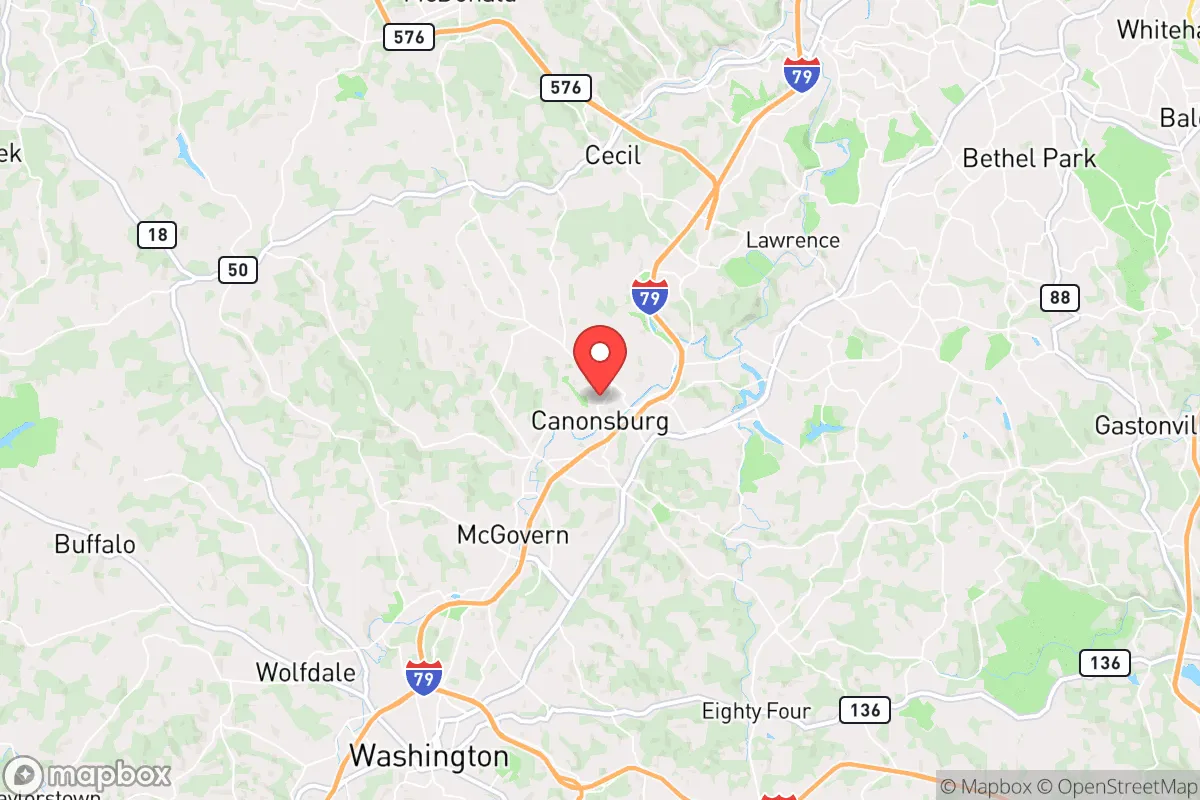
To understand Canonsburg’s politics, you have to look at its neighbors. Just 20 miles north, Pittsburgh’s Allegheny County is a Democratic bastion (Cook PVI D+15), with the city itself voting heavily blue. Drive 15 miles south to Washington, the county seat, and you’ll find a more moderate but still Republican-leaning area (R+10 or so). But Canonsburg is distinct: it’s more conservative than Washington proper, and way more so than Pittsburgh. The surrounding Washington County overall is R+12, but Canonsburg’s R+17 puts it in the top tier of red towns in the region. Compare that to the state’s EVEN rating, and you see why Canonsburg feels like a different world from Philadelphia or even Harrisburg. In the 2024 presidential race, Washington County went for Trump by about 18 points, while Pennsylvania overall was a nail-biter—Trump won it by less than 2 points. So Canonsburg is not just red; it’s a deep red island in a purple state, and that shapes everything from local policy to daily conversation.
What this means for residents
For conservative residents, Canonsburg is comfortable. You’ll find local government, school board meetings, and community events that reflect your values—think lower taxes, Second Amendment support, and a general skepticism of big government. The local Republican committee is active, and you’ll see yard signs for GOP candidates everywhere. For liberal residents, it’s a different story. You’re in the minority, and you’ll feel it in casual chats at the diner or in local elections where your candidate rarely wins. But it’s not hostile—people are neighborly, and you can find like-minded folks if you look, especially in the younger crowd or among transplants from Pittsburgh. The practical reality is that policy leans right: zoning is lax, gun laws are state-preempted but locally enforced loosely, and taxes are relatively low. There’s no local income tax, and property taxes are moderate. If you’re progressive, you might drive to Pittsburgh for cultural events or political organizing, but you can live here without friction—just don’t expect your views to dominate.
Culturally, Canonsburg holds onto its coal-and-steel heritage with pride—the annual “Canonsburg Fourth of July Parade” is a big deal, and the local Italian and Eastern European roots show in the food and festivals. Politically, that translates into a populist, working-class conservatism that’s more about “leave us alone” than social crusading. You won’t see the same intensity of culture-war fights you’d get in, say, rural Lancaster County. The trajectory? I’d say Canonsburg stays R+15 to R+20 for the next decade, barring a major demographic shift. The state’s EVEN rating means statewide races will always be close, but locally, the red runs deep. If you’re moving here, know that your vote will matter more in a primary than a general—and that the real political action is in the statehouse races, where Canonsburg’s district is a safe Republican seat.

State Political ClimatePolitical Climate in Pennsylvania
State Political AnalysisPolitical Environment in the State
Pennsylvania is the ultimate swing state, with a Cook PVI of EVEN that perfectly captures its 50/50 split. Over the past 20 years, it has shifted from a reliably blue-leaning state in presidential races (voting Democratic from 1992 to 2012) to a true battleground where margins are measured in tens of thousands of votes. The dominant coalitions are a shrinking but still potent union-and-urban Democratic base in Philadelphia and Pittsburgh, squared off against a growing, energized conservative coalition in the rural center and northern tier. The 2016 and 2020 elections cemented this trajectory: Donald Trump flipped counties like Luzerne (Wilkes-Barre) and Erie that had voted Democratic for decades, while Joe Biden barely held Philadelphia’s suburbs. The result is a state that feels like two different countries sharing a border.
Urban vs. rural divide
The political map of Pennsylvania is a textbook study in geographic polarization. Philadelphia and its collar counties—Montgomery, Delaware, Chester, and Bucks—are the engine of the Democratic vote, delivering margins of 300,000+ votes that Democrats need to offset rural losses. Pittsburgh and Allegheny County are similarly blue, though with a more moderate, union-flavored tilt. The rural "T" that runs from the northern tier (Tioga, Bradford counties) down through the center (Centre, Clinton) and across the southern border (Franklin, Adams) is deeply red. The critical battlegrounds are the "collar counties" around Philadelphia and the old industrial cities like Scranton, Wilkes-Barre, and Erie. Luzerne County, anchored by Wilkes-Barre, flipped from Obama +5 in 2012 to Trump +19 in 2020—a 24-point swing driven by working-class voters who feel left behind by the coastal economy. Erie County, on Lake Erie, is a bellwether: it voted for Obama twice, then Trump, then Biden by just 1 point. The suburbs of Philadelphia—particularly Bucks and Chester—are the real prize: they were once reliably Republican but have trended sharply Democratic since 2016, driven by college-educated voters repelled by Trump’s style.
Policy environment
Pennsylvania’s policy environment is a mixed bag that reflects its purple status. The state income tax is a flat 3.07%, one of the lowest among states with a broad-based income tax, and the sales tax is 6% (8% in Philadelphia and Allegheny County). Property taxes are high, averaging about 1.5% of home value, and are a perennial source of complaint, especially for retirees. The regulatory posture is moderate: Pennsylvania is not Texas or Florida in terms of deregulation, but it’s also not California. The state has a strong labor union presence, particularly in construction and public schools, which keeps wages higher in those sectors but also raises costs for new development. Education policy is a flashpoint: the state has a massive funding disparity between wealthy suburban districts (like Lower Merion) and poor rural ones (like those in the northern tier). School choice is limited—there are charter schools, but no universal voucher program, though a limited tax-credit scholarship program exists. Healthcare is dominated by large systems like UPMC in the west and Jefferson Health in the east. Election laws are relatively accessible: no-excuse mail-in voting was enacted in 2019 (Act 77), though it has become a partisan lightning rod, with Republicans frequently calling for its repeal. Voter ID is required only for first-time voters at the polls, which is less strict than many red states.
Recent policy direction
The last five years have seen Pennsylvania lurch in contradictory directions, reflecting its divided government. On gun and self-defense law, the state is a preemption state—cities like Philadelphia cannot pass their own gun laws stricter than the state’s—but Philadelphia has repeatedly tried to do so, leading to court battles. The state does not require a permit to open carry, but a permit is needed for concealed carry, and it is issued on a "shall issue" basis. On parental and education rights, the 2021 election of conservative school board candidates in places like Central Bucks and Pennridge sparked fierce battles over library books and transgender policies, but the pendulum has swung back somewhat with more moderate wins in 2023. On speech and privacy, Pennsylvania has no broad shield law for journalists, but it does have a strong Right-to-Know Law for public records. On medical and bodily autonomy, abortion remains legal up to 24 weeks, with no major restrictions beyond parental consent for minors—a stark contrast to neighboring Ohio and West Virginia. On property rights, the state has no statewide rent control, but Philadelphia has its own rent stabilization pilot. On taxation, the flat income tax was cut from 3.07% to 2.99% in 2024, with further cuts proposed. On voting and ballot access, Act 77 (mail-in voting) remains in place despite repeated repeal attempts, and the state has automatic voter registration at DMVs. The overall direction is a tug-of-war: the Democratic governor (Josh Shapiro) and Republican legislature are in a constant standoff, producing incremental change rather than dramatic shifts.
Civil unrest & political movements
Pennsylvania has seen its share of political flashpoints. The 2020 election aftermath was intense: Trump’s campaign filed numerous lawsuits in the state, and the "Stop the Steal" movement held rallies at the state capitol in Harrisburg. Election integrity remains a live issue, with Republican legislators pushing for audits and the elimination of mail-in voting. On the left, the Black Lives Matter protests in Philadelphia in 2020 were large and occasionally violent, leading to property damage and a lasting tension between the city’s progressive activists and its police union. Immigration politics are less heated than in border states, but Philadelphia is a self-declared "sanctuary city," which has drawn criticism from rural Republicans and occasional legislative attempts to ban such policies. There is no serious secession or nullification movement, but there is a persistent "Pennsylvania is two states" sentiment, with some rural counties floating the idea of joining a hypothetical "Greater Idaho" or forming a new state. The most visible flashpoint for a new resident would be the yard signs: in any given suburban neighborhood, you’ll see a roughly even split between "Shapiro" and "Mastriano" signs during election season, and conversations about politics at a backyard barbecue can get heated fast.
Projection
Over the next 5-10 years, Pennsylvania is likely to remain a toss-up, but the demographic trends favor Democrats in the long run. The Philadelphia suburbs are getting more diverse and more educated, which tends to push them left. Meanwhile, the rural population is aging and shrinking, which hurts Republicans. However, in-migration from other states is a wild card: Pennsylvania is seeing a net inflow from New York and New Jersey, particularly to the Lehigh Valley (Allentown, Bethlehem) and the Poconos, and these newcomers tend to be more moderate or even conservative on taxes but liberal on social issues. The wild card is the "blue wall" counties like Erie and Luzerne: if Republicans can hold them, they win the state; if Democrats can flip them back, they lock it down. The state’s electoral votes (19) will remain a top target for both parties. For a new resident, expect the political climate to stay intensely competitive, with constant campaign ads and a state government that often feels gridlocked. The practical implication is that your vote will genuinely matter more here than in almost any other state.
Bottom line for a new resident: If you’re a conservative, you’ll find a strong community in the rural areas and smaller cities like York or Lancaster, but you’ll be fighting an uphill battle on state-level policy. If you’re a liberal, you’ll feel at home in Philadelphia, Pittsburgh, or the inner suburbs, but you’ll be frustrated by the state legislature’s Republican majority. For everyone, the key takeaway is that Pennsylvania is a state where your local government—county commissioners, school boards, and mayors—has more practical impact on your daily life than the state capitol. The politics are in your face, but they’re also genuinely responsive to your vote. That’s the trade-off for living in the most important swing state in the country.
* Values derived from national, state, county, city and local statistics and may differ in a specific area. Last updated: 2026-10-23T21:47:04.000Z
Narrative content on this page is AI-generated and may contain mistakes. Verify any details that matter before acting on them.
ReloMaps may earn a commission from affiliate links at no extra cost to you.

