Photo: Wikipedia
Demographics of Canonsburg, PA
Affluence Level in Canonsburg, PA
A middle-class area roughly in line with national averages across income, home values, education, and employment.
People of Canonsburg, PA
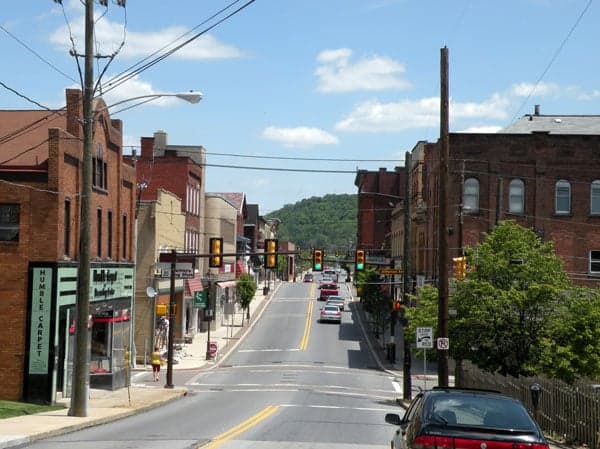
The people of Canonsburg, Pennsylvania today number 9,682, forming a community that is predominantly white (88.0%) with a notably higher-than-average Indian subcontinent population (3.7%) for a small Western Pennsylvania borough. The town retains a dense, walkable character rooted in its historic role as a coal and steel hub, with a strong sense of local identity tied to its ethnic clubs, churches, and the legacy of Perry Como. College attainment sits at 34.7%, slightly above the national average, reflecting a workforce that has shifted from industrial labor toward healthcare, education, and energy-sector jobs in the greater Pittsburgh region.
How the city was settled and grew
Canonsburg was laid out in 1789 on land originally part of a 1781 warrant to John Canon, a Revolutionary War officer and early land speculator. The town’s first permanent settlers were Scotch-Irish Presbyterians from Ulster and the Pennsylvania frontier, who built farms and small mills along Chartiers Creek. By the 1830s, the discovery of bituminous coal seams beneath the region triggered the first major population wave: Irish immigrants digging the mines and building the Pittsburgh, Washington and Baltimore Railroad. These Irish families settled in what is now East Pike Run and along West Pike Street, establishing St. Patrick’s Church (1853) as the community’s anchor. A second wave, from the 1870s through 1910, brought Italian and Eastern European (Polish, Slovak, Croatian) immigrants to work in the Standard Steel Car Company plant and the dozens of smaller foundries and machine shops. These groups concentrated in the “Hollow” (the low-lying area near the railroad tracks) and along North Central Avenue, building St. Michael’s Byzantine Catholic Church and the Italian Mutual Benefit Society hall. By 1920, Canonsburg’s population had reached roughly 10,000, making it one of the most densely settled boroughs in Washington County.
Modern era (post-1965)
The post-1965 period brought two significant demographic shifts. First, the collapse of heavy industry in the 1970s and 1980s triggered a domestic out-migration of younger families, particularly from the older ethnic neighborhoods like the Hollow and East Pike Run, as residents sought work in the Sun Belt or in Pittsburgh’s growing service sector. Second, the 1990s and 2000s saw a small but steady influx of Indian subcontinent professionals, many employed at the nearby Washington Health System, West Virginia University’s medical campus, or in Pittsburgh’s tech corridor. These families settled primarily in the newer subdivisions on the borough’s western edge, particularly around McGovern Boulevard and Henderson Avenue, where larger single-family homes built in the 1990s offered more space. The East/Southeast Asian population (0.5%) and Black population (4.4%) are more dispersed, with Black residents concentrated in the West End neighborhood near the former steel car works, a pattern dating to the Great Migration of the 1940s. The foreign-born share remains very low at 1.2%, indicating that most of the Indian subcontinent population is second-generation or naturalized, and that Canonsburg has not attracted the refugee or immigrant waves seen in larger Pennsylvania cities.
The future
Canonsburg’s population is projected to remain stable or decline slightly over the next decade, mirroring trends across Washington County. The white population share is slowly eroding as older ethnic European residents age and younger families move to newer exurban developments in North Strabane and Cecil townships. The Indian subcontinent population is likely to grow modestly, driven by continued recruitment of healthcare and engineering professionals, but will remain concentrated in the McGovern Boulevard corridor rather than dispersing into older neighborhoods. The borough’s cultural identity is becoming less defined by its Italian and Slavic club life and more by commuter-oriented amenities—coffee shops, a craft brewery, and the annual Canonsburg Fourth of July parade that still draws thousands. No single new ethnic group is expected to dominate; instead, the town is evolving into a quieter, more homogenized suburb of Pittsburgh, with a small but visible Indian professional class and a shrinking base of blue-collar European-heritage families.
For someone moving in now, Canonsburg offers a stable, affordable community with a clear sense of history and a population that is slowly diversifying in a measured, organic way. The town is becoming less of an ethnic enclave and more of a middle-class bedroom community, where the old neighborhood boundaries matter less than the quality of the school district and the 25-minute commute to downtown Pittsburgh. The next 20 years will likely see continued white population decline, a modest increase in Indian subcontinent and Black residents, and a cultural identity that balances its industrial past with a suburban present.

* Values derived from national, state, county, city and local statistics and may differ in a specific area. Last updated: 2026-10-23T21:47:04.000Z
Narrative content on this page is AI-generated and may contain mistakes. Verify any details that matter before acting on them.
ReloMaps may earn a commission from affiliate links at no extra cost to you.

