
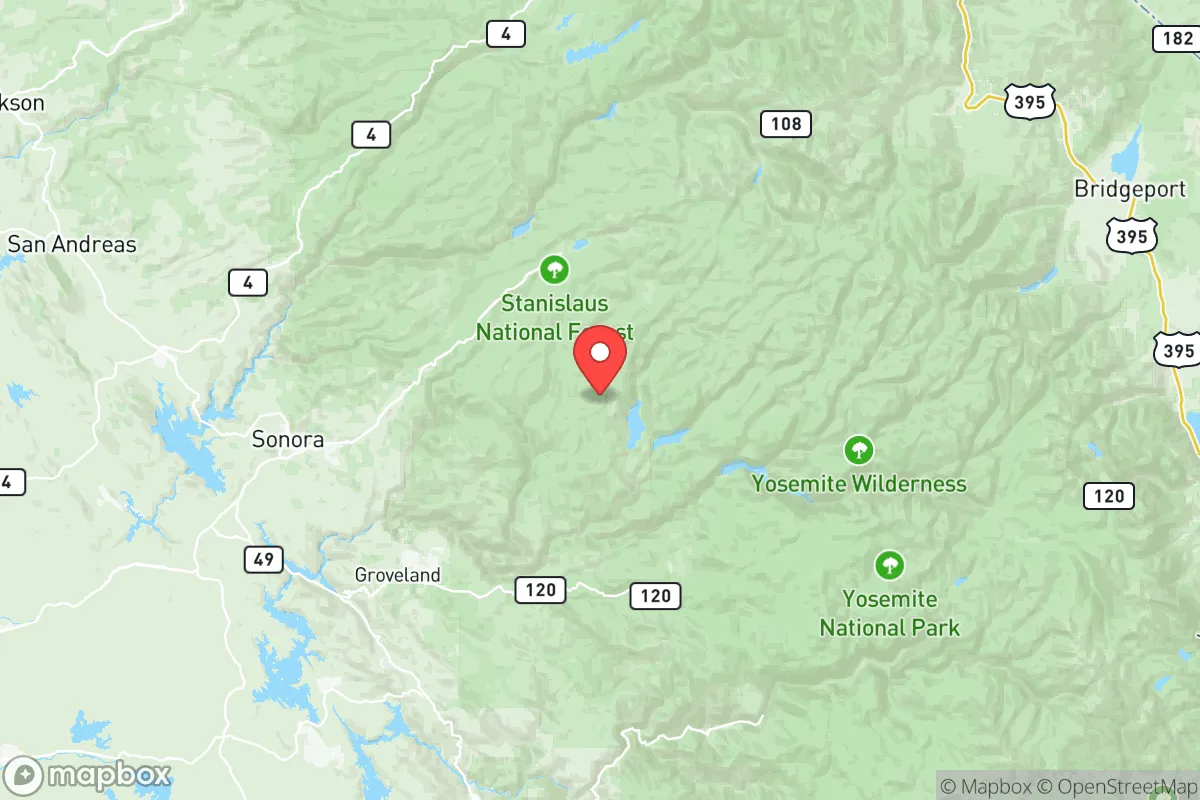
Photo: Wikipedia
Political ClimatePolitical Climate in Tuolumne County
Showing district-level results — no local-only data available.
Local Political AnalysisPolitical Analysis of Tuolumne County
Tuolumne County is a reliably Republican stronghold in the Sierra Nevada foothills, with a Cook Partisan Voting Index (PVI) of R+8—meaning it votes about eight points more Republican than the national average. In the 2024 presidential election, the county went for Donald Trump by a margin of roughly 57% to 40%, a spread that puts it well to the right of most of California. That's not a recent shift; the county has voted for the GOP candidate in every presidential race since 2000, and the GOP registration advantage has held steady at around 10-12 points for the past decade. If you're looking to buy a place where your conservative neighbors outnumber progressives by a clear majority, this is one of the few places in California where that's still the norm.
How it compares
Compared to California as a whole—where the Cook PVI is roughly D+13 and Democrats hold every statewide office—Tuolumne County is an outright outlier. The state's urban and coastal centers (San Francisco, Los Angeles, the Bay Area) are deeply blue, while Tuolumne is essentially the opposite. Inside the county itself, you'll find some variation: Sonora, the county seat and largest town, leans slightly more moderate than the rest—the precincts around downtown and near Columbia College sometimes break closer to 50-50, and in local elections a Democrat can win a council seat. Groveland, up the hill near Yosemite, is reliably red, fueled by a mix of retirees, tourism workers, and second-home owners from the Central Valley. Twain Harte and Mi-Wuk Village are solidly Republican, while Tuolumne City and Jamestown show more working-class swing tendencies, often splitting their tickets between GOP presidential candidates and moderate Democrats for local offices like supervisor or sheriff.
What this means for residents
For conservative residents, this is a comfortable place to live. The county government is consistently run by Republicans, which means lower property tax burdens relative to the state average, minimal new regulations on land use or building, and a sheriff's office that publicly backs the Second Amendment. You can buy a rifle at a local sporting goods store without hassle, and there aren't any state-level gun laws being enforced more aggressively than the letter of the law. For liberal residents, the situation is different: you'll find a smaller, but visible, progressive community centered in Sonora and parts of East Sonora. The local Democratic Party club is active and has some influence on school board races and environmental issues, but statewide policy pushes—like rent control, gas car bans, or sanctuary city rules—are generally unpopular here. The practical effect is that a liberal family won't feel unsafe, but they will feel politically outnumbered. Town hall meetings on things like marijuana dispensaries, short-term rentals, or forest management can get heated, with the majority view usually tilting to the right.
Culturally, the county's political lean shapes its most distinctive policy differences from the rest of California. There are no local rent control ordinances; the housing market is almost entirely unregulated beyond state building codes. Dispensaries for recreational cannabis have been allowed by the county but are limited in number—Sonora has only two, and many outlying towns have banned them outright. The county's approach to wildfire prevention leans heavily on aggressive logging and fuel breaks, a stance that often puts local officials at odds with state environmental agencies. And in terms of taxes, Tuolumne County has a lower-than-state-average sales tax rate (7.25% vs. up to 10.25% in the Bay Area) and property tax rates that hover around the 1% baseline set by Prop 13. For a state known for its progressive tax structure, this is a pocket of fiscal conservatism that feels largely self-contained—a place where the political culture matches the landscape: rural, independent, and quietly resistant to Sacramento's dominant influence.

State Political ClimatePolitical Climate in California
State Political AnalysisPolitical Environment in the State
California is, and has been for a generation, a reliably Democratic state at the federal level, with Democrats holding every statewide office and supermajorities in both legislative chambers. The state hasn't voted Republican in a presidential election since 1988, when it backed George H.W. Bush. However, the story inside the state is far more layered than the statewide numbers suggest. The Democratic dominance is built on massive margins in the coastal metropolitan areas, while vast swaths of the interior — including the Central Valley, the Inland Empire, and most of the far north — are deeply conservative, creating one of the sharpest urban-rural political divides in the nation. Over the last 10-20 years, the state has moved left on social and environmental policy, but recent trends show a modest rightward shift among Latino and working-class voters, particularly in the Central Valley, creating a more complex political landscape than the simple "deep blue" label implies.
Urban vs. rural divide
The political map of California is a study in geographic polarization. The coastal metros — Los Angeles, San Francisco, Oakland, San Diego, and San Jose — drive the state’s Democratic lean. These areas are home to the state's tech industry, entertainment sector, and large unionized public-sector workforces, and they consistently deliver margins of 60-80% for Democrats. In contrast, the Central Valley, from Bakersfield north through Fresno and Modesto, is reliably red; Kern County, for instance, voted +27 points for Trump in 2020. The northern interior counties — Shasta, Butte, and Tehama — are among the most conservative in the state, with some precincts voting 70%+ Republican. What's shifting is the Inland Empire (Riverside and San Bernardino counties), historically more purple, which has been trending right as new residents flee coastal costs. Orange County, once a Republican stronghold, flipped to Democratic in 2018 and 2020, but its suburban cities like Huntington Beach and Yorba Linda remain conservative bastions, with Huntington Beach passing a local voter-ID measure in 2024.
Policy environment
California operates under a framework that is distinctly high-tax, high-regulation, and progressive on social policy. The state has a progressive income tax with top marginal rates above 13% and a state sales tax that can exceed 10% in some cities when local add-ons are included. Property taxes are famously capped by Proposition 13 (1978), which limits annual increases to 2% and reassessment to sale only, meaning longtime owners pay far less than newcomers — a major equity issue for transplants. The regulatory posture is aggressive: the California Environmental Quality Act (CEQA) is frequently used to block housing and energy projects, and the state Air Resources Board sets some of the nation's strictest emissions rules. Education policy is state-dominated, with a powerful teachers' union, declining test scores relative to national averages, and a school funding formula that directs more money to low-income districts but does little to address structural inefficiencies. Healthcare is heavily regulated; the state operates its own insurance exchange (Covered California) and has expanded Medicaid to all low-income adults regardless of immigration status. Election laws are among the most permissive in the country — universal mail-in ballots, same-day registration, and no voter ID requirement — which Republican-leaning voters often cite as a concern regarding security, while Democrats argue it improves access.
Recent policy direction
Over the last five years, California has continued to push left on several fronts. On gun and self-defense law, the state has some of the nation's strictest regulations: an "assault weapon" ban, a 10-day waiting period, universal background checks, and a "may-issue" concealed carry regime that was struck down in 2024 by a federal appeals court in Renna v. Bonta, prompting the state to adopt a new, still-restrictive permitting system. Parental and education rights have been a flashpoint: AB 1955 (2024) prevents school districts from requiring teachers to notify parents if a child changes their gender identity, prompting backlash and several local school boards to pass parental-notification policies anyway. Freedom of speech has been tested by state laws against "hateful conduct" at public universities (AB 2011) and efforts to regulate online speech, though federal First Amendment protections remain strong. Privacy and surveillance: the California Consumer Privacy Act (CCPA) and its 2020 expansion (CPRA) give residents significant control over personal data, among the strongest in the nation. Medical and bodily autonomy is fully protected for abortion and gender-affirming care, with the state acting as a sanctuary for patients from states with bans — a 2022 law (SB 1147) protects providers from out-of-state legal action. Property rights remain constrained by CEQA and rent control laws (the Costa-Hawkins Act was partially repealed in 2024, allowing more local rent control), but a 2025 bill (SB 423) expedites housing approvals in cities that fail to meet building targets. Taxation has seen no major cuts; a 2024 ballot measure to raise the corporate tax rate failed, but the state budget remains structurally dependent on high-income earners and capital gains. Voting access expanded further with same-day registration and automatic voter registration at the DMV, while a 2023 law (AB 544) prohibits local voter ID requirements, preempting Huntington Beach's recent measure.
Civil unrest & political movements
California has a long history of political activism, both left and right. The 2020 George Floyd protests were some of the largest and most destructive in the nation, particularly in Los Angeles and Oakland, with looting and property damage leading to a significant public safety backlash in moderate suburbs. Homeless encampments and related fires have become a persistent source of low-grade civil conflict, especially in San Francisco and Los Angeles, where "quality of life" crimes have eroded public confidence. The sanctuary state law (SB 54, 2017) limits local law enforcement cooperation with federal immigration authorities, creating a constant tension with ICE; recent high-profile removals of illegal immigrants convicted of crimes in 2025 have reignited debate. On the right, the "California Exodus" narrative persists, though unevenly; rural counties have seen small but vocal secession movements (the "State of Jefferson" movement in the far north), while conservative voters have organized recall campaigns, including the successful 2021 recall of San Francisco District Attorney Chesa Boudin and the failed 2021 recall of Governor Gavin Newsom. Election integrity is a hot-button topic: Republican voters in rural counties have pressed for ballot drop-box monitoring and signature verification audits, while Democratic officials defend the mail-in system as highly secure. The 2024 presidential election saw isolated incidents of mailed ballot issues in Los Angeles County, but no widespread fraud was found.
Projection
Over the next 5-10 years, California's political trajectory is likely to be one of slow, grudging moderation on some economic issues, while remaining deeply progressive on social policy. The state's demographic trends — a decline in white non-college voters, a growing Asian American electorate that leans slightly right on economics, and a Latino population that is politically fractured between generations — suggest no near-term flip to Republican control. However, the continued exodus of middle- and high-income households to lower-cost states (Arizona, Texas, Nevada) is shifting the tax base and amplifying the power of public-sector unions and the very wealthy who can afford to stay. This could lead to a fiscal crisis by 2030 if out-migration continues, forcing the state to either cut services or raise taxes on the remaining base — likely driving further out-migration. For a new resident moving in now, expect that the state will remain a blue-state leader on climate, abortion, and immigration, but will face growing pressure to reform housing policy and public safety, potentially leading to more centrist governance at the local level in cities like San Diego and San Francisco. The state will not become red, but its internal political geography will become even more fractured, with coastal cities doubling down on progressive policies while inland counties and suburbs push back.
Bottom line for a new resident: If you lean conservative, you will find your political community in the Central Valley, Inland Empire, or far north, but you'll be outvoted on state policy, meaning higher taxes and regulations than you might prefer. If you lean liberal, the environment is broadly aligned with your values, but you'll pay for it through high costs and a bureaucracy that can frustrate even progressive goals. The practical reality for everyone is that California's political climate is less about day-to-day partisanship and more about navigating a state that is simultaneously ambitious and dysfunctional — a place where your city council and county supervisor often matter more than the occupant of the Governor's mansion. Plan your local jurisdiction carefully; a move from San Francisco to El Dorado Hills is effectively a move to a different country politically.
* Values derived from national, state, county, city and local statistics and may differ in a specific area. Last updated: 2026-09-14T05:28:19.000Z
Narrative content on this page is AI-generated and may contain mistakes. Verify any details that matter before acting on them.
ReloMaps may earn a commission from affiliate links at no extra cost to you.

