
Photo: Wikipedia
Demographics of Tuolumne County
Affluence Level in Tuolumne County
A middle-class area roughly in line with national averages across income, home values, education, and employment.
People of Tuolumne County
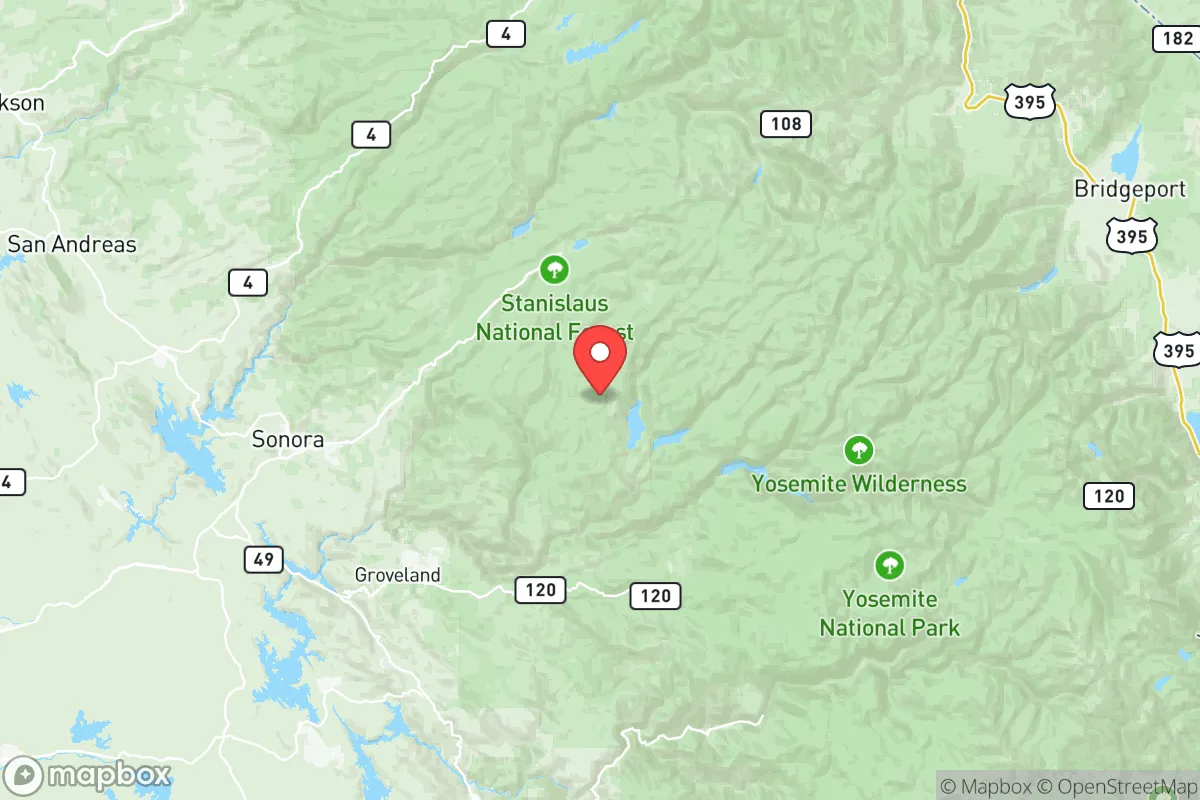
Today, the people of Tuolumne County, California, number roughly 54,873 and form a predominantly white (78.6%) and older population, with a foreign-born share of just 1.7%—one of the lowest in the state. The county’s identity is rooted in a Gold Rush past, a ranching and logging heritage, and a distinct sense of rural independence that still shapes its politics and culture. This is a region where small, historic towns like Sonora, Jamestown, and Twain Harte serve as the focal points of community life, and where the population density of 25 people per square mile means neighbors are few but often deeply connected by multi-generational family ties.
Settlement & growth (pre-1960)
The human history of Tuolumne County begins with the Sierra Miwok and Central Sierra Yokuts people, who lived along the Stanislaus and Tuolumne Rivers for thousands of years, pursuing acorns, salmon, and game across the low-elevation foothills and the high Sierra Nevada mountains. Their villages were scattered near present-day Tuolumne City (the town of Tuolumne) and Big Oak Flat. Spanish and Mexican colonization was minimal; the region was visited but never missionized due to the rugged terrain, leaving little direct Spanish settlement. The first non-Native immigrants were French and Basque trappers who wandered through in the 1820s–40s, but they left only names on maps, not permanent populations.
The defining moment for Tuolumne County’s population came in 1848–49: the California Gold Rush. Word spread globally that gold had been discovered at Coloma, and by 1850 a torrent of fortune-seekers had transformed the western Sierra foothills. Tuolumne County became one of the epicenters, with Sonora—formally founded in 1848 by a Mexican miner from Sonora, Mexico—growing to some 5,000 residents by 1854, the largest town in the county. The gold fields exploded with Cornish, Irish, German, Italian, and Chinese miners. The Cornish (Cousin Jacks) brought hard-rock mining expertise and settled in Columbia and Jamestown; the Chinese, who numbered roughly 4,000 by the 1860s, built elaborate networks along Chinese Camp (a genuine settlement name) and worked placer claims others had abandoned. The Italian population, many from northern Italy, concentrated in Sonora and Tuolumne City, where they established dairies, vineyards, and orchards after mining faded.
By the 1880s, the surface gold was exhausted, and the county’s population shrank by nearly half. The next wave came from timber and ranching. Mi-Wuk Village and Groveland grew as logging camps for the West Side Lumber Company, which employed Anglo-American, Italian, and Mexican workers. The 1920s–40s saw a small influx of Dust Bowl migrants (Okies) from Oklahoma and Arkansas, who found work in the lumber mills and apple orchards around Twain Harte. These were largely Protestant, poor, and conservative—a culture that persists in the county’s rural interior. By 1950, the population had stabilized at about 27,000, overwhelmingly white, and with a strong independent streak shaped by mining camp democracy and ranch life.
Modern era (post-1965)
The 1965 Hart-Cellar Act had a muted effect on Tuolumne County compared to urban California. The county’s foreign-born share (1.7%) is negligible, and immigration since 1965 has been mostly domestic. The largest demographic shift has been the retirement migration of Anglo-Americans from the San Francisco Bay Area and Los Angeles. Beginning in the 1970s and accelerating through the 2000s, retirees seeking lower housing costs, cleaner air, and a slower pace bought homes in planned communities like Copperopolis (a historic mining town revived as a golf-course community) and the newer subdivisions of Sonora’s east side. This wave has raised the median age from 38 in 1990 to nearly 49 today.
Hispanic population has grown steadily, from roughly 4% in 1990 to 13.2% today. This is not a recent immigrant wave (foreign-born share is barely 1.7%), but rather long-term natural increase and internal migration from the Central Valley. Sonora and Jamestown have the largest Hispanic concentrations, working in construction, hospitality, and agriculture. The East/Southeast Asian population (1.1%) and Indian (subcontinent) population (0.1%) are tiny and scattered, with no distinct enclave. Black residents (1.6%) are also thinly dispersed, mostly in Sonora and Columbia. The county remains heavily white and non-Hispanic white, but the white share has declined from 89% in 1990 to 78.6% today, with nearly all that loss going to Hispanic growth.
The cultural identity has sharpened around rural conservatism. Tuolumne County voted +29 points Republican in the 2024 presidential election, and local politics center on property rights, limited regulation, and opposition to land-use restrictions. The population is aging and low-growth; birth rates are below replacement, and the school-age population has dropped steadily since 2010. Young adults frequently leave for college and do not return, creating a demographic hole in the 20–35 age bracket.
The future
Demographic projections suggest Tuolumne County will continue to slow-grow or decline. The California Department of Finance forecasts a 1–3% population loss over the next decade due to an aging population and net out-migration of working-age adults. The Hispanic share will likely rise, possibly to 18–20% by 2040, driven by natural increase within the existing community and a trickle of arrivals from the Central Valley. The Asian and Black populations may increase slightly as housing costs in the Bay Area push some families inland, but they will remain under 5% each. The Indian-subcontinent population will probably stay tiny, under 1%.
New residential development is concentrated in Copperopolis, where a master-planned community with golf courses and low property taxes is attracting second-home buyers and telecommuters. Columbia and Jamestown are seeing some infill, but the county’s GIS shows limited developable land due to steep terrain, national forest (3/4 of the county’s land is federal), and wildfire risk. The cultural identity will likely remain anchored by the Gold Rush mythology, ranching, and a libertarian-leaning independence that rejects the demographic and political trends of coastal California. For a newcomer, this means joining a community that is stable, outdoors-oriented, and neighborly but also resistant to rapid change. The region is not heading toward diversity in any meaningful sense; it is becoming slightly more Hispanic, slightly more suburban at its edges, but fundamentally remaining a white, conservative, rural enclave with a slow-motion aging process.
For someone moving to Tuolumne County in 2026, the trade-off is clear: you get a historic, scenic, low-crime setting with strong community ties and minimal traffic, but you accept a population that is older, less diverse, and largely closed to dramatic demographic change. The county is a living museum of Gold Rush settlement and 20th-century timber life, gradually making room for a few more Hispanic families and a sprinkling of telecommuters, but resisting the cosmopolitan currents that have reshaped other parts of California.

* Values derived from national, state, county, city and local statistics and may differ in a specific area. Last updated: 2026-09-14T05:28:19.000Z
Narrative content on this page is AI-generated and may contain mistakes. Verify any details that matter before acting on them.
ReloMaps may earn a commission from affiliate links at no extra cost to you.

