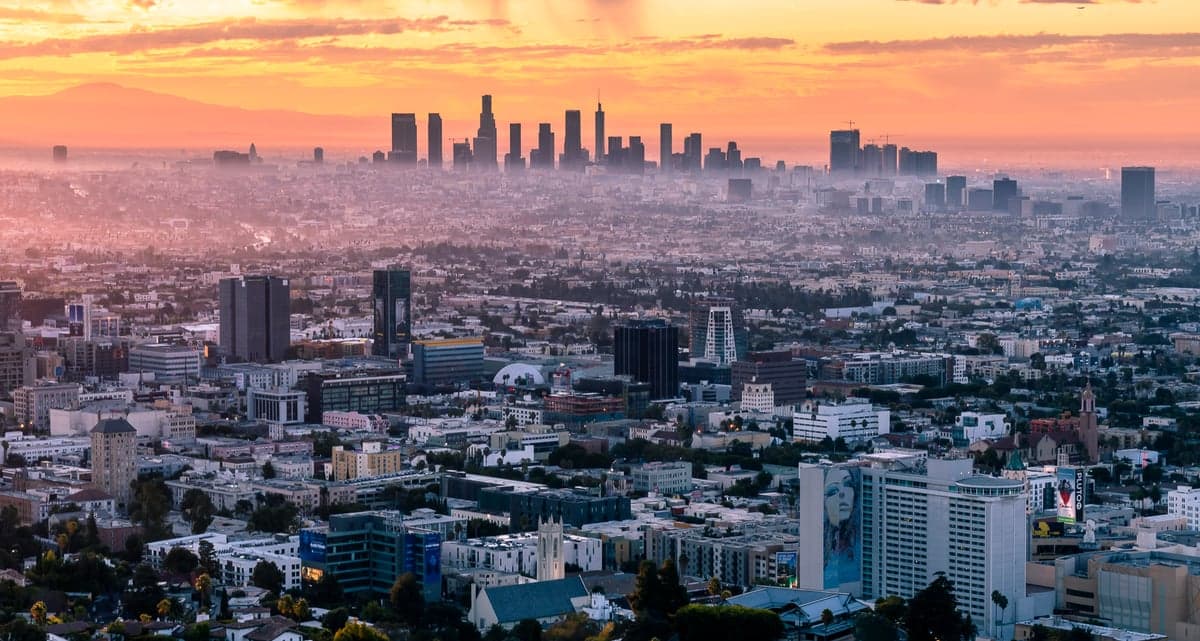
Photo: Wikipedia
Political ClimatePolitical Climate in Los Angeles County
Showing district-level results — no local-only data available.
Local Political AnalysisPolitical Analysis of Los Angeles County
Los Angeles County is one of the most reliably Democratic strongholds in the United States, carrying a Cook Partisan Voting Index (PVI) of D+22. That means the county votes about 22 points more Democratic than the national average. To put that in perspective, the state of California as a whole sits at D+12, so LA County is a full ten points bluer than the state it anchors. The county hasn't voted for a Republican presidential candidate since 1988, and the margin has only widened since then. If you're looking at the political trajectory, it's not shifting rightward — it's consolidating its leftward tilt, driven by growing populations in deeply blue urban cores and the inland suburbs.
How it compares to California
The D+22 vs. D+12 gap is significant. While California is already a solidly blue state, LA County is the engine that makes it so. The county accounts for roughly a quarter of the state's population but delivers a disproportionate share of Democratic votes. For example, in the 2020 presidential election, Joe Biden won LA County by over 1.6 million votes, while his statewide margin was about 5 million. That means roughly one-third of California's Democratic margin came from LA County alone. The rest of the state — including the Central Valley, inland Empire, and parts of Orange County — is more competitive or even leans red. So when you hear about California's progressive policies, you're really hearing about the political will generated in LA County. The state's D+12 PVI is pulled leftward by this county's D+22 weight.
What this means for residents
For liberal residents, living in LA County means your vote is rarely in doubt — you're in a deep-blue bubble where progressive policies on housing, homelessness, and environmental regulation are the norm. The county government, led by a five-member Board of Supervisors, is uniformly Democratic, and the city councils of major cities like Los Angeles, Long Beach, and Santa Monica are similarly aligned. For conservative residents, it can feel like swimming upstream. There are pockets of red, but they're shrinking. The Santa Clarita Valley (Santa Clarita, Valencia) and parts of the Antelope Valley (Lancaster, Palmdale) have historically leaned more conservative, but even those areas are trending purple. In the 2022 gubernatorial recall, Lancaster voted 55% to keep Gavin Newsom, a sign that the old Republican strongholds are fading. Swing precincts are rare, but you'll find them in the San Fernando Valley neighborhoods like Chatsworth and Northridge, where moderate voters sometimes split tickets. For both sides, the practical effect is that local elections are often decided in the Democratic primary, not the general election.
One cultural distinction that sets LA County apart from the rest of California is its sheer scale and diversity. The county is home to over 80 cities, from the ultra-liberal enclave of West Hollywood to the more moderate, family-oriented suburbs of Torrance and Glendale. Policy-wise, LA County is often a testbed for statewide initiatives. The county's Measure H sales tax for homeless services, passed in 2017, preceded similar statewide efforts. On the flip side, the county's rent control and tenant protection ordinances are stricter than state law, creating a patchwork that landlords and tenants navigate carefully. The political reality here is that the county's leftward tilt isn't just about voting — it shapes daily life through zoning laws, policing policies, and public transit investments. Whether you're a liberal who appreciates the progressive safety net or a conservative who feels the squeeze of higher taxes and regulations, LA County's politics are the backdrop to every commute, every rent check, and every local election.

State Political ClimatePolitical Climate in California
State Political AnalysisPolitical Environment in the State
California is a solidly Democratic state with a Cook PVI of D+12, meaning it votes about 12 points more Democratic than the national average in presidential elections. Over the past 20 years, the state has shifted from a competitive purple state—where Republicans like Arnold Schwarzenegger could win statewide—to a deep blue stronghold, driven largely by the massive population and economic weight of the coastal metros. That said, the state is far from monolithic: vast inland regions vote as Republican as any place in the country, and the real political story is the growing tension between the dominant coastal coalition and the increasingly frustrated conservative minority.
Urban vs. rural divide
The political map of California is essentially a battle between the densely populated coast and the sprawling interior. The San Francisco Bay Area and Los Angeles County are the Democratic engine rooms, delivering margins of 70-80% for Democratic candidates. San Diego and Sacramento also lean blue, though more moderately. In contrast, the Central Valley and inland mountain regions are deeply red: Bakersfield (Kern County) and Fresno are conservative strongholds, while rural counties like Modoc and Lassen in the far north vote Republican by 30-40 point margins. The Inland Empire (Riverside and San Bernardino counties) is a genuine battleground within the state—once reliably red, it has been trending purple as suburban voters shift left, though it still elects Republican local officials in many districts. The divide isn't just urban vs. rural; it's also coastal vs. interior, with the coast's economic and cultural dominance ensuring the state's overall blue tilt.
Policy environment
California's policy environment is defined by high taxes, heavy regulation, and expansive government services. The state has a progressive income tax with rates up to 13.3%, one of the highest in the nation, and a state sales tax that can exceed 10% in some cities. Property taxes are capped at 1% of assessed value under Proposition 13, but reassessment upon sale means newer homeowners often pay far more than long-term residents. The regulatory posture is aggressive: California sets its own vehicle emissions standards, has some of the strictest environmental laws in the country, and mandates employer-provided health insurance and paid family leave. Education policy is dominated by the California Teachers Association, a powerful union, and the state spends above the national average per pupil, though outcomes vary widely. Election laws are among the most liberal: universal mail-in voting, same-day registration, and no-excuse absentee voting are all standard. For a conservative relocator, the tax and regulatory burden is the biggest shock; for a liberal one, the availability of services and protections is a major draw.
Recent policy direction
Over the past five years, California has moved decisively left on a range of issues. On gun and self-defense law, the state has passed some of the nation's strictest measures: a 2023 law effectively bans the carrying of firearms in most public places, and the state's assault weapons ban and magazine capacity limits remain among the toughest. Parental and education rights have become a flashpoint: a 2024 law prohibits school districts from requiring parental notification when a child changes their gender identity, sparking fierce debate. On speech and privacy, the state has strengthened consumer data protections under the California Privacy Rights Act (CPRA), but also expanded hate crime statutes and anti-discrimination laws in ways critics argue chill speech. Medical and bodily autonomy is fully protected: California is a sanctuary for abortion access and gender-affirming care, with laws shielding providers from out-of-state lawsuits. Property rights are constrained by rent control expansion (the 2019 Costa-Hawkins repeal) and strict zoning laws, though recent legislation has begun to preempt local single-family zoning to encourage density. Taxation continues to trend upward: a 2024 ballot measure proposed raising the corporate tax rate, though it failed. Voting and ballot access has been made easier, with automatic voter registration and expanded mail-in voting now permanent. For a conservative, the direction is unmistakably toward more state control; for a liberal, it's a model of progressive governance.
Civil unrest & political movements
California has a long history of political activism, and recent years have seen both left- and right-wing movements flare. The 2020 George Floyd protests were among the largest and most destructive in the state, particularly in Los Angeles and Oakland, where property damage and looting were widespread. On the right, the "Recall Newsom" movement in 2021 gathered over 1.6 million signatures, though the governor easily survived the election. Immigration politics remain a central tension: California is a "sanctuary state" under SB 54, which limits local law enforcement cooperation with federal immigration authorities. This has led to clashes with the Trump administration and ongoing friction in border-adjacent areas like San Diego and El Centro. Secession rhetoric—the "Calexit" movement—has faded since its peak in 2016, but a small but vocal minority still advocates for independence. Election integrity controversies have been less pronounced than in some states, though Republican activists have raised concerns about mail-in ballot security, particularly in Orange County, which flipped from red to blue in 2018. A new resident would notice the ubiquity of political signage, the frequency of local protests, and the general intensity of political engagement, especially in coastal cities.
Projection
Over the next 5-10 years, California's Democratic dominance is likely to persist, but the margin may narrow slightly. Demographic trends are mixed: the state's Latino population, historically a key Democratic constituency, is becoming more politically diverse, with younger Latino voters showing less partisan loyalty. Meanwhile, the state continues to lose net domestic migrants to Texas, Arizona, and other states, many of whom are moderate or conservative-leaning. However, the people moving in—largely from abroad and from other blue states—tend to reinforce the Democratic coalition. The inland areas will likely remain red, but their political influence is diluted by the coastal population's sheer size. A relocator moving in now should expect the policy environment to remain left-leaning, with continued expansion of social services, environmental regulation, and gun control. The wild card is housing: if the state's affordability crisis deepens, it could trigger a political realignment, as younger voters and working-class families become more focused on economic issues. For now, the trajectory is steady blue, with occasional Republican wins in local races but no serious threat to Democratic control of the state government.
For a new resident, the bottom line is this: if you align with progressive values on social issues and don't mind high taxes and heavy regulation, California offers a supportive environment with robust public services. If you're conservative, you'll find like-minded communities in the Central Valley, inland suburbs, and rural north, but you'll be swimming against the current on state policy. The state's political climate is not for everyone, but it is transparent and predictable—what you see is what you get, and it's unlikely to change dramatically anytime soon.
* Values derived from national, state, county, city and local statistics and may differ in a specific area. Last updated: 2026-07-17T02:38:06.000Z
Narrative content on this page is AI-generated and may contain mistakes. Verify any details that matter before acting on them.
ReloMaps may earn a commission from affiliate links at no extra cost to you.

