Photo: Wikipedia
Demographics of Los Angeles County
Affluence Level in Los Angeles County
An upper-middle-class area. Household wealth, education levels, and homeownership run ahead of national benchmarks.
People of Los Angeles County
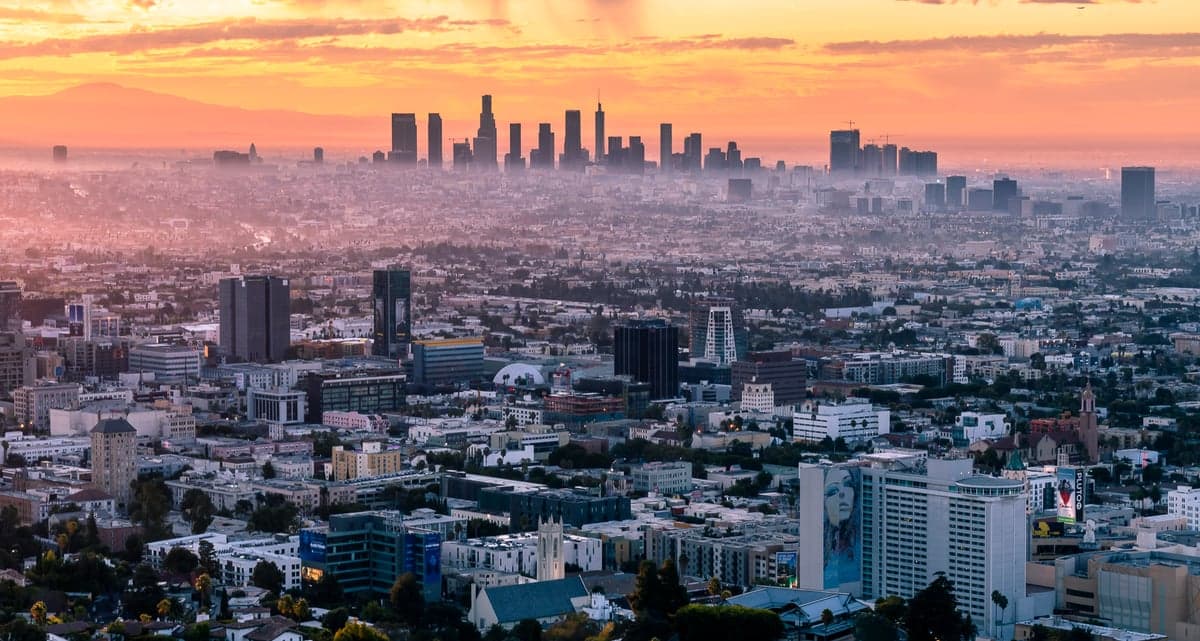
Los Angeles County is home to 9.85 million people, making it the most populous county in the United States, a place where no single ethnic group holds a majority. The county is defined by its extreme diversity: 48.3% of residents identify as Hispanic, 25.2% as White, 13.6% as East and Southeast Asian, 7.5% as Black, and 1.3% as Indian from the subcontinent, with 15.1% foreign-born. This is a region shaped by a century of continuous migration, from the Dust Bowl to the Pacific Rim, creating a dense, polyglot urban landscape that ranges from the high-rises of downtown Los Angeles to the suburban sprawl of the San Fernando Valley and the coastal enclaves of Santa Monica and Long Beach.
Settlement & growth (pre-1960)
Before European contact, the area now known as Los Angeles County was home to the Tongva people, who lived in over 100 villages across the Los Angeles Basin and the Channel Islands, including settlements near present-day San Pedro and Santa Monica. The Spanish arrived in 1769, establishing Mission San Gabriel Arcángel in 1771 and the pueblo of Los Angeles in 1781, recruiting settlers from Mexico. The region remained sparsely populated under Spanish and then Mexican rule, centered on vast rancho land grants like Rancho San Pedro and Rancho Santa Anita.
The U.S. annexation of California in 1848 and the subsequent Gold Rush triggered the first major Anglo-American migration. By the 1870s, the arrival of the transcontinental railroad connected Los Angeles to the rest of the country, and a land boom in the 1880s drew Midwestern farmers and speculators. Pasadena and Glendale became destinations for white Protestant families from the Midwest seeking a mild climate and affordable land. The discovery of oil in the 1890s at places like Signal Hill brought a wave of workers from the East Coast and the South.
The 20th century saw explosive growth. The film industry relocated from New York to Hollywood in the 1910s, attracting actors, writers, and technicians from across the country and Europe. During the Great Depression, the Dust Bowl drove hundreds of thousands of "Okies" and "Arkies" from Oklahoma, Texas, and Arkansas to the San Joaquin Valley and into Los Angeles County, settling in Bakersfield (Kern County) and working-class neighborhoods of South Los Angeles and Pomona. World War II transformed the county into a manufacturing hub for aircraft and ships, drawing Black workers from the South during the Second Great Migration to neighborhoods like Watts and Compton. By 1960, Los Angeles County had grown to over 6 million people, a majority-white population with significant Black and Mexican-American minorities.
Modern era (post-1965)
The Immigration and Nationality Act of 1965 fundamentally reshaped Los Angeles County. The elimination of national-origin quotas opened the door to mass immigration from Asia and Latin America. The county's Hispanic population surged from roughly 10% in 1960 to 48.3% today, driven by continuous migration from Mexico and Central America. East Los Angeles became the historic heart of the Mexican-American community, while newer immigrants from Guatemala and El Salvador concentrated in Koreatown and the San Fernando Valley.
East and Southeast Asian immigration accelerated after 1965. The Chinese-American community, long centered in Chinatown, expanded into the San Gabriel Valley, where cities like Monterey Park became the first suburban Chinatown in the U.S. Korean immigrants established Koreatown near downtown Los Angeles, now one of the largest Korean enclaves outside of Asia. Vietnamese refugees arrived after 1975, settling in Westminster (Orange County) and San Jose (Santa Clara County), but also forming communities in Long Beach, home to the largest Cambodian population in the United States. Filipino immigrants, arriving steadily since the 1970s, concentrated in Eagle Rock and Cerritos. The Indian-subcontinent population, though smaller at 1.3%, grew rapidly after 1990, with professionals settling in Artesia and Cerritos.
Domestic migration also reshaped the county. The Rust Belt decline sent white and Black families from the Midwest and Northeast to Southern California through the 1970s and 1980s, though that flow has reversed in recent decades. Suburbanization pushed middle-class families outward: white flight from South Los Angeles and Compton accelerated in the 1970s, moving to Santa Clarita, Lancaster, and Palmdale in the Antelope Valley. Black families also suburbanized, moving to Lancaster and Palmdale and to Inland Empire cities like Riverside and San Bernardino. The county's white population share fell from over 70% in 1970 to 25.2% today, while the Asian and Hispanic shares rose.
The future
Los Angeles County is projected to become even more diverse. The Hispanic share is expected to continue growing, though at a slower pace, as immigration from Mexico has leveled off and birth rates among Hispanic residents have declined. The East and Southeast Asian population will likely grow modestly, driven by continued immigration from China, the Philippines, and Vietnam, and by the natural growth of established communities in the San Gabriel Valley and Long Beach. The Indian-subcontinent population, while small, is growing rapidly from a low base, concentrated in professional-class suburbs like Artesia and Cerritos.
The white population is aging and declining in absolute numbers, as younger white residents move to lower-cost states like Texas and Arizona. The Black population has been slowly declining for decades, as middle-class families leave for the Inland Empire, the South, and the Atlanta metro area. The foreign-born share, currently 15.1%, may stabilize or decline slightly as immigration enforcement tightens and as second-generation children of immigrants age into the native-born population.
Geographically, growth is shifting outward. The core of Los Angeles County — the city of Los Angeles itself — is near build-out, with population growth concentrated in the Antelope Valley (Lancaster, Palmdale) and the Santa Clarita Valley. These areas are attracting a mix of Hispanic and white families priced out of coastal neighborhoods. The county's cultural identity is becoming less "Anglo" and more pan-Latin and pan-Asian, with Spanish and Mandarin increasingly heard in public spaces alongside English.
Los Angeles County is becoming a majority-minority, globally connected metropolis where no single group dominates. For someone moving in now, the county offers a level of ethnic and cultural diversity unmatched in the United States, but also the challenges of high housing costs, traffic congestion, and a rapidly shifting demographic landscape. The future is one of continued diversification, suburban expansion, and the slow decline of the county's historic white and Black populations, replaced by a younger, more immigrant-driven mix of Hispanic and Asian communities.

* Values derived from national, state, county, city and local statistics and may differ in a specific area. Last updated: 2026-07-17T02:38:06.000Z
Narrative content on this page is AI-generated and may contain mistakes. Verify any details that matter before acting on them.
ReloMaps may earn a commission from affiliate links at no extra cost to you.

