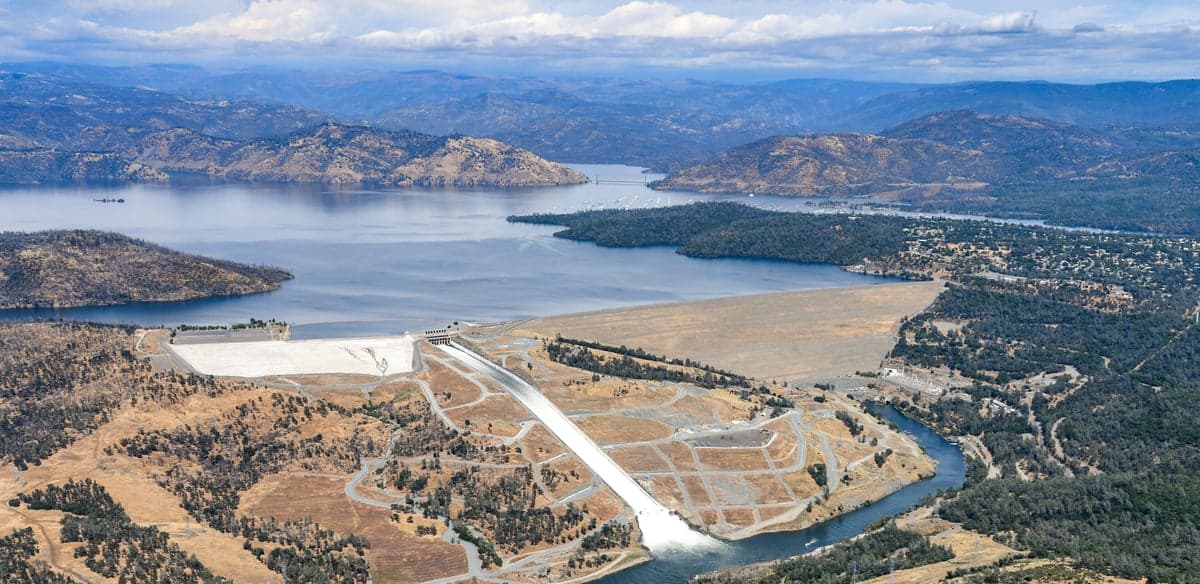
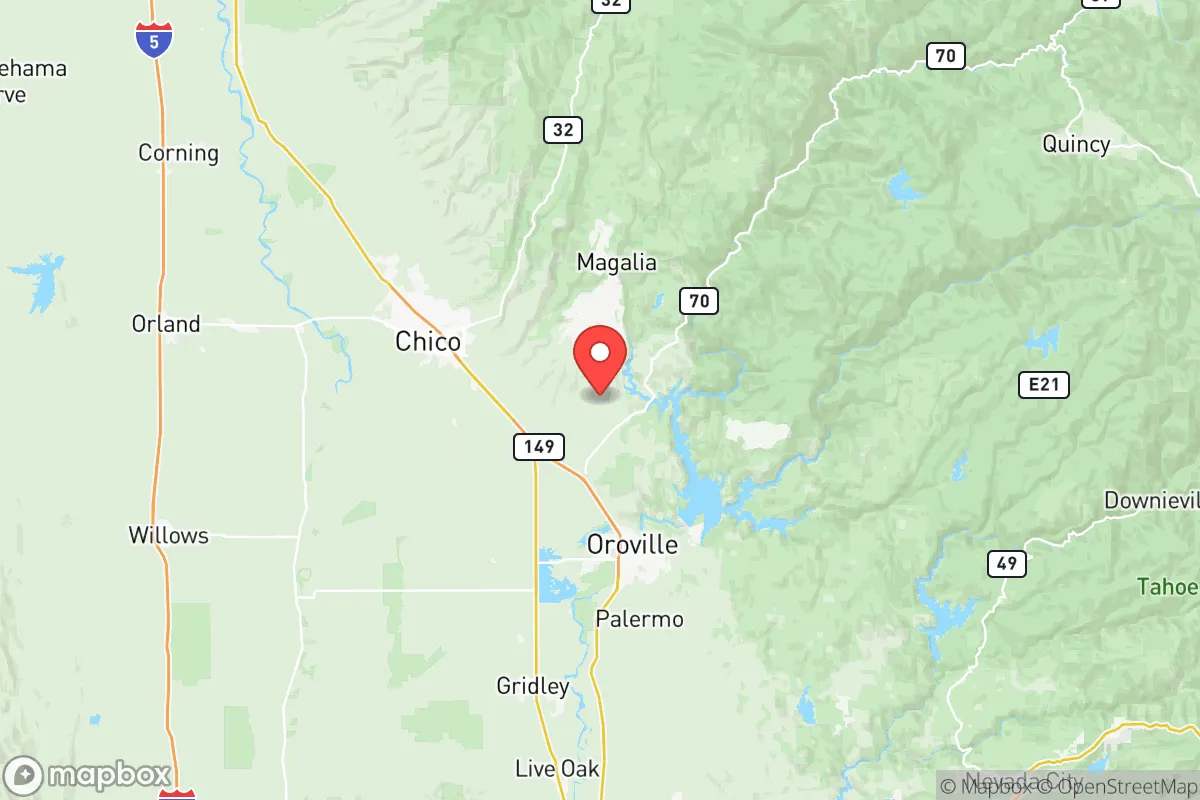
Photo: Wikipedia
Demographics of Butte County
Affluence Level in Butte County
A middle-class area roughly in line with national averages across income, home values, education, and employment.
People of Butte County
Butte County, California, is home to roughly 209,470 residents, a population shaped by successive waves of Gold Rush fortune-seekers, agricultural laborers, and Californians seeking affordable housing. The county’s identity is rooted in its historic role as a mining and farming hub, with a population that is 66.6% White, 19.5% Hispanic, 4.9% East/Southeast Asian, and 1.7% Black, alongside a notably low foreign-born share of just 3.5%. Today, the county’s character blends a conservative-leaning rural and small-town ethos with the liberal influence of Chico’s university community, creating a distinctive cultural tension that defines daily life.
Settlement & growth (pre-1960)
Long before European contact, the land now called Butte County was home to the Mechoopda Maidu people, whose villages dotted the Sacramento Valley floor and the foothills of the Sierra Nevada. The Maidu lived in semi-permanent settlements along Butte Creek and the Feather River, relying on acorns, salmon, and game. Spanish and Mexican colonization had minimal direct impact here—the area lay far from the coastal missions—but the 1848 discovery of gold at Sutter’s Mill transformed the region overnight.
The California Gold Rush of 1849 brought the first major wave of non-Native settlers. Prospectors poured into the foothills, founding boomtowns like Oroville (established 1849) and Magalia (1850) as mining camps. By the 1850s, Chinese immigrants—numbering in the thousands—arrived to work abandoned claims and build the area’s early infrastructure, leaving a lasting mark in Oroville’s historic Chinatown. The 1860s saw the arrival of European immigrants, particularly Irish and German farmers, who took up land grants in the valley around Chico and Gridley, shifting the economy from mining to wheat and later fruit orchards.
The completion of the California and Oregon Railroad through Butte County in the 1870s spurred agricultural expansion. By the 1880s, Japanese and Italian laborers were recruited to work the expanding rice fields and fruit farms around Biggs and Durham. The Dust Bowl of the 1930s drove a wave of white “Okie” and “Arkie” migrants from the Southern Plains into the county, settling in agricultural communities like Thermalito and Palermo, where they worked as farm laborers and later as cannery workers. This group, alongside earlier Anglo settlers, cemented the county’s conservative, rural character. By 1950, Butte County’s population had reached roughly 64,000, overwhelmingly white and native-born, with small but established Japanese and Chinese communities concentrated in Oroville and Chico.
Modern era (post-1965)
The 1965 Hart-Cellar Act had a muted effect on Butte County compared to coastal California, given its already low foreign-born share. However, the 1970s and 1980s brought a new domestic migration: retirees and families from the San Francisco Bay Area and Los Angeles, seeking cheaper land and a slower pace. This influx concentrated in Paradise, a foothill town that grew from 5,000 residents in 1970 to over 26,000 by 2000, and in the suburban sprawl south of Chico. The 2018 Camp Fire destroyed Paradise and much of the surrounding area, displacing over 50,000 people and reshaping the county’s demographic map. Many survivors relocated to Chico and Oroville, accelerating a trend of urbanization.
Hispanic population growth has been the most significant demographic shift since 1990, rising from roughly 8% to 19.5% today. This wave is driven by Mexican and Central American immigrants and their U.S.-born children, drawn to agricultural work in the rice, almond, and walnut orchards around Gridley, Biggs, and Richvale. Today, Hispanic residents are concentrated in these rural farming communities and in south Chico, where they form a visible and growing part of the labor force in construction, services, and agriculture.
The East/Southeast Asian population, now 4.9%, is a mix of longer-established Japanese American families (many of whom returned after WWII internment) and newer Hmong and Vietnamese communities, who arrived as refugees in the 1980s and 1990s. These groups are concentrated in Oroville and Chico, where they run small businesses and work in healthcare and manufacturing. The Black population remains small at 1.7%, with most living in Chico and Oroville, and is largely composed of families who moved from the Bay Area in the 1990s and 2000s for lower housing costs. The Indian subcontinent population is negligible at 0.4%, with no significant enclave.
Suburbanization has reshaped the county since 2000. Chico’s population has grown to over 100,000, with new subdivisions spreading east toward the foothills and south toward Durham. Oroville has seen slower growth, while the rural towns of Gridley and Biggs have remained stable, anchored by agriculture. The county’s college-educated share stands at 31.7%, driven largely by Chico State University, which brings a steady stream of younger, more liberal residents to the city.
The future
Butte County is projected to become slightly more diverse over the next 10–20 years, but the pace will be slow. The Hispanic share is expected to rise toward 25–28% by 2040, driven by higher birth rates and continued migration for agricultural work. The East/Southeast Asian population will likely grow modestly, as Hmong and Vietnamese families in Oroville and Chico see second-generation growth. The white population, while still the majority, will continue to age and shrink as younger white residents leave for coastal job markets.
The biggest wildcard is housing. The 2018 Camp Fire destroyed much of Paradise’s housing stock, and rebuilding has been slow. Many displaced residents have permanently relocated to Chico, increasing density and pushing development into previously rural areas like Cohasset and Forest Ranch. This urbanization is likely to continue, with Chico absorbing most new growth. The county’s cultural identity will remain a blend of conservative agricultural values and Chico’s liberal university influence, with the rural towns staying more traditional and the city becoming more diverse and politically mixed.
For someone moving to Butte County now, the region offers a relatively affordable, slower-paced alternative to coastal California, with a population that is stable, predominantly native-born, and increasingly Hispanic. The county is not becoming a melting pot in the style of the Bay Area, but it is slowly diversifying, with the most change concentrated in Chico and the agricultural towns of the valley floor. The foothills remain overwhelmingly white and older, while the valley is younger and more varied. The bottom line: Butte County is a place where the old California of farms and small towns is gradually giving way to a more suburban, slightly more diverse future, but the pace is measured, and the character remains distinctly Northern Californian.

* Values derived from national, state, county, city and local statistics and may differ in a specific area. Last updated: 2026-11-08T20:45:11.000Z
Narrative content on this page is AI-generated and may contain mistakes. Verify any details that matter before acting on them.
ReloMaps may earn a commission from affiliate links at no extra cost to you.

