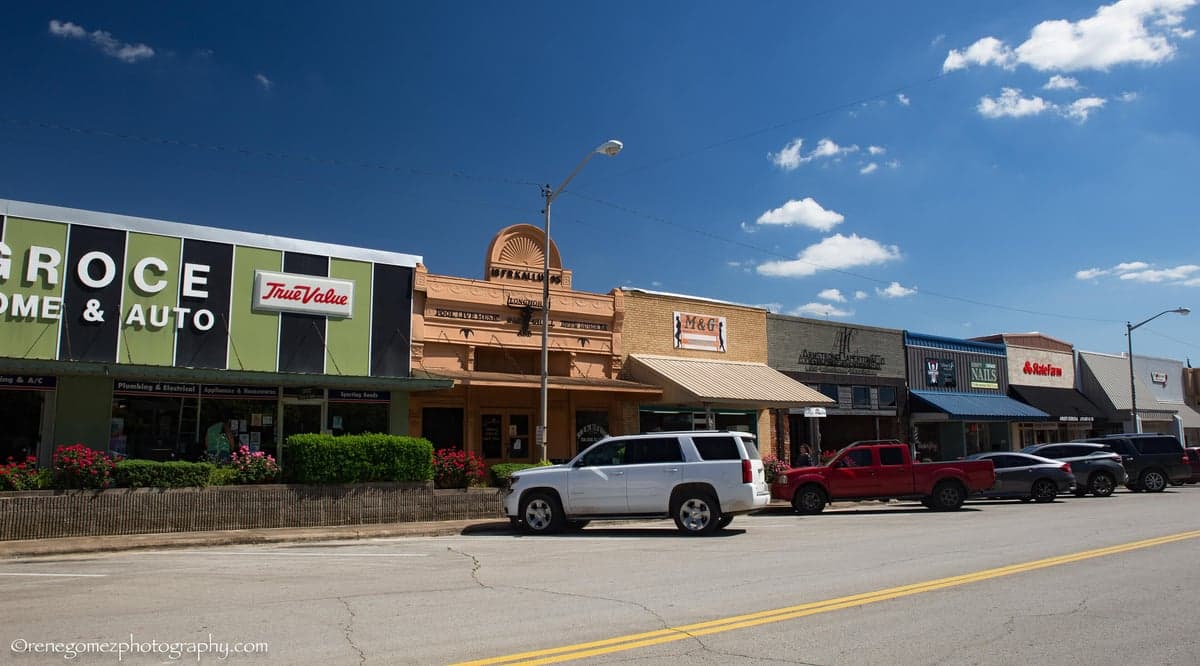
Photo: Wikipedia
Political ClimatePolitical Climate in Caldwell, TX
District shown is the primary district for this city’s centroid. Cities may span multiple districts.
Local Political AnalysisPolitical Analysis of Caldwell, TX
Caldwell sits in a solidly conservative corner of Texas, and that’s not changing anytime soon. The town itself, the seat of Burleson County, anchors an area with a Cook Political Report PVI of R+12, meaning Republicans hold a structural advantage of about 12 points over the national average. In practice, that puts Caldwell to the right of the state as a whole, though Texas is already a red state; the real story here is how the local brand of conservatism differs from the fast-growing suburbs of Austin or Houston, and how that shapes daily life for everyone who calls the Brazos Valley home.
How it compares
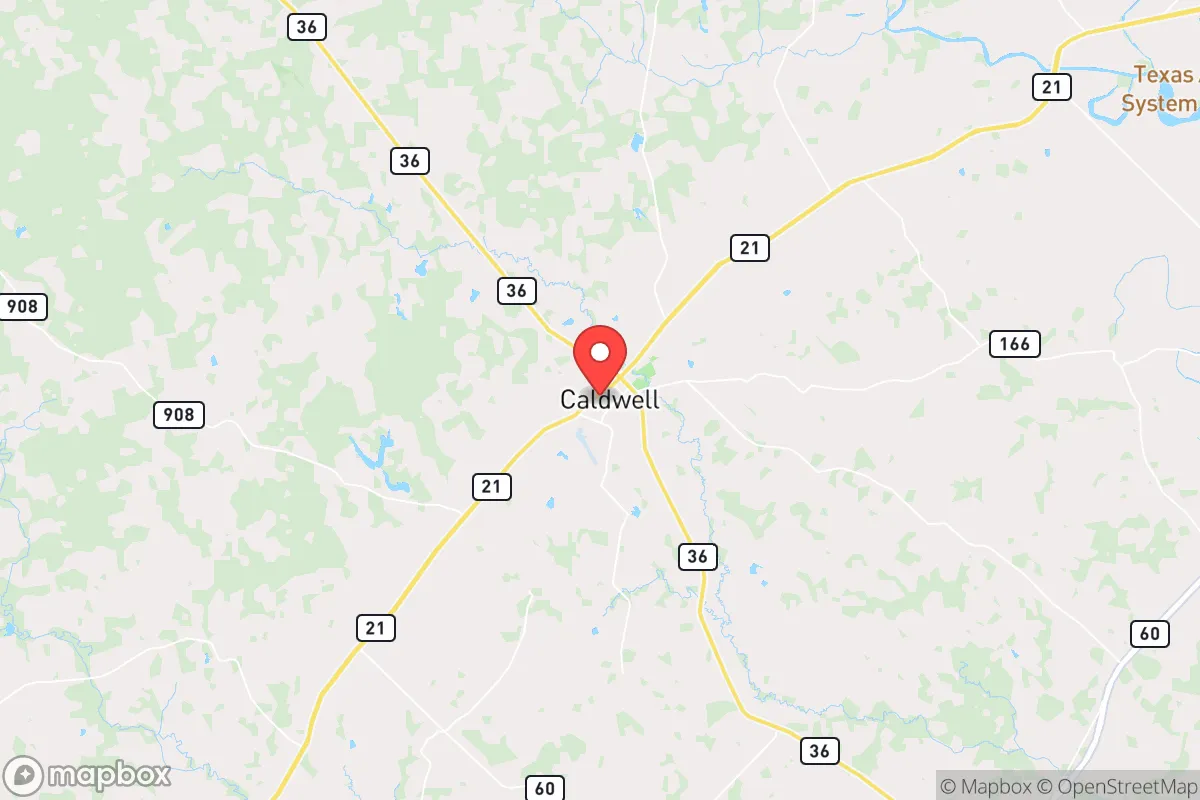
If you’re coming from somewhere like Austin, the contrast is stark. Caldwell is roughly 40 miles southeast of the state capital, but politically it might as well be a different country. Travis County votes blue by wide margins, while Burleson County reliably goes red — often by 30 to 40 points in statewide races. The R+12 PVI is a county-wide average, but the town of Caldwell itself leans even more conservative than the county’s eastern fringes, which have a bit more of a rural, independent streak. Nearby cities like Bryan and College Station, about 25 miles west, are more politically mixed thanks to Texas A&M’s student population and faculty, but they still lean Republican overall. The real political contrast is with the I-35 corridor: places like Georgetown or Round Rock have become purple-ish suburbs, while Caldwell has stayed firmly in the old-school, agriculture-and-oil Texas mold.
What this means for residents
For conservative residents, the practical reality is that local government, the school board, and the county commissioners’ court are all reliably in friendly hands. Republican primaries are where the real decisions get made, since the general election is rarely competitive. That means issues like property taxes, rural road funding, and Second Amendment matters are debated within a fairly narrow ideological range. For liberal residents, the situation is more about finding your people than changing the outcome. There’s a small but visible Democratic presence in Caldwell, often clustered around the county courthouse and the local school system, but you’re not going to see many yard signs for statewide Democrats. The honest truth is that a progressive in Caldwell learns to pick their battles — local races for constable or justice of the peace are often decided on personality and reputation rather than party label, so there’s room to be effective even if you’re in the minority.
What daily life is like for families
For families, the political climate translates into a very specific kind of community culture. Church attendance is high, the local VFW and American Legion posts are active, and the annual Burleson County Fair is a bigger deal than any political rally. School board meetings tend to draw crowds when there’s a controversy over curriculum or library books, but most of the time, the focus is on funding for the aging school buildings and teacher pay. The trajectory is interesting, though — Caldwell is starting to see some spillover from the Austin exurbs, with new subdivisions going up on the edge of town. That’s bringing in younger families who may not be as deeply rooted in the local political culture, and it’s a safe bet that the county will shift a few points left over the next decade, even if it never becomes competitive. The long-term outlook is for a slow, subtle diversification of the political landscape, but the R+12 baseline means the fundamental character of the area will stay conservative for the foreseeable future.

State Political ClimatePolitical Climate in Texas
State Political AnalysisPolitical Environment in the State
Texas is a solidly Republican state at the statewide level, but it’s not the monolith national headlines often suggest. The GOP has won every statewide office since 1994, and Donald Trump carried the state by 5.6 points in 2024, a slight improvement over his 5.5-point margin in 2020. However, the last two decades have seen a slow but steady demographic shift: the booming suburbs of Dallas-Fort Worth, Houston, and San Antonio are trending bluer, while the rural Panhandle, East Texas, and the Hill Country remain deeply conservative. The practical reality is a state where Republicans hold all levers of power in Austin, but the margin of control is thinning in the fast-growing exurbs that will decide the next decade.
Urban vs. rural divide
The political map of Texas is a tale of three distinct regions. The major metros — Austin, Houston, Dallas, San Antonio, and El Paso — are Democratic strongholds. Harris County (Houston) and Dallas County have voted blue in every presidential election since 2008 and 2012, respectively, and Travis County (Austin) is one of the most liberal urban cores in the South. El Paso, with its heavily Hispanic population and border proximity, is reliably Democratic and has been for decades. The real battleground is the suburban ring: Collin County (north of Dallas), Fort Bend County (southwest of Houston), and Williamson County (north of Austin) all flipped from red to blue or purple between 2016 and 2020, driven by college-educated professionals and a growing Asian-American and Hispanic electorate. Meanwhile, the rural expanse — places like Lubbock, Amarillo, and the sprawling ranch country of West Texas — votes Republican by margins of 70-80 percent. The 2024 election showed the GOP clawing back some suburban ground, particularly in South Texas border counties like Zapata and Starr, where Hispanic voters shifted right on economic and border security concerns.
Policy environment
Texas has no state income tax, which is the single biggest draw for relocators from California, Illinois, and New York. The state funds itself through a mix of property taxes, a 6.25 percent state sales tax (plus local add-ons that can push it to 8.25 percent in cities like Houston), and oil and gas severance taxes. The regulatory posture is famously light-touch: no state-level occupational licensing for many trades, minimal environmental permitting friction, and a right-to-work law that keeps union density among the lowest in the nation. On education, Texas uses a school finance system that relies heavily on local property taxes, which means wealthy suburbs like Highland Park (Dallas) and Westlake (Austin) have well-funded schools while rural districts struggle. The state has also expanded charter schools aggressively and passed a school choice voucher program in 2023. Healthcare is a mixed bag: Texas has the highest uninsured rate in the country at roughly 17 percent, having refused Medicaid expansion under the Affordable Care Act. Election laws are restrictive by national standards — strict voter ID requirements, limited mail-in voting (only for those 65 and older or with a disability), and a 2021 law (SB 1) that added new ID requirements for mail ballots and banned 24-hour and drive-thru voting.
Recent policy direction
The last five years have seen Texas move decisively in a conservative direction on nearly every front a relocator might weigh. On guns, the state became a constitutional carry state in 2021 (HB 1927), allowing permitless carry of handguns for anyone 21 or older who can legally possess a firearm. On abortion, Texas passed SB 8 in 2021, the first state law to ban abortion after roughly six weeks via private civil enforcement, and then a near-total ban (HB 1280) took effect in 2022 after Roe v. Wade was overturned. On parental rights, the 2023 legislative session passed a ban on gender-affirming care for minors and a law requiring school libraries to get parental consent for certain books. Property rights were strengthened with a 2021 law limiting annexation by cities and a 2023 law restricting local tree ordinances. On speech and privacy, Texas passed a 2021 law (HB 20) that prohibits social media platforms from deplatforming users based on political viewpoint — a law currently tied up in litigation. The state also banned COVID-19 vaccine mandates by private employers in 2023. On voting, SB 1 tightened ballot access, and in 2023 the legislature passed a law making it a felony for election officials to send unsolicited mail-in ballot applications. The direction is unmistakable: Texas is leaning into a low-tax, low-regulation, culturally conservative model, with the state preempting local ordinances on everything from fracking bans to plastic bag bans to sanctuary city policies.
Civil unrest & political movements
Texas has a visible and active protest culture, but it’s geographically split. Austin has seen massive demonstrations on both sides — the 2020 George Floyd protests drew tens of thousands, and the city has since seen recurring rallies for abortion rights and transgender rights. Meanwhile, the border town of Eagle Pass became a national flashpoint in 2024 when Governor Greg Abbott installed razor wire and floating barriers in the Rio Grande, leading to a standoff with the Biden administration over federal border enforcement. The state has also seen organized militia activity in border counties, with groups like the Texas Minutemen conducting civilian patrols. On the left, the Texas Democratic Party has been energized by the suburban flips, but it remains factionalized between a moderate wing (led by Houston-area Congressman Henry Cuellar) and a progressive wing (Austin’s Greg Casar). Secession rhetoric is mostly a fringe phenomenon — a 2022 Texas GOP platform plank calling for a referendum on independence drew national attention but has little grassroots traction. The most visible political movement in the state right now is the school choice push, which has pitted rural Republicans (who fear losing funding for local schools) against suburban and urban conservatives (who want more options). New residents will notice the constant presence of political yard signs, the ubiquity of gun culture (open carry is common in rural areas), and the stark contrast between the liberal enclaves of Austin and the conservative suburbs that surround it.
Projection
Over the next five to ten years, Texas is likely to remain Republican at the statewide level, but the margin will continue to narrow. The state is adding roughly 1,000 new residents per day, and the fastest-growing counties — Comal (New Braunfels), Hays (San Marcos), and Montgomery (north of Houston) — are politically mixed. The Hispanic vote is the wildcard: if the 2024 trend of Hispanic men moving right continues, Texas could actually become more Republican. If the trend reverses, the state could be competitive by 2032. The urban cores will stay blue, the rural areas will stay deep red, and the suburbs will remain the battleground. Expect continued legislative fights over school funding, property tax relief, and water rights as the state grows. A new resident moving in now should expect a state that is culturally conservative in its laws but demographically diverse, with a political climate that is increasingly polarized along geographic and educational lines.
For a new resident, the bottom line is this: Texas offers a low-tax, business-friendly environment with a conservative legal framework on guns, abortion, and parental rights, but it comes with trade-offs. Property taxes are high (averaging 1.8 percent of home value, among the highest in the nation), public schools are unevenly funded, and the healthcare system leaves many without coverage. If you lean conservative, you’ll find a state government that shares your priorities and a growing network of like-minded communities in the suburbs and exurbs. If you lean liberal, you’ll find vibrant blue cities with strong cultural scenes, but you’ll need to accept that state law will override local preferences on most hot-button issues. Either way, the state’s trajectory is one of continued growth, and the political climate will be shaped by the very people moving in today.
* Values derived from national, state, county, city and local statistics and may differ in a specific area. Last updated: 2026-10-31T04:26:06.000Z
Narrative content on this page is AI-generated and may contain mistakes. Verify any details that matter before acting on them.
ReloMaps may earn a commission from affiliate links at no extra cost to you.

