Photo: Wikipedia
Demographics of Caldwell, TX
Affluence Level in Caldwell, TX
A middle-class area roughly in line with national averages across income, home values, education, and employment.
People of Caldwell, TX
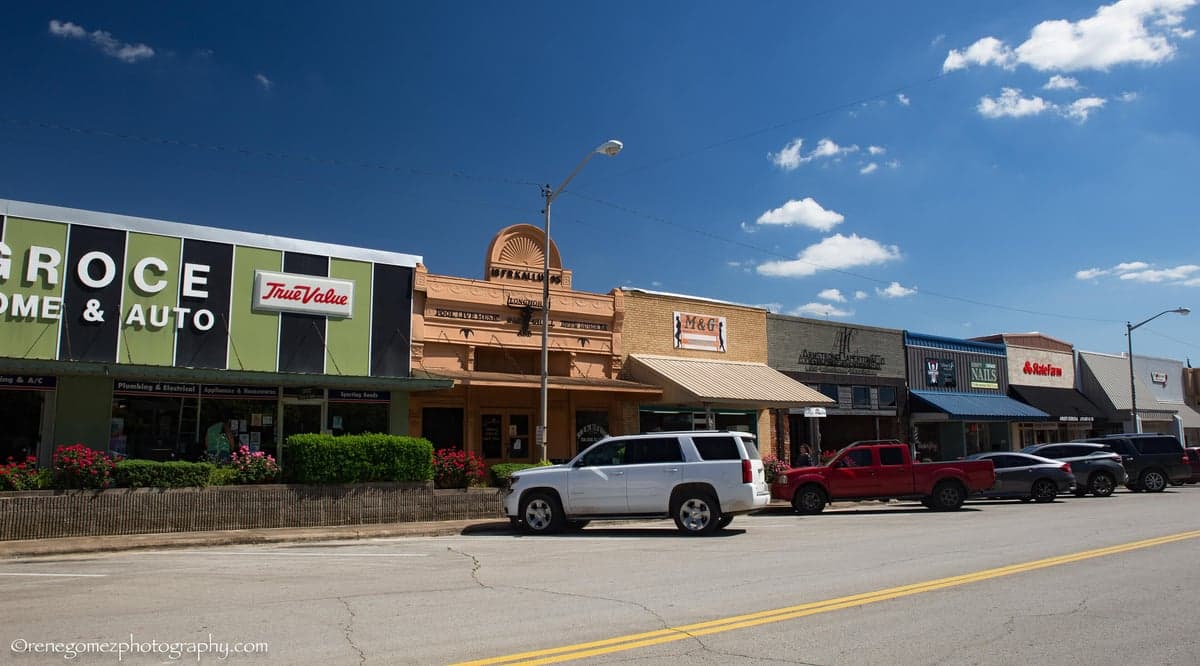
The people of Caldwell, Texas today number roughly 4,238, a community defined by its deep rural Texas roots, a significant and growing Hispanic presence, and a strong Black community that has been part of the city for over a century. The city is majority-white (52.3%), with a substantial Hispanic population (25.8%) and a Black population (14.1%) that is nearly double the national average, while the foreign-born share sits at just 7.0%. This is a working-class, church-going, and family-oriented town where the county courthouse square remains the social and commercial hub, and where the rhythms of agriculture, the nearby Brazos River, and the local school system still anchor daily life.
How the city was settled and grew
Caldwell was founded in 1840 as the seat of the newly organized Burleson County, named for a Texas Revolution hero. The original settlers were overwhelmingly Anglo-American farmers from the Upper South—Tennessee, Kentucky, and Missouri—who arrived via the Old San Antonio Road, drawn by cheap, fertile bottomland along the Brazos River. These early families built the first homes in the area now known as Old Town Caldwell, clustered around the courthouse square, and established the cotton and cattle economy that would define the region for a century. The arrival of the Houston and Texas Central Railroad in the 1870s brought a second wave of settlers, including a significant number of German and Czech immigrants who purchased farmland to the east and south, in what became the East Side and South Caldwell districts, where their descendants still own land today.
The most consequential demographic shift came after the Civil War, when newly freed Black families moved into Caldwell to work as sharecroppers and day laborers on the cotton plantations. They established a distinct, self-sufficient community in the northeast quadrant of town, a neighborhood known historically as Freeman's Quarters, which grew its own churches, schools, and businesses. By 1900, Black residents made up roughly a third of the town's population, a share that has remained remarkably stable for over a century. The early 20th century brought a small wave of Mexican laborers who worked the railroad and the cotton gins, settling in a modest enclave along the railroad tracks in the Depot District, though their numbers remained small until much later.
Modern era (post-1965)
The post-1965 period brought two major shifts. First, the mechanization of cotton farming pushed many Black families off the land and into town, consolidating the population of Freeman's Quarters and creating a new Black middle-class neighborhood to the north, Northside Heights, built in the 1970s and 1980s. Second, and more transformative, was the steady growth of the Hispanic population, which has risen from a small minority in 1970 to its current 25.8% share. This growth has been driven by domestic migration from South Texas and, to a lesser extent, by immigration from Mexico, with many families finding work in the poultry processing plants and the oilfield service industry that now anchor the local economy. These newer Hispanic residents have concentrated in the West End, a post-1990 subdivision development, and have increasingly moved into the older housing stock of the East Side, reshaping the character of those neighborhoods. The white population, meanwhile, has seen modest out-migration of younger adults to larger cities like Bryan-College Station and Austin, though the county seat retains a stable, older Anglo core in Old Town.
The future
Caldwell's population is becoming more diverse, and the trend is likely to accelerate. The Hispanic share is projected to continue climbing, driven by higher birth rates and continued in-migration from the Rio Grande Valley, while the Black population is expected to remain stable at roughly 14%. The white population, now at 52.3%, is aging and slowly declining in share, though the city's role as a bedroom community for the Bryan-College Station metro area (about 25 miles north) is bringing a new wave of younger, more educated white and Hispanic commuters into new developments on the Highway 21 Corridor on the city's southern edge. The college-educated share, currently 23.0%, is likely to rise as these commuters arrive, but Caldwell is not poised to become a suburb in the traditional sense—it remains a rural county seat with a strong agricultural and industrial base. The city's cultural identity is evolving from a binary Black-white history into a tri-cultural community, with Spanish increasingly heard in public spaces and Hispanic-owned businesses opening on the square.
For someone moving to Caldwell now, the bottom line is this: you are joining a small, stable, and genuinely diverse Texas town that is slowly becoming more Hispanic and slightly more educated, but which retains its deep roots in agriculture, faith, and family. The neighborhoods are distinct—Old Town for the historic core, Freeman's Quarters and Northside Heights for the Black community, the West End for newer Hispanic families, and the Highway 21 Corridor for incoming commuters—but the town itself is small enough that these lines blur daily at school, church, and the feed store. It is a place where the population is changing, but the character is not.

* Values derived from national, state, county, city and local statistics and may differ in a specific area. Last updated: 2026-10-31T04:26:06.000Z
Narrative content on this page is AI-generated and may contain mistakes. Verify any details that matter before acting on them.
ReloMaps may earn a commission from affiliate links at no extra cost to you.

