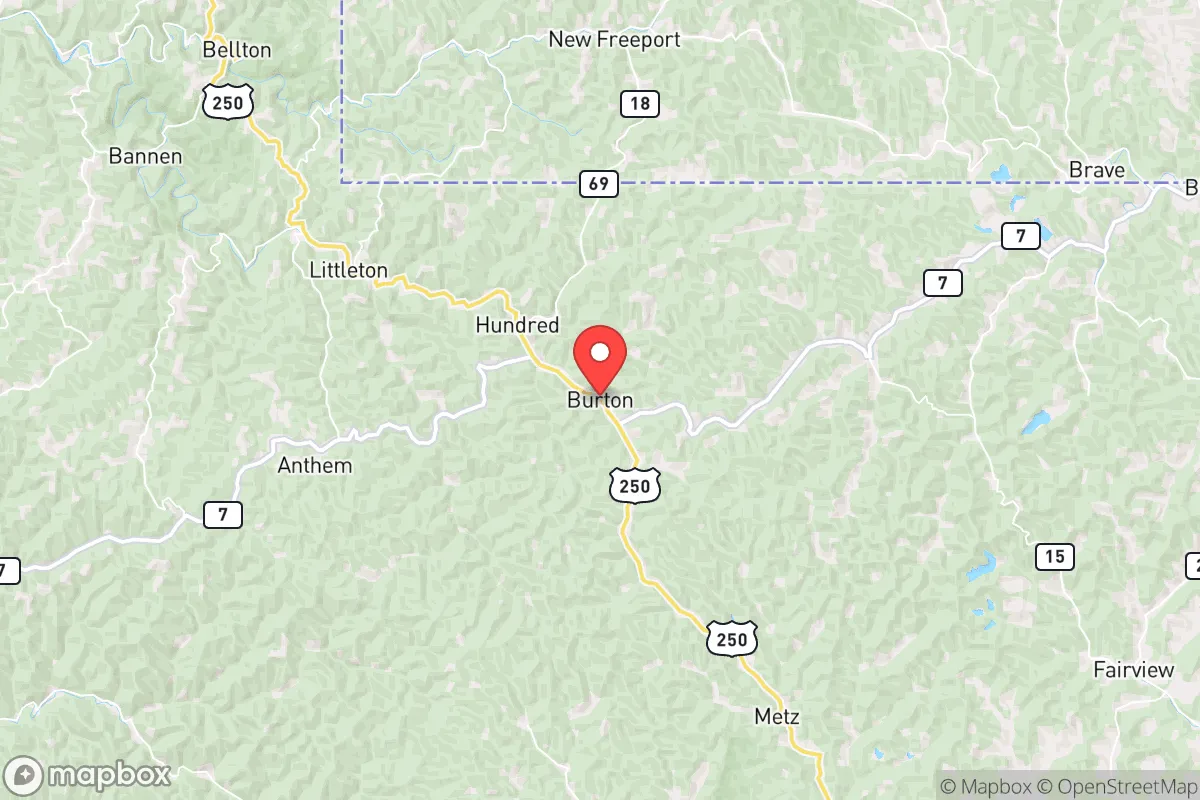
Political ClimatePolitical Climate in Burton, WV
District shown is the primary district for this city’s centroid. Cities may span multiple districts.
Inherited from parent county — no local data available.
* Lean and PVI are calculated from the surrounding county’s 2020 and 2024 presidential results, Cook-style — a finer measure here than its congressional district (WV-2).
Political rankings in West Virginia
- Most Conservative Cities in West Virginia
- Most Liberal Cities in West Virginia
- Best Liberal-Leaning Towns in the South
- Best Liberal-Leaning Towns in Appalachia
- Safest Liberal-Leaning Towns in the South
- Safest Conservative-Leaning Towns in the South
- Affordable Small Towns for Conservatives
- Safest Conservative-Leaning Cities in the U.S.
- Most Conservative Counties in West Virginia
- Most Liberal Counties in West Virginia
Local Political AnalysisPolitical Analysis of Burton, WV
Burton, WV is about as deep red as it gets in this part of the state, with a Cook PVI of R+28. That's not just Republican, that's Republican the way the Ohio River is wet. It's been that way for as long as I can remember, and it's only gotten more solid over the last couple decades. The old-timers will tell you it used to be a bit more mixed, especially around union jobs and the coal mines, but those days are long gone. Now, it's pretty much straight-ticket GOP, and the few Democrats left around here are the kind who'd rather not talk politics at the dinner table. The trajectory is pretty clear: it's going to stay red, and probably get redder, as the younger folks who stay tend to lean even harder that way.
How it compares
Compared to the rest of West Virginia, Burton is a little more intense. The state as a whole is solid red, but places like Morgantown or Charleston have some blue pockets, especially around the universities and the capital. Burton doesn't have that. It's more like the rural counties south of us, where the only real political contest is the primary. If you drive up to Wheeling or over to Fairmont, you'll see a bit more variety, but down here in Burton, it's pretty uniform. The Cook PVI for the state isn't officially listed, but trust me, it's deep red too, just not quite as deep as Burton. We're like the reddest part of a red state.
What this means for residents
For conservatives, it means you're in your element. Your vote counts in the primary, but in the general election, it's pretty much a foregone conclusion. You'll see your values reflected in local policy, from the school board to the county commission. For liberals, it means you're probably keeping your head down. You can still live your life, go to the store, and wave at your neighbors, but you're not going to find much political support. There's no real liberal infrastructure here, no local Democratic party to speak of. If you're liberal, you're either keeping quiet or you're used to being the odd one out. It's not hostile, but it's definitely not comfortable for anyone on the left.
One thing that sets Burton apart from some of the other deep red towns around here is the cultural feel. It's not just about voting Republican; it's about a certain way of life. You'll see more Trump flags than American flags some years, and the local churches are pretty vocal about politics. There's a strong sense of community, but it's a community that's very clear about its values. If you're looking for a place where you can be openly progressive, this isn't it. But if you're looking for a place where people are friendly, help each other out, and mostly just want to be left alone to live their lives, you'll find that here too. The politics are just the background noise of everyday life.

State Political ClimatePolitical Climate in West Virginia
State Political AnalysisPolitical Environment in the State
West Virginia has become one of the most reliably Republican states in the nation, shifting from a competitive, ancestrally Democratic stronghold to a deep-red bastion over the past two decades. In 2024, Donald Trump carried the state by nearly 39 points, a margin that has only widened since 2016, when he won by 42 points. This transformation is driven by a wholesale realignment of the white working-class electorate, the collapse of the state’s once-dominant union-based Democratic machine, and a cultural backlash against national Democratic positions on energy, guns, and social issues. The state’s political identity is now defined by a near-total Republican lock on statewide offices, a supermajority in the legislature, and a political culture that prizes gun rights, coal and natural gas, and a deeply skeptical view of federal authority.
Urban vs. rural divide
The political map of West Virginia is less an urban-rural split than a story of small cities surrounded by overwhelmingly conservative countryside. The state’s largest metro, Charleston, is a Democratic-leaning island in a red sea, but even here the margin has narrowed: Joe Biden won Kanawha County by just 2 points in 2020, down from Hillary Clinton’s 5-point win in 2016. Morgantown, home to West Virginia University, is the state’s most reliably blue city, with Monongalia County voting for Biden by 8 points in 2020, driven by a younger, more educated electorate and a substantial student population. Huntington and Wheeling have flipped from blue to red over the past decade, with Cabell and Ohio Counties now voting Republican by double digits. The rural counties that ring these metros — from Mingo in the south to Wetzel in the north — routinely deliver 75-80% of their votes to Republican candidates. The only real political variation is between “red” and “deeper red”: the eastern panhandle, including Berkeley County and Jefferson County, has become a Republican stronghold as exurban Washington D.C. commuters and retirees have moved in, while the southern coalfields, once the heart of the state’s Democratic machine, now vote Republican by margins that would have been unthinkable in the 1990s.
Policy environment
West Virginia’s policy environment is among the most conservative in the country, shaped by a near-total Republican control of state government since 2015. The state has no personal income tax on most retirement income, and in 2023 the legislature passed a bill that will phase out the state income tax entirely over several years, contingent on revenue triggers. The corporate tax rate is a flat 6.5%, and the state has a right-to-work law, a ban on project labor agreements, and a regulatory climate that strongly favors natural resource extraction — particularly coal, natural gas, and timber. On education, the state has one of the nation’s most expansive charter school laws, passed in 2019, and a robust school choice program that includes education savings accounts for all students, enacted in 2021. Gun laws are among the most permissive in the country: the state has permitless carry for adults 21 and older, no firearm registration, no waiting periods, and a “Stand Your Ground” law. Election laws have tightened: the state requires a photo ID to vote, has limited early voting to a single week, and in 2021 passed a law that restricts absentee ballot drop boxes and bans the mass mailing of absentee ballot applications. On healthcare, the state expanded Medicaid under the Affordable Care Act in 2013, but has not adopted a state-based exchange, and abortion is banned at all stages of pregnancy with very narrow exceptions, following the trigger law that took effect after the Dobbs decision.
Recent policy direction
The last five years have seen a rapid acceleration of conservative policy in West Virginia, with the legislature passing laws that touch nearly every dimension of personal and economic liberty a relocator might weigh. On gun rights, the 2021 permitless carry law (SB 458) eliminated the requirement for a concealed carry permit, and the 2023 “Second Amendment Preservation Act” (HB 2004) prohibits state and local law enforcement from enforcing any future federal gun restrictions that the state deems unconstitutional. On parental and education rights, the 2021 “Parental Bill of Rights” (HB 2080) requires schools to notify parents of any changes to a student’s mental or physical health services, and the 2023 “Don’t Say Gay” style law (HB 2080) bans classroom instruction on sexual orientation and gender identity in grades K-12. On property rights, the state has a strong eminent domain protection law, and in 2023 passed a bill (HB 2003) that prohibits local governments from banning natural gas hookups in new construction. On privacy and surveillance, the state has no comprehensive data privacy law, but in 2023 passed a law (HB 2001) that prohibits the use of facial recognition technology by law enforcement without a warrant. On medical and bodily autonomy, the state’s near-total abortion ban (HB 302) took effect in 2022, with exceptions only for medical emergencies and in cases of rape or incest (with a police report requirement). On taxation, the 2023 income tax phase-out bill (SB 203) is the most significant tax reform in decades, with the rate dropping from 6.5% to 5.1% in 2024 and further cuts triggered by revenue growth. On voting and ballot access, the 2021 omnibus election bill (SB 1) shortened the early voting period, banned ballot drop boxes except at county courthouses, and prohibited the secretary of state from mailing absentee ballot applications to all voters.
Civil unrest & political movements
West Virginia has a long history of labor militancy and political protest, but the modern landscape is dominated by conservative and libertarian movements. The 2018 teachers’ strike, which shut down every public school in the state for nine days, was the most significant labor action in recent memory, winning a 5% pay raise and a halt to proposed healthcare premium increases. That strike, however, did not translate into lasting Democratic gains — the Republican legislature has since passed laws restricting public-sector union bargaining power. On the right, the “Second Amendment Sanctuary” movement swept through the state in 2019-2020, with over 40 counties passing resolutions declaring they would not enforce future federal gun restrictions. The state has seen periodic protests at the state capitol over abortion, vaccine mandates, and transgender rights, but these have been relatively small and orderly compared to other states. Immigration politics are largely a non-issue in West Virginia, which has one of the smallest foreign-born populations in the country — about 1.5% — and no sanctuary city policies. Election integrity controversies have been muted compared to other states, though the 2020 election saw a brief push for a forensic audit of the state’s voting machines, which was rejected by the Republican secretary of state. There is no active secession or nullification movement, though the “Second Amendment Preservation Act” and similar bills reflect a strain of state sovereignty rhetoric that is popular in the legislature. A new resident would notice that political signs and flags — particularly “Don’t Tread on Me” and “Thin Blue Line” imagery — are common in rural areas, but political violence or visible unrest is extremely rare.
Projection
Over the next 5-10 years, West Virginia’s political trajectory is likely to continue its rightward drift, but demographic and economic pressures may introduce new fault lines. The state’s population is aging and shrinking — it lost 3.2% of its population between 2010 and 2020, the second-highest rate in the nation — and the remaining electorate is becoming older, whiter, and more conservative. In-migration from the eastern panhandle, driven by remote workers and retirees from the D.C. area, is bringing a more culturally conservative but economically moderate cohort that may push the state toward a more “libertarian” rather than “social conservative” orientation. The income tax phase-out, if it continues, will make the state more attractive to high-income migrants, potentially shifting the political center of gravity toward fiscal conservatism and away from culture-war issues. However, the state’s dependence on coal and natural gas revenue — which funds a significant portion of the state budget — creates a long-term vulnerability as the energy transition accelerates, and this could lead to fiscal pressures that force the next generation of leaders to confront trade-offs between tax cuts and public services. The Democratic Party in West Virginia is unlikely to recover in the near term, but a more moderate Republican faction — centered around figures like Senator Shelley Moore Capito — may emerge as a counterweight to the hardline conservative wing that currently dominates the legislature. Someone moving in now should expect to find a state that is deeply conservative, increasingly libertarian on economic issues, and likely to remain so for the foreseeable future, but with a growing tension between the old coal-based economy and the new remote-work and tourism-driven growth in the eastern panhandle and the New River Gorge region.
For a new resident, the bottom line is that West Virginia offers a political environment that is among the most conservative in the country, with low taxes, permissive gun laws, and a strong emphasis on local control and individual liberty. A conservative family will find a welcoming culture, a school choice system that allows for homeschooling or private education, and a state government that is actively working to reduce the tax burden and regulatory footprint. A liberal resident will find a state where their political views are in the minority, where abortion is banned, where public schools are underfunded and under pressure from school choice policies, and where the dominant political culture is skeptical of federal authority and social change. The state’s political stability — no major scandals, no violent unrest, no dramatic policy reversals — makes it a predictable place to live, but the long-term demographic and economic trends mean that the political landscape will continue to evolve, even if the direction of travel remains firmly rightward.
* Values derived from national, state, county, city and local statistics and may differ in a specific area. Last updated: 2026-11-17T02:22:22.000Z
Narrative content on this page is AI-generated and may contain mistakes. Verify any details that matter before acting on them.
ReloMaps may earn a commission from affiliate links at no extra cost to you.

