Demographics of Burton, WV
Affluence Level in Burton, WV
A middle-class area roughly in line with national averages across income, home values, education, and employment.
People of Burton, WV
The people of Burton, West Virginia today form a small, tightly-knit community of 390 residents that is overwhelmingly white (98.7%) and native-born, with zero foreign-born population. The town carries a distinct Appalachian character—quiet, family-oriented, and rooted in the surrounding coal country of Wetzel County—with a notably low college attainment rate of 14.8% reflecting generations of direct entry into trades and resource industries. Burton’s identity is defined less by diversity than by deep local continuity, where many families trace their presence back multiple generations.
How the city was settled and grew
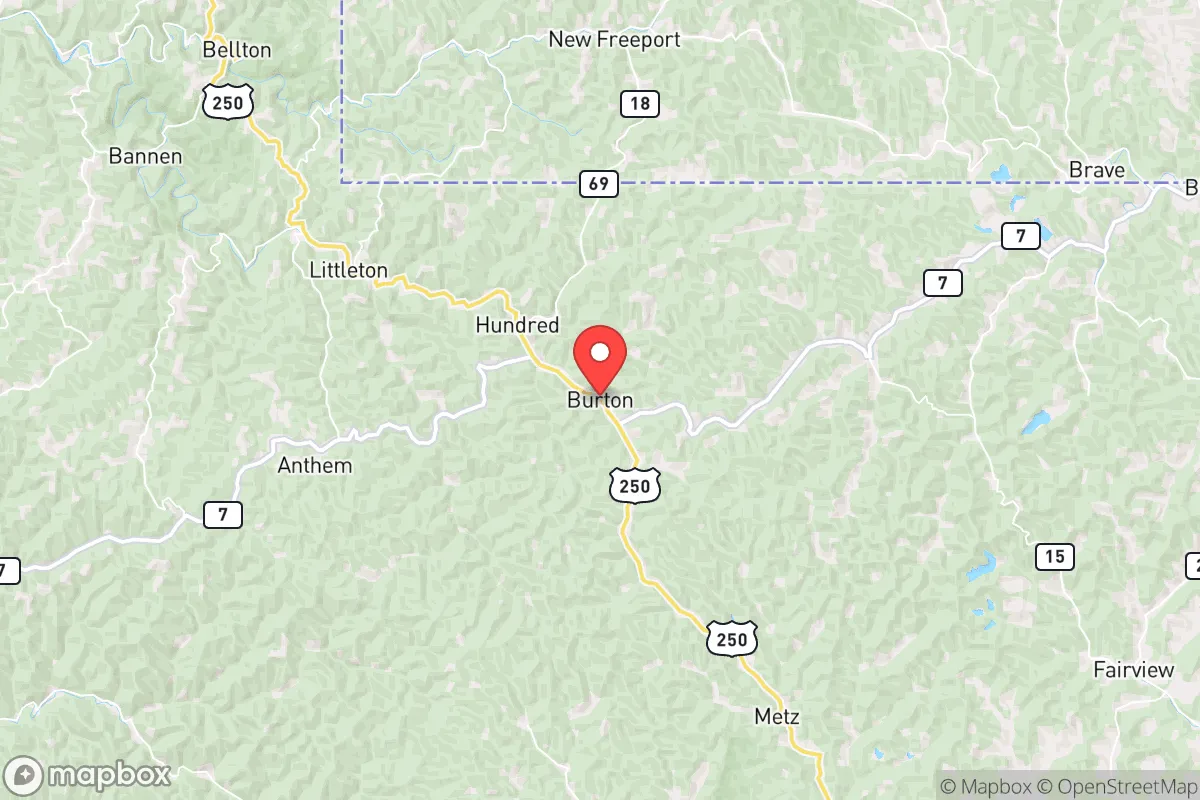
Burton was founded in the late 19th century as a coal-mining and railroad stop along the Ohio River tributaries of northern West Virginia. The original settlers were overwhelmingly of English, Scots-Irish, and German stock who moved into the Appalachian foothills from Pennsylvania and Virginia, drawn by land grants and the promise of work in the region’s expanding bituminous coal mines. The town’s first concentrated neighborhood, Old Town Burton around the original depot, was built by these early mining families in the 1880s and 1890s. A second wave arrived during the early 20th-century coal boom, with workers settling in the Hollow Run district along the creek beds, where company-built row houses housed miners and their families. Unlike larger West Virginia coal towns, Burton never attracted significant immigrant labor from Southern or Eastern Europe; its population remained almost entirely native-born white through the mid-20th century. The post-World War II era saw modest growth as returning veterans and their families built homes in the Burton Heights area on the town’s eastern ridge, but the population peaked around 600 in the 1950s before the coal industry began its long structural decline.
Modern era (post-1965)
After the 1965 Hart-Cellar Act, Burton experienced virtually no immigration-driven demographic change—the foreign-born share has remained at 0.0% for decades. The town’s modern-era story is one of domestic out-migration rather than in-migration. As regional coal employment contracted through the 1970s and 1980s, younger adults left for employment centers in Pittsburgh, Columbus, and the Carolinas, leaving an aging population. The small number of new residents who did arrive were almost entirely white families from other parts of Wetzel County or neighboring Marshall County, drawn by low housing costs and rural quiet. These newcomers tended to settle in the Pleasant Valley subdivision, a small development of single-family homes built in the 1990s on the town’s western edge. The Downtown Burton core, centered on the intersection of WV-7 and County Route 7, saw its commercial base shrink as the population declined, with many storefronts converted to residential use. The town’s racial composition has remained static: 98.7% white, with no measurable Black, Hispanic, Asian, or Indian populations as of the latest data.
The future
Burton’s population trajectory points toward continued slow decline, with the 390 current residents representing a roughly 35% drop from the mid-20th-century peak. The town is becoming older and less diverse—already one of the most homogeneous communities in Wetzel County—with no signs of reversal. The lack of foreign-born residents, combined with the absence of any major employer or new housing development, means the demographic profile is unlikely to shift meaningfully in the next 10-20 years. The Burton Heights and Pleasant Valley neighborhoods will likely retain their current character as clusters of aging single-family homes, while Hollow Run may see further depopulation as older residents pass away. The broader cultural identity remains firmly rooted in Appalachian mining heritage, with little pressure from outside influences. For someone moving in now, Burton offers a stable, predictable community where neighbors know each other by name, but it is not a place experiencing demographic change or growth.
Burton is becoming a quieter, older version of itself—a shrinking Appalachian town where the population is almost entirely white, native-born, and locally rooted. For a relocating family or individual seeking a low-cost, low-drama rural setting with deep community ties and no demographic flux, Burton fits that description precisely, but it offers little in the way of new economic opportunity or population diversity.

* Values derived from national, state, county, city and local statistics and may differ in a specific area. Last updated: 2026-11-17T02:22:22.000Z
Narrative content on this page is AI-generated and may contain mistakes. Verify any details that matter before acting on them.
ReloMaps may earn a commission from affiliate links at no extra cost to you.

