Photo: Wikipedia
Political ClimatePolitical Climate in Burke, VA
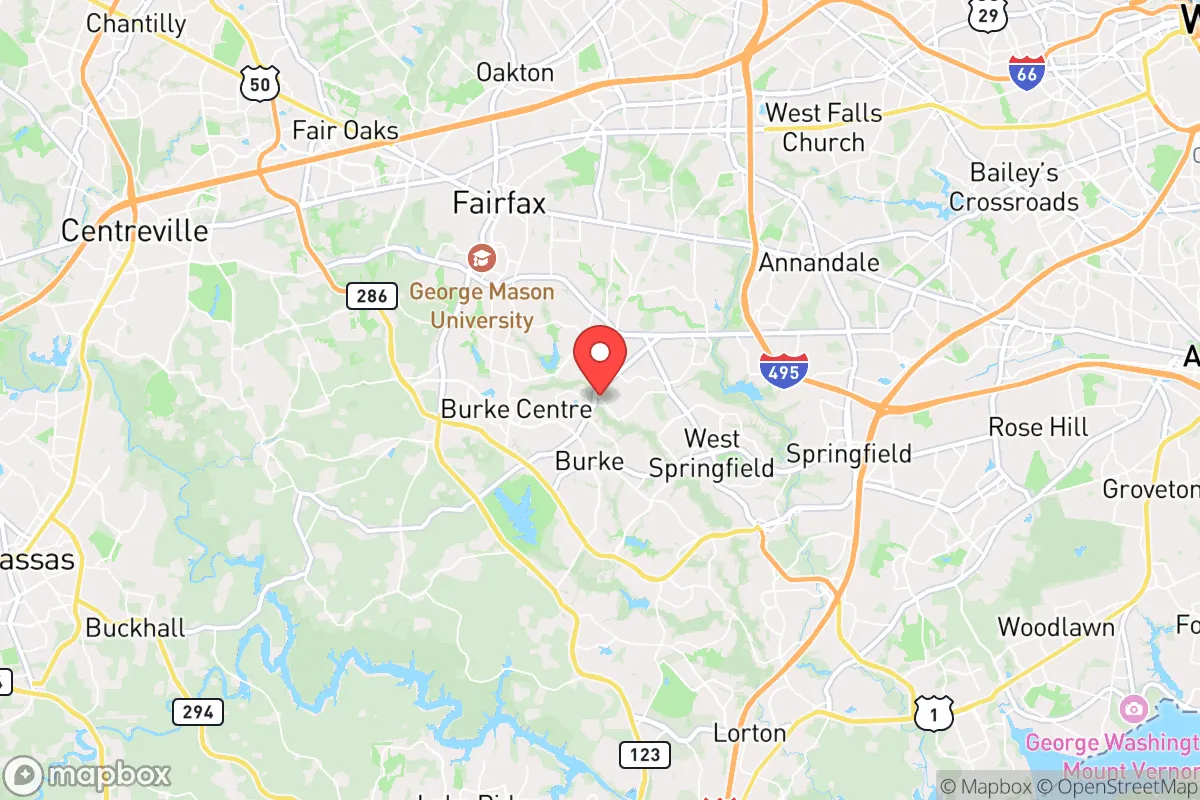
District shown is the primary district for this city’s centroid. Cities may span multiple districts.
Local Political AnalysisPolitical Analysis of Burke, VA
Burke, Virginia, is a deep-blue suburb in a purple state, and that distinction shapes nearly every aspect of local life. With a Cook Partisan Voting Index (PVI) of D+18, Burke is one of the most reliably Democratic communities in Northern Virginia—far more liberal than the state as a whole, which sits at D+4. This isn't a recent shift; Burke has been trending left for decades, driven by an influx of federal employees, tech workers, and families drawn to Fairfax County's strong public schools and progressive county government. The 2020 presidential election saw Joe Biden carry Fairfax County by over 40 points, and Burke's precincts routinely deliver margins that would make a Republican candidate's path to victory nearly impossible in any local or state-level race.
How it compares
To understand Burke's political climate, you have to look at the contrast with its neighbors. Drive 15 miles west to Manassas or 20 miles south to Fredericksburg, and you'll find communities that are far more competitive—Manassas leans Republican in local races, while Fredericksburg is a purple city that swings with the national mood. Even within Fairfax County, Burke stands out: nearby Springfield and Annandale are also blue, but Burke's D+18 rating is notably higher than the county average of roughly D+15. The real shock comes when you compare Burke to the rest of Virginia. The state's D+4 PVI reflects a delicate balance between the deep-blue D.C. suburbs, the swing-vote exurbs, and the reliably red rural and southwestern regions. Burke's D+18 means it's essentially a Democratic stronghold in a state that still elects Republican governors (Glenn Youngkin won in 2021) and has a split legislature. In practical terms, a Burke resident's vote for president or Senate is almost certainly going to the Democratic column, while a voter in, say, Loudoun County's western edge might see their ballot matter more in a close race.
What this means for residents
For liberal residents, Burke is a comfortable place to live politically. You'll find Democratic campaign signs on nearly every block during election season, and local issues like school funding, transit expansion (the new Burke Centre VRE station upgrades), and environmental policies are debated from a progressive baseline. Conservative residents, however, are a clear minority—and they know it. They often feel their views are underrepresented in local government and school board decisions, though Fairfax County's nonpartisan local elections mean that individual candidates can still win on competence and community service rather than party label. The practical effect is that Burke's political discourse tends to be more homogeneous than the state's, which can feel either reassuring or stifling depending on your perspective. For families, the biggest policy impact is on schools: Fairfax County Public Schools consistently rank among the nation's best, and the county's progressive tax base funds them generously—but that also means higher property taxes than in redder parts of Virginia.
Culturally, Burke reflects the broader Northern Virginia ethos: highly educated, diverse (about 30% Asian American, 15% Hispanic or Latino), and oriented toward Washington, D.C., for employment and culture. The area's Democratic lean is reinforced by the fact that many residents work for the federal government or defense contractors, where political neutrality is the norm but the workforce skews liberal. You won't find the same gun-rights advocacy or evangelical Christian influence here that you would in rural Virginia towns like Culpeper or Harrisonburg. Instead, Burke's political identity is tied to issues like affordable housing, climate resilience (the county has a detailed "Community-wide Energy and Climate Action Plan"), and maintaining the quality of its parks and libraries. For a conservative moving in, the adjustment is real—but many find that the excellent schools and safe streets outweigh the political mismatch. For a liberal, it's a place where your vote feels like it counts, even if the state around you remains a battleground.

State Political ClimatePolitical Climate in Virginia
State Political AnalysisPolitical Environment in the State
Virginia has shifted from a reliably conservative-leaning swing state to a solidly Democratic-leaning one over the past two decades, with a Cook PVI of D+4. The transformation is driven almost entirely by explosive growth in the Washington, D.C. suburbs, which now outweigh the state's traditionally conservative rural and exurban regions. For a relocator, this means the state’s political reality is deeply split: you can live in a deeply red county or a deep-blue city, but the state government in Richmond is firmly controlled by Democrats, and that control has been tightening since 2019.
Urban vs. rural divide
The political map of Virginia is a textbook case of the urban-rural chasm. The entire Democratic margin comes from the D.C. suburbs—Fairfax County, Arlington, Alexandria, and Loudoun County—which together cast roughly a third of the state’s votes and deliver margins of 30-40 points for Democrats. Richmond and Norfolk/Virginia Beach add further blue heft, though Virginia Beach itself is a perennial swing city that has trended left. Meanwhile, rural Southside and Southwest Virginia—places like Roanoke, Danville, and Bristol—vote Republican by margins of 30-50 points. The key tipping-point region is the exurban crescent from Fredericksburg down to Charlottesville and Harrisonburg, where fast-growing counties like Spotsylvania and Stafford have flipped from red to purple in the last decade. In 2024, Democrats swept every statewide office and held the legislature, but the rural-urban split is so stark that a Republican can still win a statewide race if turnout in the D.C. suburbs dips—as happened in the 2021 governor’s race, where Glenn Youngkin won by running up margins in the exurbs and rural areas while keeping the D.C. suburbs close.
Policy environment
Virginia’s policy environment is a mixed bag that reflects its purple-to-blue trajectory. The state income tax is a flat 5.75% (one of the highest flat rates in the South), and sales tax is 5.3% (plus local add-ons). Property taxes are set locally and vary widely—Loudoun County has rates around $1.00 per $100 assessed, while rural counties like Lee County are under $0.50. The regulatory posture is moderate: Virginia is a right-to-work state, but it has a minimum wage of $12.00 (rising to $13.50 in 2026) and a strong public-sector union presence in Northern Virginia. Education policy is a flashpoint: the state has a robust charter school law but few charters actually open, and the 2023 “Lab School” law allows public funds to follow students to innovation-focused schools, but it’s been slow to implement. Healthcare is dominated by the expansion of Medicaid under the ACA, which was enacted in 2018 under a Democratic governor and has added over 500,000 enrollees. Election laws are among the most accessible in the South: no-excuse absentee voting, same-day registration, and early voting starting 45 days before an election. There is no voter ID law beyond a signature match, which conservatives view as a vulnerability.
Recent policy direction
The last five years have seen Virginia lurch leftward on most fronts, with notable exceptions. On gun and self-defense law, Democrats passed a 2020 package that included universal background checks, a one-handgun-per-month limit, and a “red flag” law allowing temporary seizure of firearms from individuals deemed a threat. A 2023 law also banned carrying firearms in certain public spaces, including the state capitol. On parental and education rights, the 2021 Youngkin administration pushed through a “Parents’ Bill of Rights” that requires schools to notify parents of curriculum changes and allows them to opt children out of sexually explicit content. However, the Democratic legislature blocked further restrictions on transgender student policies. On speech and privacy, Virginia passed the Consumer Data Protection Act in 2021, one of the strongest state privacy laws, but it has no private right of action. On medical and bodily autonomy, the state has become a regional abortion haven: a 2020 law repealed most restrictions, and a 2023 constitutional amendment to enshrine abortion rights passed the legislature but must be re-passed in 2025 before going to voters. On property rights, the state has a strong “right to farm” law protecting agricultural operations from nuisance lawsuits, but localities in Northern Virginia have aggressively used zoning to limit development. On taxation, the 2023 budget included a one-time tax rebate and a small increase in the standard deduction, but the flat income tax remains. On voting and ballot access, the 2020 election saw widespread use of drop boxes and mail-in ballots, and a 2021 law made Election Day a state holiday. Conservatives have raised concerns about ballot security, but no major fraud has been proven.
Civil unrest & political movements
Virginia has been a national flashpoint for political movements. The 2017 “Unite the Right” rally in Charlottesville and the subsequent violence left three dead and made the city a symbol of far-right extremism. In response, the state banned firearms at public demonstrations and removed Confederate statues from the capitol grounds. On the left, the 2020 racial justice protests in Richmond led to the toppling of a Robert E. Lee statue and a statewide push to remove Confederate monuments. Immigration politics are less heated than in border states, but Prince William County and Fairfax County have “sanctuary” policies limiting cooperation with ICE, while rural counties like Augusta have passed resolutions declaring themselves “Second Amendment sanctuaries.” Election integrity remains a live issue: the 2020 election saw Trump’s campaign challenge Virginia’s results (unsuccessfully), and the 2021 gubernatorial race was decided by just 2 points, fueling ongoing distrust among conservatives. A new resident will notice that political yard signs are ubiquitous in the exurbs, and that local news is dominated by debates over school curriculum and development.
Projection
Over the next 5-10 years, Virginia will likely continue its slow drift leftward, but not uniformly. The D.C. suburbs are still growing—Loudoun County added 40,000 residents between 2020 and 2024—and these new arrivals are overwhelmingly white-collar professionals who lean Democratic. However, the exurban counties like Stafford and Spotsylvania are growing even faster, and they are trending Republican as they fill with families priced out of Fairfax. The wild card is the Hampton Roads region: Virginia Beach is becoming more Democratic, but the surrounding rural counties are not. If the Democratic margin in Northern Virginia continues to grow, the state will become solidly D+6 or D+7 by 2030, making it nearly impossible for a Republican to win statewide. But if the exurban shift accelerates, the state could remain competitive. For a relocator, the practical takeaway is that the state’s political future will be decided in the exurbs—places like Fredericksburg and Harrisonburg—not in the cities or the deep country.
For a new resident, the bottom line is that Virginia offers a stark choice: live in a blue city or suburb and enjoy progressive policies on abortion, gun control, and voting access, or live in a red rural area and experience a more conservative local culture with lower taxes and fewer regulations. The state government will remain Democratic-controlled for the foreseeable future, so conservative residents should expect continued gun restrictions, abortion protections, and a high income tax. Liberal residents will find a welcoming environment in Northern Virginia and Richmond, but should be prepared for sharp cultural divides in the exurbs and rural areas. The state is not a monolith—it’s a collection of political islands, and your experience will depend entirely on which island you choose.
* Values derived from national, state, county, city and local statistics and may differ in a specific area. Last updated: 2026-08-26T19:04:09.000Z
Narrative content on this page is AI-generated and may contain mistakes. Verify any details that matter before acting on them.
ReloMaps may earn a commission from affiliate links at no extra cost to you.

