
Photo: Wikipedia
Political ClimatePolitical Climate in Brunswick, GA
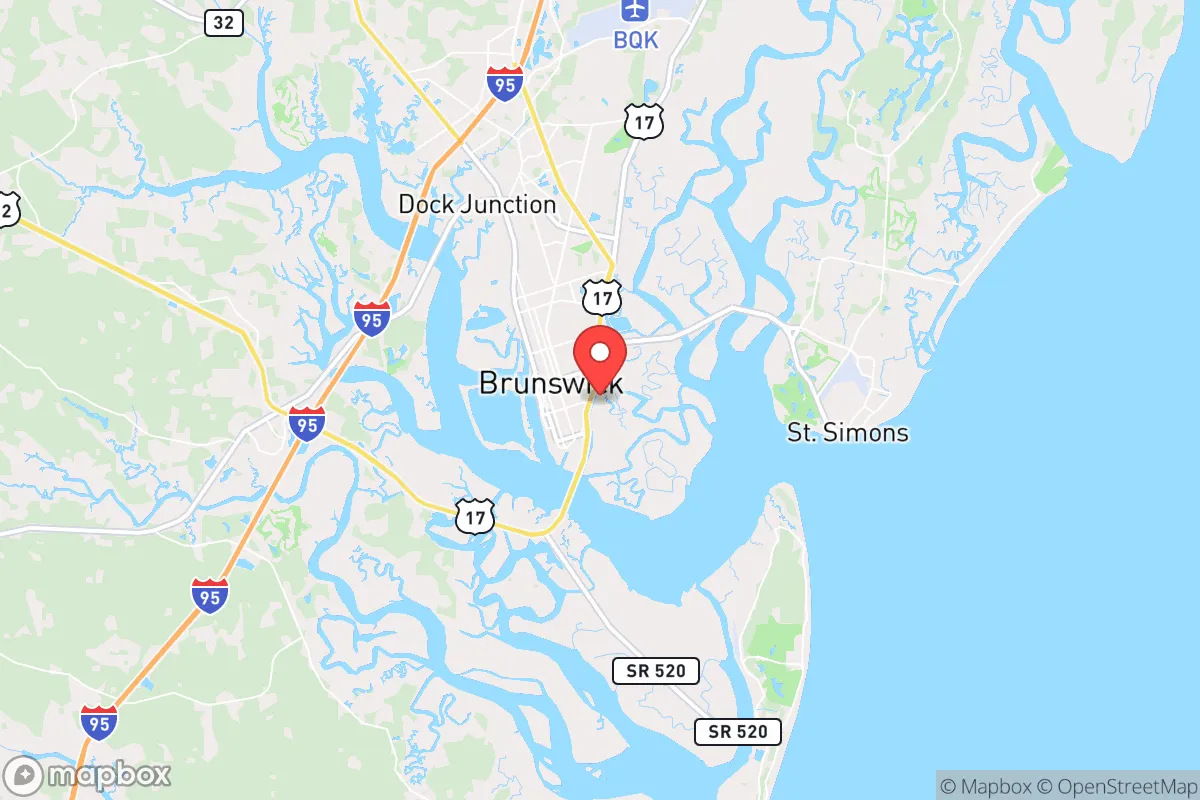
District shown is the primary district for this city’s centroid. Cities may span multiple districts.
Local Political AnalysisPolitical Analysis of Brunswick, GA
Brunswick and its surrounding Glynn County lean reliably Republican, carrying a Cook Partisan Voting Index of R+8, which means the area votes about eight points more conservative than the national average. That’s a solid red anchor on Georgia’s coast, but it’s not a monolith—the city of Brunswick itself, with its historic downtown and larger Black population, often votes more Democratic, creating a noticeable urban-rural split within the county. Over the last decade, the area has held steady in its Republican tilt, even as the broader state of Georgia has become a fiercely contested battleground, flipping blue for president in 2020 and 2024. So while Georgia as a whole is a true purple state, Brunswick and Glynn County remain a reliably conservative pocket, though not as deep red as the rural counties to the west like Bacon or Appling.
How it compares
The contrast between Brunswick and the state of Georgia is stark. Georgia’s statewide Cook PVI is effectively neutral—it’s a toss-up, with Democrats and Republicans trading wins in recent presidential and Senate races. Brunswick’s R+8 rating puts it in a different league, more aligned with places like St. Simons Island (also in Glynn County) or Kingsland to the south, rather than the Atlanta suburbs or Savannah’s core. For example, in the 2022 governor’s race, Republican Brian Kemp won Glynn County with about 62% of the vote, while he took the state with 53.4%. That’s a real gap. Meanwhile, nearby Darien in McIntosh County leans more moderate, and Jekyll Island’s state-owned resort community tends to vote with the county’s conservative majority. The takeaway: if you’re used to Georgia’s purple swing-state drama, Brunswick feels like a more predictable, redder environment.
What this means for residents
For conservative residents, Brunswick’s lean means local elections and policy debates usually tilt their way. The county commission and school board have a Republican majority, and issues like lower taxes, Second Amendment rights, and limited government regulation tend to get a sympathetic hearing. You’ll find plenty of GOP campaign signs in yards, and conservative viewpoints dominate local talk radio and civic club conversations. For liberal residents, it means being in the minority, but not an isolated one—the city of Brunswick itself provides a more progressive enclave, with a vocal Democratic party presence and active groups focused on environmental protection (the Marshes of Glynn are a big deal) and social justice. Statewide, you’re still in a purple state, so your vote for president or U.S. Senate carries weight, but locally, you’ll need to build coalitions to see your priorities advance. The practical reality is that most folks get along fine—this is the South, after all, where neighborliness often trumps politics—but the political culture is unmistakably conservative.
Culturally, Brunswick stands apart from Georgia’s more liberal urban centers like Atlanta or Athens. The area’s economy is heavily tied to the Port of Brunswick, the timber industry, and tourism on the Golden Isles, which fosters a pro-business, low-regulation ethos. Policy-wise, you’ll see fewer progressive initiatives like sanctuary city ordinances or aggressive climate action plans compared to metro Atlanta. Instead, the focus is on economic development, infrastructure for the port, and maintaining the area’s natural beauty without heavy-handed restrictions. For newcomers, the biggest adjustment might be the slower pace of political change—things move deliberately here, and that’s by design. Looking ahead, as coastal Georgia continues to grow, especially with the expansion of the port and new residential developments, the political balance could shift slightly, but for now, Brunswick remains a reliably red spot in a purple state, offering a distinct, conservative coastal flavor that’s different from the rest of Georgia.

State Political ClimatePolitical Climate in Georgia
State Political AnalysisPolitical Environment in the State
Georgia has transformed from a reliably Republican stronghold into the nation’s premier battleground state, a shift that has accelerated dramatically over the last decade. The state’s current political reality is defined by a razor-thin partisan divide: Joe Biden won the state by just 0.2% in 2020, and the 2022 Senate runoff gave Democrats a full term, yet Republicans still hold every statewide office and both legislative chambers. This isn’t a blue wave—it’s a dead heat, driven by the explosive growth of the Atlanta metro colliding with deeply conservative rural and exurban areas. For a relocator, this means you’re moving into a state where your vote genuinely matters, but where the policy environment remains firmly center-right, even as the cultural and demographic ground shifts beneath it.
Urban vs. rural divide
The political map of Georgia is a story of two Georgias, and the dividing line is the Atlanta Perimeter. The core of Democratic power is Metro Atlanta—specifically the urban core of Atlanta itself, along with the close-in suburbs of Decatur, Sandy Springs, and the increasingly blue Gwinnett County (which flipped blue in 2016 and hasn't looked back). These areas are dense, diverse, and growing fast, powered by transplants from other states and a young, educated workforce. Outside the I-285 ring, the state is overwhelmingly Republican. The rural southwest, the agricultural belt, and the northern mountain counties vote red by margins of 70-80%. A key example is Forsyth County, just north of Atlanta, which remains one of the most reliably Republican large counties in the nation, voting +37 points for Trump in 2024. The real action is in the "collar counties" like Cherokee and Paulding, which are exurban and growing, but still deeply red. The political future of the state hinges on whether these outer suburbs stay red or start trending purple like Gwinnett did.
Policy environment
Georgia’s state-level policy is a textbook example of conservative governance with a pragmatic, pro-business twist. The state has a flat income tax rate of 5.39%, which is scheduled to drop to 4.99% by 2029. There is no state-level property tax, but local millage rates vary widely—expect higher rates in blue metros like Atlanta and lower rates in rural counties. The regulatory environment is light, with Georgia consistently ranking in the top 10 for "ease of doing business." On education, the state has a robust school choice program, including the Georgia Promise Scholarship Act (2024), which provides state funds for private school tuition. However, public school funding remains a flashpoint, with rural districts struggling and metro Atlanta districts generally well-funded. Healthcare policy is a mixed bag: Georgia did not expand Medicaid under the ACA, but it did implement a limited "Georgia Pathways" work requirement program in 2023, which has seen very low enrollment. Election law is a major topic: the 2021 Election Integrity Act (SB 202) tightened voter ID requirements for absentee ballots, limited drop boxes, and made it a crime to hand out food and water to voters in line. This law remains deeply controversial and is a key reason the state is a national political battleground.
Recent policy direction
The last three years have seen a clear conservative legislative push, but with some notable exceptions. On gun rights, Georgia is a "constitutional carry" state (since 2022), meaning no permit is needed to carry a concealed firearm. On parental rights, the state passed the "Parents' Bill of Rights" (SB 449) in 2022, which requires schools to notify parents of any changes to a student's health or well-being, a law that has been a flashpoint in the culture war. On abortion, Georgia’s "Heartbeat Bill" (HB 481) bans abortion after roughly six weeks, with exceptions for rape, incest, and the life of the mother. This law was struck down by the state Supreme Court in 2023 but reinstated pending appeal, creating a volatile legal environment. On property rights, the state has strong protections against eminent domain abuse, but local zoning battles in growing areas like Athens and Savannah are intense. On voting access, the trend is toward restriction: the state purged over 100,000 voters from the rolls in 2022, a practice upheld by the courts. On privacy and surveillance, Georgia has no comprehensive data privacy law, though a bill is pending. The overall direction is a state that is culturally conservative but economically libertarian, with a strong tilt toward local control on most issues.
Civil unrest & political movements
Georgia has been a focal point for political activism on both sides. The 2020 election cycle saw massive, sustained protests in Atlanta over racial justice, culminating in the passage of the state's hate crimes law. The "Stop the Steal" movement was also highly active, with rallies at the state capitol and a significant push for election audits. The most visible ongoing flashpoint is the "Cop City" controversy in DeKalb County, where a proposed police training facility has sparked years of protests, arson attacks, and a state-level crackdown that has been labeled as authoritarian by critics. Immigration politics are also hot: Georgia passed a strict anti-sanctuary city law (HB 1105) in 2024, threatening to withhold state funds from local governments that don't cooperate with ICE. The state is also a major hub for the "election integrity" movement, with the Georgia Republican Party maintaining a permanent election integrity operation. For a new resident, you will see political polarization in daily life—yard signs, bumper stickers, and local news coverage are intensely partisan, especially in the suburbs.
Projection
Over the next 5-10 years, Georgia is likely to remain a toss-up state, but the demographic trends favor a slow drift toward competitiveness rather than a clear blue shift. The Atlanta metro is growing by about 100,000 people per year, and these new arrivals are disproportionately young, diverse, and college-educated—a demographic that leans Democratic. However, the exurbs and rural areas are also growing, and they are getting redder. The wild card is the "graying" of the state: Georgia has a rapidly growing retiree population, especially in areas like Lake Oconee and the North Georgia mountains, who tend to vote Republican. The state's political future will be decided in the suburbs of Henry County and Newton County, which are currently purple and trending blue. A relocator moving in now should expect a state that is politically competitive, with a conservative policy baseline that will only change if Democrats win the governorship or a legislative majority—something that is plausible but not likely in the next decade.
For a new resident, the bottom line is this: Georgia offers a low-tax, business-friendly environment with a conservative legal framework, but you are moving into a state that is culturally and politically divided. If you are a conservative, you will find a state government that largely reflects your values, but you will live in a community that is increasingly diverse and politically contested. If you are a liberal, you will find a vibrant, progressive urban core in Atlanta, but you will be living under a state government that is actively pursuing a conservative agenda. The practical takeaway is that your vote matters here more than in almost any other state, and your daily experience will depend heavily on which of the two Georgias you choose to call home.
* Values derived from national, state, county, city and local statistics and may differ in a specific area. Last updated: 2026-10-29T21:43:08.000Z
Narrative content on this page is AI-generated and may contain mistakes. Verify any details that matter before acting on them.
ReloMaps may earn a commission from affiliate links at no extra cost to you.

