
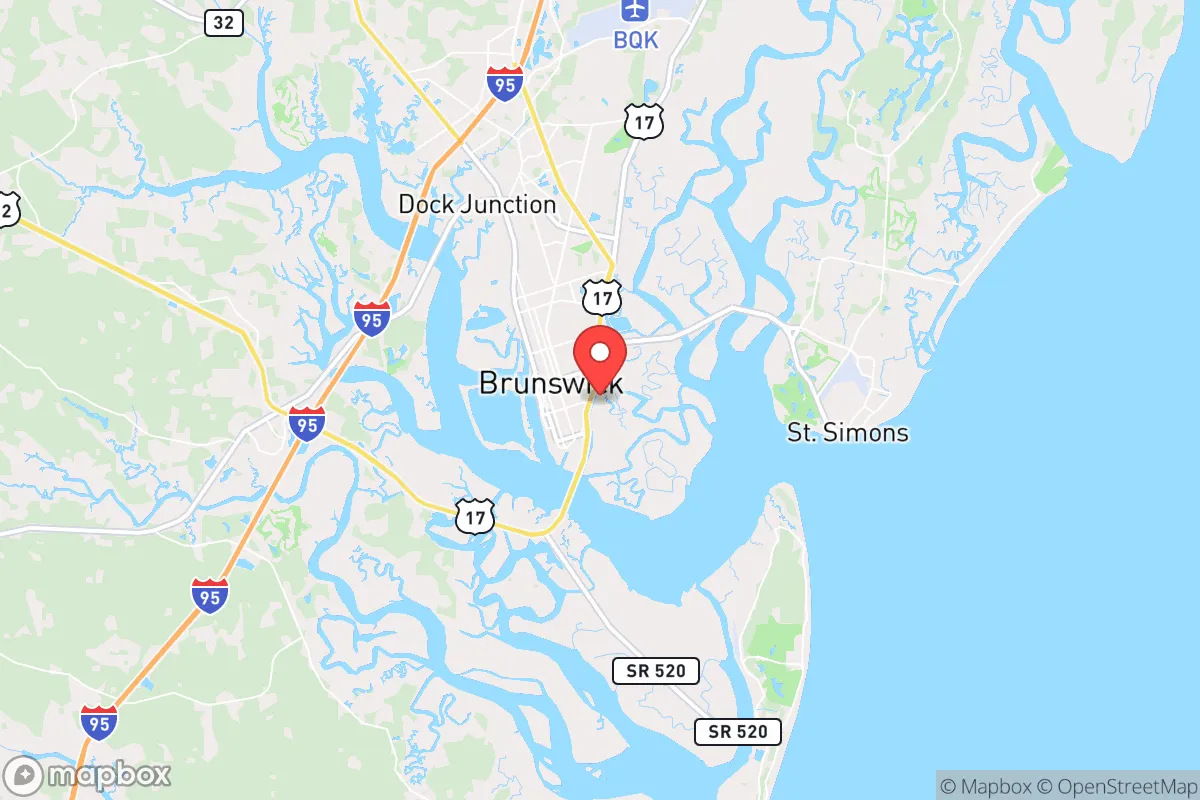
Photo: Wikipedia
Personal Sovereignty in Brunswick, GA
Viable for self-reliance. Generally workable, though some barriers may limit total independence.
What does Personal Sovereignty tell us?
Personal Sovereignty measures your capacity for self-reliance and independence with minimal government friction. Higher scores mean fewer barriers between you and the way you want to live... but it assumes you have the space you need and good neighbors.
What does this tell us?
Personal Sovereignty measures your capacity for self-reliance and independence with minimal government friction. Higher scores mean fewer barriers between you and the way you want to live... but it assumes you have the space you need and good neighbors.
State Policy
Energy independence: Importer (12% of energy produced in-state)
Personal Liberty
Homesteading

Personal Liberty Analysis
Brunswick, Georgia, offers a personal sovereignty environment shaped by Georgia’s broadly permissive state laws and a local culture that leans toward self-reliance, though it sits within a county (Glynn) that applies moderate local regulations. For a relocation reader prioritizing autonomy—whether single or raising a family—the key trade-off is between Georgia’s light-touch state framework on taxes, guns, and parental rights, and the practical constraints of coastal zoning, floodplain rules, and a local economy tied to tourism and the Port of Brunswick. The area provides a solid baseline for personal freedom, but the specifics of property use and self-defense require careful attention to local ordinances.
Tax burden and regulatory posture in Glynn County
Georgia is a right-to-work state with a flat income tax rate of 5.49% (as of 2025) and no state-level estate or inheritance tax, which directly supports personal financial autonomy. Glynn County’s property tax millage rate for 2024 is approximately 13.5 mills for the unincorporated area, with Brunswick city residents paying an additional 4.5 mills for municipal services—a combined rate that is moderate for coastal Georgia but higher than inland rural counties like Appling or Bacon. Sales tax in Glynn County is 7%, composed of the state’s 4% rate plus a 3% local option (SPLOST and LOST). No local occupational tax or business license fee is levied on most home-based businesses, which is a meaningful advantage for freelancers or remote workers seeking to operate without bureaucratic friction. The regulatory posture is generally permissive: Glynn County does not impose rent control, and zoning for single-family homes is by-right in most residential districts. However, the county enforces a strict floodplain management ordinance (adopted per FEMA requirements) that can restrict building or major renovations in flood zones—a significant constraint for anyone considering waterfront or low-lying property. Environmental regulations from the Georgia Department of Natural Resources also apply to any construction near marshes or tidal creeks, adding a layer of permitting that can delay projects by 3–6 months. Overall, the tax burden is moderate and predictable, but the regulatory environment is not as hands-off as in Georgia’s rural interior; it’s a coastal compromise.
Self-defense and gun law specifics in Brunswick
Georgia is a constitutional carry state as of 2022, meaning no permit is required to carry a concealed or open handgun for any law-abiding adult 21 or older (18 for long guns). Brunswick residents benefit from this directly: you can carry in your vehicle without a permit, and the state preempts local governments from enacting stricter gun ordinances than state law. Glynn County does not have its own gun registration, waiting periods, or magazine capacity limits. Stand-your-ground and castle doctrine are fully codified in Georgia law (O.C.G.A. § 16-3-23.1), with no duty to retreat in any place where you are lawfully present. This applies to your home, vehicle, and workplace. For those who want a permit for reciprocity while traveling, Glynn County Probate Court issues Georgia Weapons Carry Licenses (GWCL) with a turnaround time of roughly 30–60 days; the fee is $74.25 for a five-year license. No firearms safety course is required for the permit, though many applicants take one voluntarily. The local sheriff’s office (Glynn County Sheriff’s Department) is generally supportive of Second Amendment rights, and there are no known “gun-free zones” beyond those mandated by state law (e.g., courthouses, jails, and some school property). For a self-defense-focused resident, Brunswick offers one of the more permissive legal environments in the Southeast, with the only practical limitation being that private businesses can post “no firearms” signs, which carry the force of law for trespassing if you refuse to leave.
Self-reliance and homesteading viability: lot sizes, zoning, and off-grid feasibility
Homesteading in Brunswick is viable but constrained by lot size and coastal geography. In unincorporated Glynn County, the minimum lot size for a single-family home on a septic system is one acre in most residential zones (R-1), though lots as small as 0.25 acres are common in older subdivisions with public sewer. For those seeking true self-reliance, agricultural zoning (A-1) requires a minimum of 5 acres and allows livestock, poultry, and crop cultivation by right. However, the county’s soil is primarily sandy loam with high water tables, which limits deep-rooted crops and makes septic system installation more expensive (often $8,000–$15,000 due to mounded systems). Off-grid feasibility is mixed: Georgia law does not prohibit rainwater collection, and Glynn County has no ordinance against it, but the county requires connection to public water and sewer if available within 200 feet of the property line, which effectively bans true off-grid living in most developed areas. Solar panels are permitted without special permits for roof-mounted systems, but ground-mounted arrays over 20 square feet require a building permit and must comply with setback rules. No county-wide ban on composting toilets exists, but they must be approved by the Environmental Health Department as part of a septic system variance—a process that can take 3–6 months. For livestock, the county allows up to 4 chickens per acre without a permit, but roosters are prohibited in subdivisions. Larger animals (goats, cows) require a minimum of 2 acres per animal unit. The local extension office (Glynn County UGA Extension) offers soil testing and workshops, but the coastal climate (high humidity, salt spray) makes year-round gardening challenging without hoop houses or raised beds. Overall, homesteading is possible but requires navigating local health and zoning rules that are more restrictive than in Georgia’s rural interior counties like Toombs or Jeff Davis.
Personal liberties: parental rights, medical autonomy, speech, and property
Georgia law provides strong protections for parental rights. Parents have the legal right to direct the upbringing, education, and healthcare of their minor children, including the right to opt out of school curricula (O.C.G.A. § 20-2-142). Glynn County Schools allow parents to request exemptions from sex education and certain health screenings without penalty. Homeschooling is straightforward: parents file a declaration of intent with the Georgia Department of Education annually, and no standardized testing is required (though it is recommended). Medical autonomy is more limited: Georgia does not have a broad medical freedom law, and vaccine mandates for school attendance are enforced for standard childhood immunizations, though religious exemptions are available. The state does not have a right-to-try law for experimental treatments beyond federal provisions. Free speech is protected under the First Amendment, and Brunswick has no local ordinances restricting public assembly or leafleting beyond standard time-place-manner rules. Property rights are generally strong: Georgia is a “lien theory” state, meaning the borrower holds title to the property, and Glynn County does not have rent control or inclusionary zoning mandates. However, the county does enforce a strict property maintenance code that can require mowing, debris removal, and exterior repairs—a potential friction point for those who prefer a more laissez-faire approach to their land. The local government also has a noise ordinance (Glynn County Code § 10-31) that prohibits “unreasonable” noise between 11 p.m. and 7 a.m., which could affect late-night projects or gatherings. For speech and assembly, the Brunswick City Council has not passed any recent ordinances targeting protest or public expression, and the area generally respects these liberties in practice.
In the broader context of coastal Georgia, Brunswick offers a solid but not extreme level of personal sovereignty. It is more permissive than Savannah (which has stricter noise and short-term rental rules) but less so than rural counties like Brantley or Wayne, where zoning is minimal and off-grid living is easier. The tax burden is moderate, gun laws are among the most favorable in the nation, and parental rights are well-protected. The main constraints are coastal environmental regulations and local property maintenance codes that limit the “do what you want with your land” ethos. For a conservative-leaning individual or family who values self-reliance but wants access to a port city with amenities, Brunswick strikes a practical balance—freedom is the default, but you’ll need to work within a few local rules that reflect its coastal and suburban character.

* Values derived from national, state, county, city and local statistics and may differ in a specific area. Last updated: 2026-10-29T21:43:08.000Z
Narrative content on this page is AI-generated and may contain mistakes. Verify any details that matter before acting on them.
ReloMaps may earn a commission from affiliate links at no extra cost to you.

