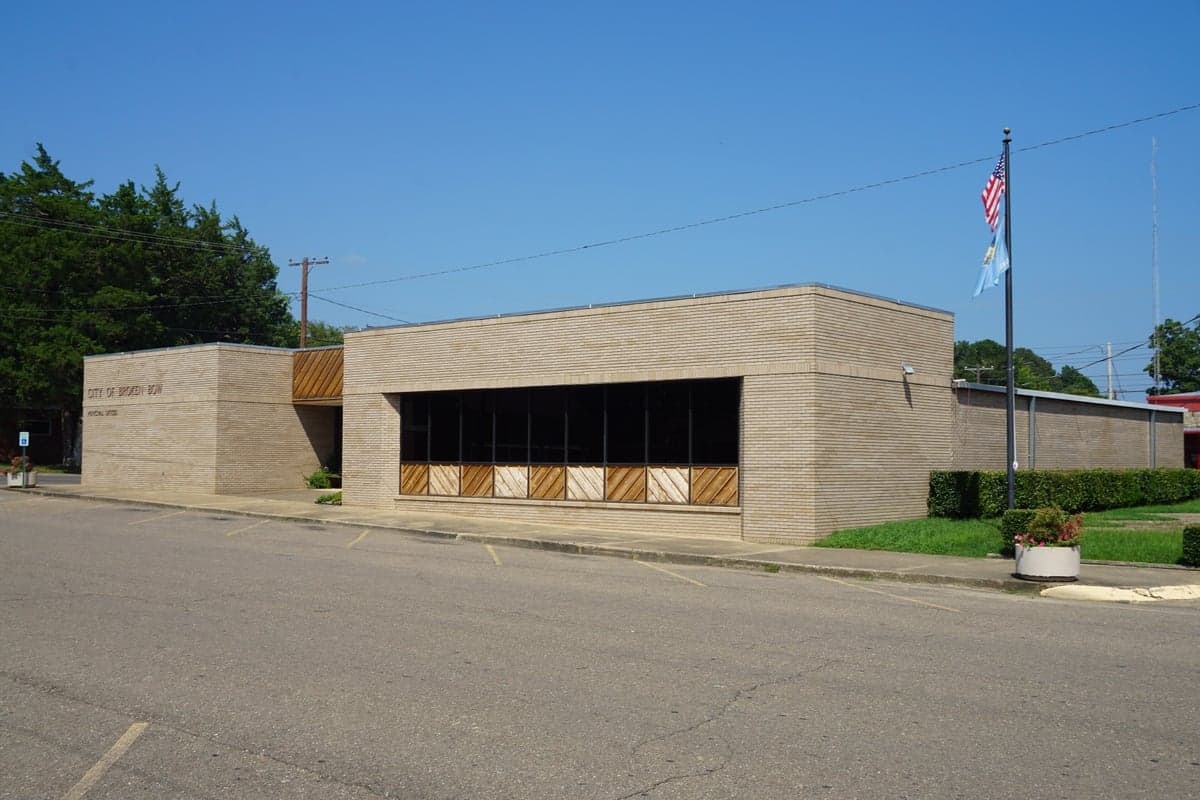
Photo: Wikipedia
Strategic Assessment of Broken Bow, OK
Workable tactical position. Some exposure to population density or targets, but generally defensible in a crisis.
What does the Strategic Assessment tell us?
Our Strategic Assessment grades tactical survivability of an area. Major population centers, military targets, fallout zones, natural disasters, and border exposure all drive risk — lower exposure means a more defensible position in a crisis.
This is heavily inspired by Joel Skousen's Strategic Relocation book. Highly recommended you checkout the book ($)What does this tell us?
Our Strategic Assessment grades tactical survivability of an area. Major population centers, military targets, fallout zones, natural disasters, and border exposure all drive risk — lower exposure means a more defensible position in a crisis.
This is heavily inspired by Joel Skousen's Strategic Relocation book. Highly recommended you checkout the book ($)Strategic Pillars
Key Distances
Regional Safe Places
Below is our recommended "safe zones" in Oklahoma and the surrounding area based on our strategic heuristics. For most people, it's unrealistic to live in a “safe zone” full-time due to work, family or other personal reasons. They tend to be more rural. However, many of these areas are perfect for second homes and retreat properties that double as a vacation home or even a short-term rental.
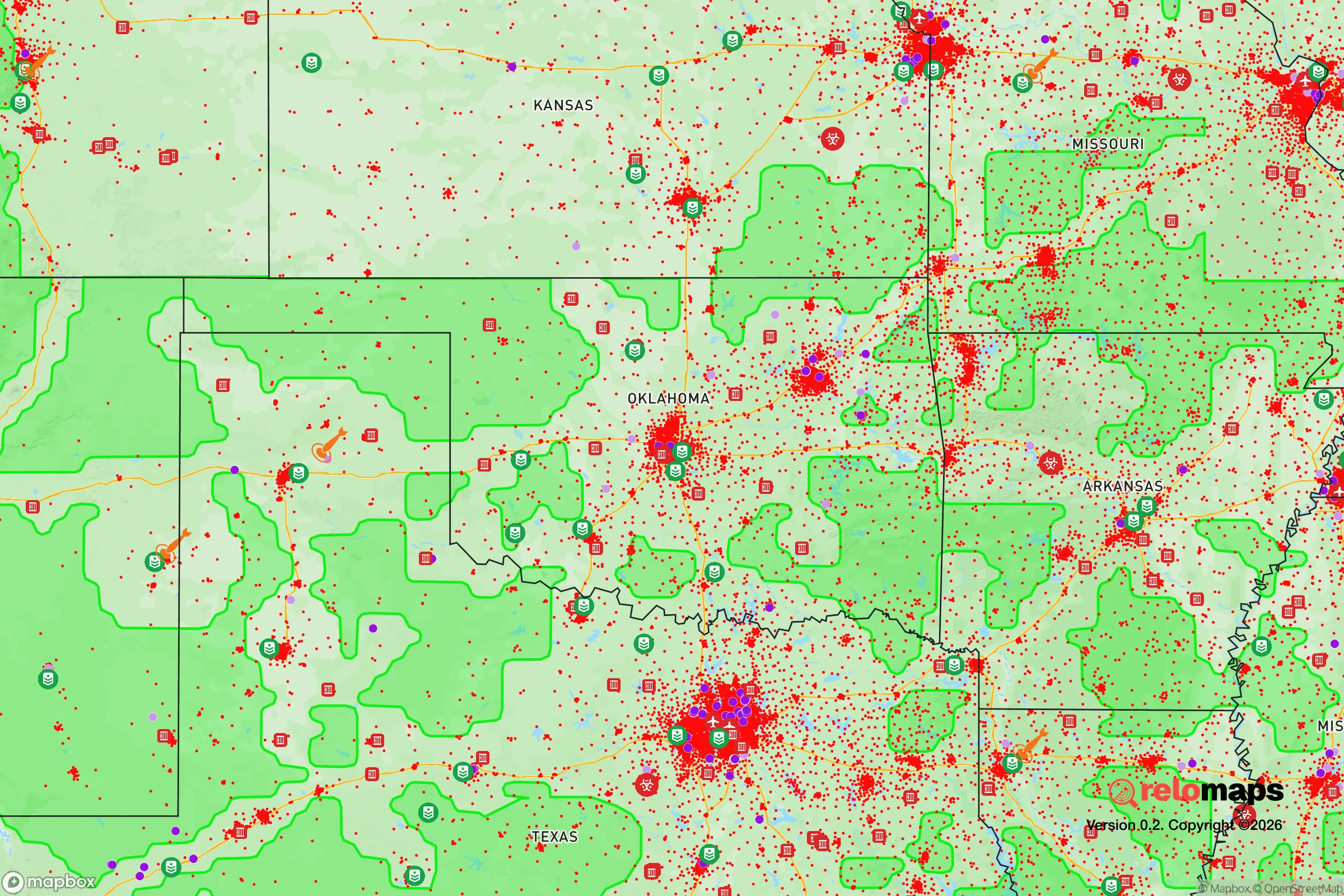
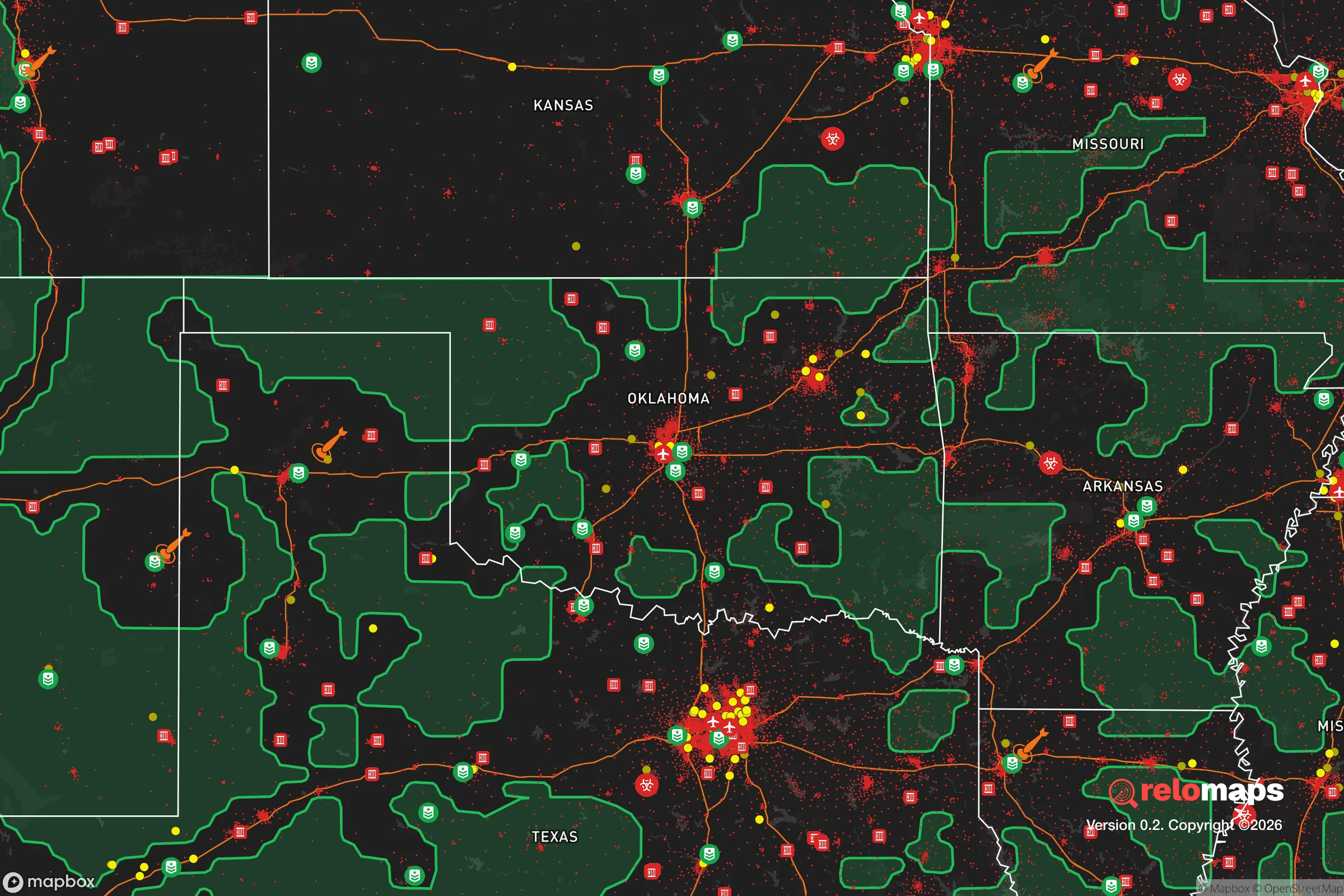


Important Note: For informational purposes only. This does not mean nothing bad ever happens in the green zones. Please use common sense. This is based on public data and modeled with AI. We tried to take a conservative approach but mistakes happen. We update this regularly as new information becomes available.
Solar Generator Recommendations
Backup power matters more here than in safer locations. We've picked three solar generators across budgets and capacity tiers — start with the budget unit if you only need a few essentials, or step up if you want to run a fridge and HVAC for days at a time.
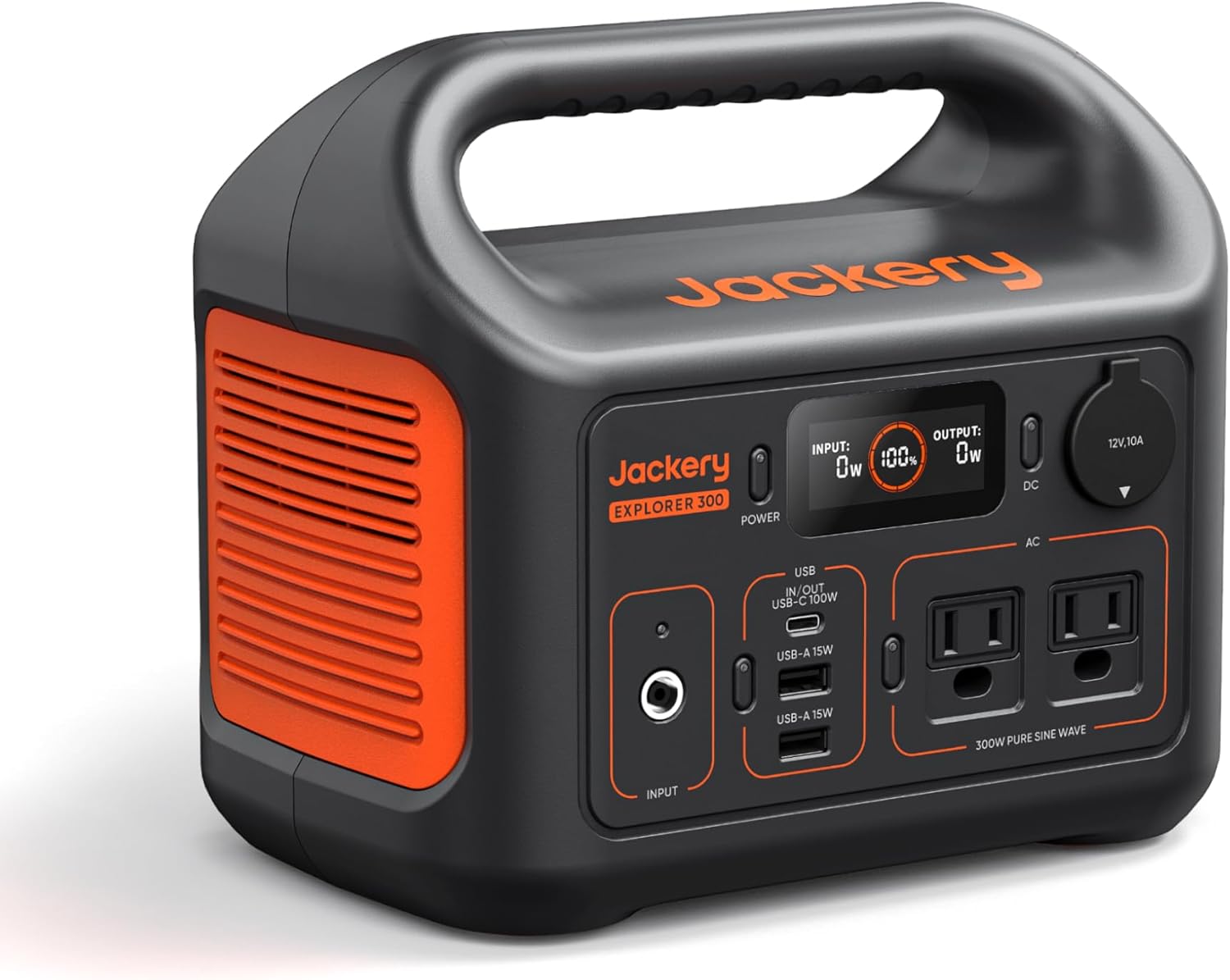
Jackery Portable Power Station Explorer 300
Budget OptionPower on the Go: Weighing only 11 lbs, it's convenient to set up and store with book-sized foldable solar panels

BLUETTI Portable Power Station AC180
Designed for both indoor and outdoor scenarios, AC180 is highly capable as it has a robost capacity and continuous output power.

EF ECOFLOW DELTA Pro Ultra Power Station
Upgraded PickEcoFlow DELTA Pro Ultra is a whole-home energy system designed to grow with your family. Integrated with the Smart Home Panel 2, it scales to meet your evolving energy needs — keeping your home powered, intelligent, and secure through every stage of life.
We earn a commission, at no additional cost to you.
Strategic Assessment Analysis
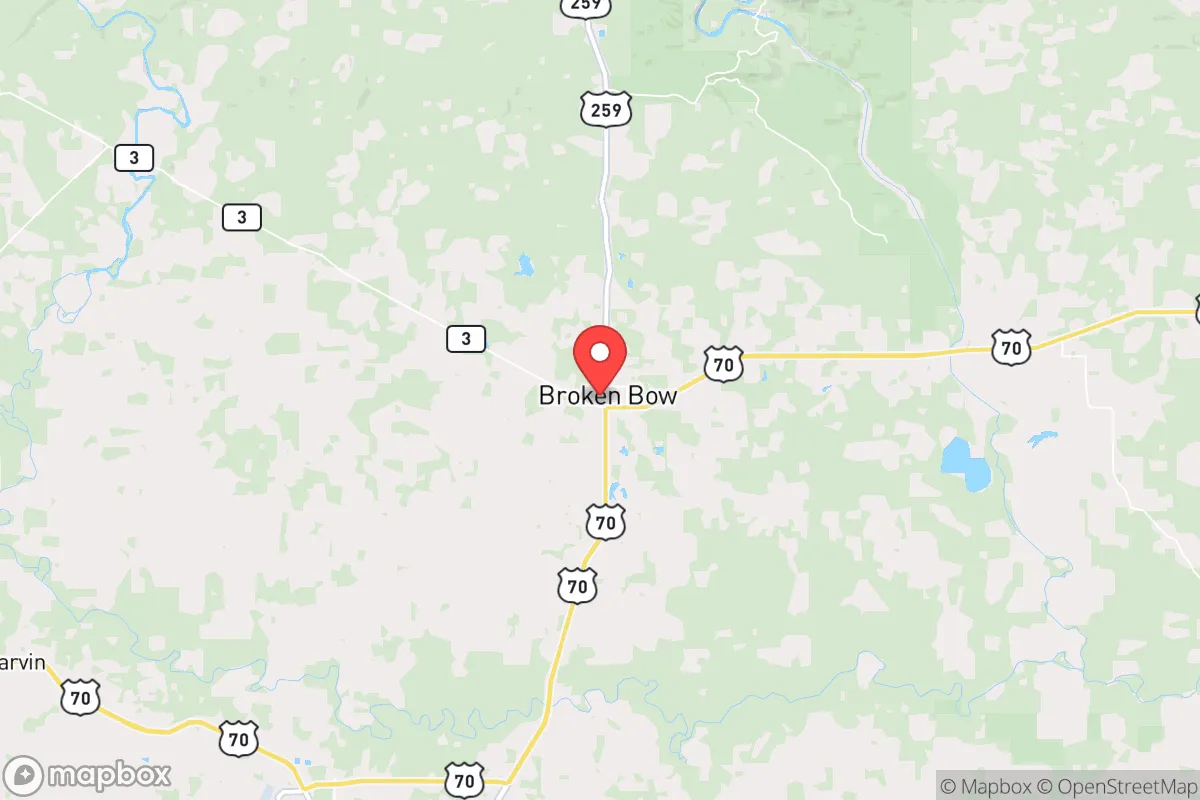
Broken Bow, Oklahoma, offers a resilience profile that is genuinely strong on paper but carries specific, often-overlooked vulnerabilities. Its location in far southeastern Oklahoma, roughly 200 miles from Dallas and 170 miles from Oklahoma City, provides a meaningful buffer from major metropolitan blast zones while still being within a practical driving distance for supply runs. The area’s strategic value lies in its abundant water, timber, and low population density, but a relocator must weigh those assets against tornado exposure, a strained local infrastructure, and the reality that the nearest major medical and logistical hubs are hours away.
Geographic position and natural advantages for long-term self-sufficiency
Broken Bow sits in McCurtain County, a region that is geographically distinct from the rest of Oklahoma. It is part of the Ouachita Mountains and the dense pine forests of the Kiamichi Country, which gives it a natural resource profile that is rare in the Great Plains. The most significant asset is water: Broken Bow Lake and the Mountain Fork River provide a reliable, high-volume freshwater source that is not dependent on municipal wells or aging pipelines. For a household planning on rainwater catchment or surface water filtration, this is a substantial advantage over most of western Oklahoma, where water scarcity is a chronic issue.
The terrain itself offers defensibility. The rolling hills, dense timber, and limited road networks create natural choke points and reduce the likelihood of casual foot traffic. Unlike flat, open prairie, this landscape provides cover and makes a property easier to secure. The local economy is tied to timber, tourism, and the Choctaw Nation’s casino and resort operations, which means there is a baseline of local employment that is less volatile than oil-and-gas dependent towns. The climate is also milder than the rest of Oklahoma, with more rainfall and less extreme temperature swings, which supports year-round gardening and livestock management.
Exposure to tornadoes, wildfires, and proximity to critical infrastructure targets
The primary natural risk in Broken Bow is severe weather, specifically tornadoes and straight-line winds. McCurtain County sits on the southern fringe of Tornado Alley, and while it does not see the frequency of Moore or Edmond, it is not immune. The April 2024 tornado outbreak produced an EF-2 that damaged structures near the lake, and the region regularly sees damaging hail and wind events. The local building stock is mixed; many older homes lack reinforced safe rooms, and the area’s reliance on mobile homes in rural pockets is a genuine vulnerability. A relocator should plan for a below-ground storm shelter or an interior reinforced safe room as a non-negotiable feature.
Wildfire risk is moderate but real, particularly in the dry late-summer months. The dense pine forests that make the area beautiful also create fuel loads, and the limited volunteer fire department coverage in outlying areas means a fire can spread quickly before professional response arrives. On the man-made risk side, Broken Bow’s distance from major cities is a double-edged sword. It is far enough from Dallas, Fort Worth, and Oklahoma City to avoid direct blast effects from a nuclear detonation, but it is not far enough to escape fallout patterns under certain wind conditions. The nearest significant military or industrial targets are Tinker Air Force Base near Oklahoma City and the Dallas-Fort Worth metroplex; prevailing westerly winds could carry fallout into southeastern Oklahoma in a worst-case scenario. Additionally, the nearby Hugo, Oklahoma area has a significant railroad and natural gas pipeline corridor, and the Red River valley to the south is a known transit route for hazardous materials.
Practical resilience for a relocator: food, water, energy, and defensibility
For a household serious about self-sufficiency, Broken Bow offers a workable base, but it requires deliberate preparation. The growing season is roughly 220 days, which is excellent for a serious garden, and the local soil, while acidic and sandy in places, is workable with compost and raised beds. The area has a strong hunting and fishing culture; deer, turkey, and small game are abundant, and the Mountain Fork River supports year-round fishing. However, the local grocery infrastructure is thin. The main supermarket options are a Brookshire’s and a Walmart in Broken Bow proper, and both are vulnerable to supply chain disruptions. A relocator should plan for at least a 90-day food reserve, not because of an imminent collapse, but because a winter ice storm or a regional trucking disruption can empty shelves for a week or more.
Water is the area’s strongest suit. A well is the most reliable option, with typical depths in the region ranging from 100 to 300 feet, and the water table is generally stable. For those on municipal water, Broken Bow’s system draws from the lake and is generally reliable, but it is not hardened against a long-term power outage. A backup generator, a hand pump, or a gravity-fed rainwater system is a wise investment. Energy is a mixed picture. The local electric cooperative, Kiamichi Electric, serves the area, but rural outages are common after storms, and some outages have lasted several days in recent years. Solar is viable, with the region averaging about 5.0 peak sun hours per day, but the heavy tree cover means most properties require significant clearing to get adequate sun exposure. Propane is the most common backup fuel, and a 500-gallon tank is a practical baseline.
Defensibility is a function of property selection. The ideal setup is a property with a single, gated access point, a clear line of sight to the road, and a water source on-site. The local sheriff’s office response time in rural McCurtain County is typically 15 to 30 minutes, so a household must be its own first responder. The community itself is a mixed bag; the Choctaw Nation has a strong presence and a functioning tribal government, which adds a layer of social cohesion, but the broader county population is sparse and spread out. Neighbors are generally self-reliant, but there is no dense mutual-aid network like you might find in a small farming town in the Midwest.
The overall strategic picture for a disaster-conscious relocator
Broken Bow is a solid, not spectacular, choice for a resilience-focused relocation. It offers genuine advantages in water availability, natural cover, and distance from primary targets, and the cost of land remains well below the national average. The trade-offs are real: severe weather risk, a thin local supply chain, and a healthcare system that is limited to a small regional hospital in Idabel, with Level I trauma care requiring a two-hour drive to Texarkana or Tulsa. For a single individual or a family willing to invest in a storm shelter, a well, and a solar-plus-battery system, this area can support a high degree of self-sufficiency. It is not a bug-out location for a short-term crisis; it is a place to build a long-term, low-profile operation where the land and water do most of the work. The key is to treat it as a homesteading project, not a passive relocation, and to accept that the nearest major city is a deliberate drive, not a quick trip.

* Values derived from national, state, county, city and local statistics and may differ in a specific area. Last updated: 2026-10-29T00:16:58.000Z
Narrative content on this page is AI-generated and may contain mistakes. Verify any details that matter before acting on them.
ReloMaps may earn a commission from affiliate links at no extra cost to you.

