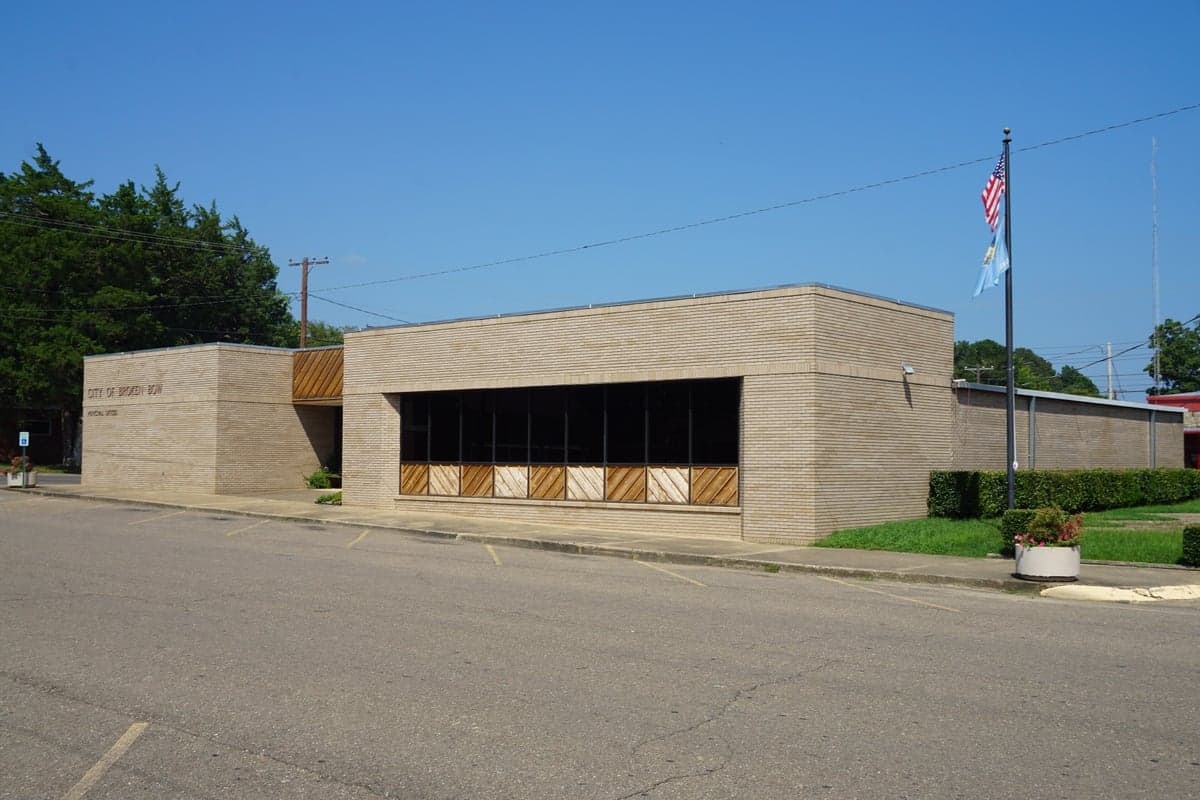
Photo: Wikipedia
Demographics of Broken Bow, OK
Affluence Level in Broken Bow, OK
A middle-class area roughly in line with national averages across income, home values, education, and employment.
People of Broken Bow, OK
The people of Broken Bow, Oklahoma, today number 4,215, forming a small, tight-knit community where a strong sense of local identity is rooted in the area’s timber and railroad history. The population is predominantly White (56.3%), with a notable Black community (7.1%) and a growing Hispanic population (5.9%), while 6.1% of residents are foreign-born. The city’s character is distinctly rural and family-oriented, with a lower-than-average college attainment rate (13.4%) reflecting a workforce historically tied to manual labor and natural resources. This is a place where generational roots run deep, and newcomers are often drawn by affordable land and a slower pace of life.
How the city was settled and grew
Broken Bow was founded in 1911 as a railroad town, carved out of the dense timberlands of southeastern Oklahoma. The Choctaw Nation originally held this land, and after allotment, much of it passed into White and Black homesteaders’ hands. The first major wave of settlers were White farmers and loggers from the Ozarks and the Deep South, who built the original downtown along the Kansas City Southern Railway. The Historic Downtown District, centered on Main Street, was the commercial and social hub for these early families. A second, smaller wave of Black families arrived during the Great Migration, finding work in the sawmills and railroad yards; they established a distinct community in the South Side area, near the rail tracks, where a few historic churches still stand. By 1930, the population had reached roughly 1,500, and the town’s economy revolved entirely around timber, with the Dierks Brothers lumber company as the dominant employer.
Modern era (post-1965)
The post-1965 era brought gradual demographic shifts. The Immigration and Nationality Act of 1965 had a muted effect here compared to larger cities, but it did open the door for a small but steady influx of Hispanic families, primarily from Mexico and Central America, who came to work in the poultry processing plants and timber yards. These new residents initially settled in the West Side neighborhoods, near the industrial corridor along US-70, where affordable rental housing was available. The Black population, which had peaked at around 12% in the 1970s, declined slightly as younger generations moved to larger cities for jobs, leaving an older, more settled community in the South Side. Meanwhile, White families began suburbanizing outward from the historic core, developing the Northwood Addition and Lakeview Estates subdivisions in the 1980s and 1990s, drawn by newer homes and larger lots. The 2000s saw a modest uptick in Asian (East/Southeast Asian) residents, but the data shows that share remains at 0.0% today, indicating no sustained community formed. The Indian subcontinent population is also 0.0%.
The future
The population of Broken Bow is projected to remain stable or grow slowly, with the most significant change being the continued increase in the Hispanic share. The Hispanic population, currently at 5.9%, is expected to rise as younger families move into the area for work in the expanding tourism and service sectors tied to Broken Bow Lake and Beavers Bend State Park. These new arrivals are concentrating in the West Side and in newer, unincorporated subdivisions like Cedar Creek to the south, where housing is more affordable. The White population share is likely to continue its gradual decline, not from out-migration but from an aging demographic and lower birth rates. The Black community is expected to remain stable, anchored by longstanding families in the South Side. The city’s cultural identity is slowly evolving from a purely timber-and-railroad town to a recreation-oriented community, but the core values of self-reliance, neighborliness, and conservative social norms remain deeply entrenched.
For someone moving in now, Broken Bow offers a low-cost, low-crime environment where community ties are strong and the pace of life is unhurried. The population is becoming slightly more diverse, particularly with Hispanic families, but remains overwhelmingly White and native-born. The city is not experiencing rapid growth or dramatic cultural change; instead, it is a place where tradition holds firm, and newcomers who respect that tradition will find a welcoming, if reserved, community. The bottom line: Broken Bow is a stable, family-oriented town where the past is still present, and the future looks much like the present—only with more tourists and a few more Hispanic neighbors.

* Values derived from national, state, county, city and local statistics and may differ in a specific area. Last updated: 2026-10-29T00:16:58.000Z
Narrative content on this page is AI-generated and may contain mistakes. Verify any details that matter before acting on them.
ReloMaps may earn a commission from affiliate links at no extra cost to you.

