Photo: Wikipedia
Demographics of Brighton, MI
Affluence Level in Brighton, MI
An upper-middle-class area. Household wealth, education levels, and homeownership run ahead of national benchmarks.
People of Brighton, MI
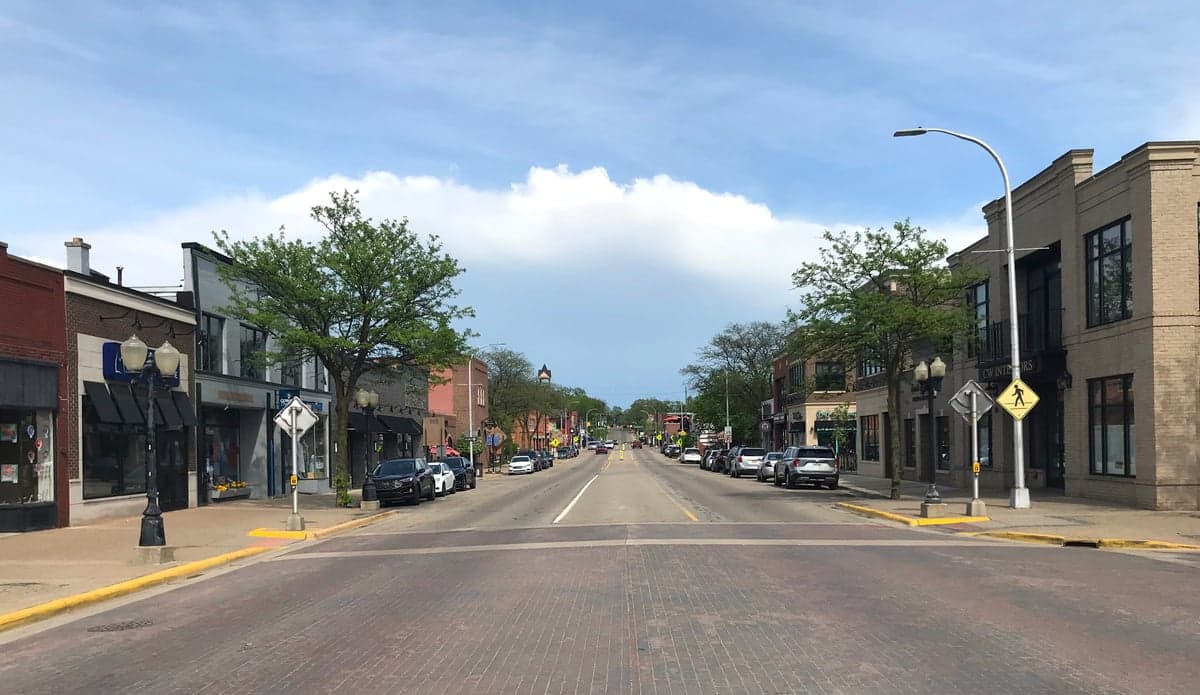
The people of Brighton, Michigan today form a predominantly white, highly educated, and family-oriented community of 7,576 residents. With a 93.9% white population and a foreign-born share of just 1.1%, the city remains one of the least ethnically diverse in Livingston County, yet it attracts newcomers through its strong schools, low crime rates, and proximity to Detroit-area employment. The city’s identity is shaped by a blend of historic small-town character and modern suburban convenience, with a median household income well above the state average and a college attainment rate of 47.3% that signals a professional-class tilt.
How the city was settled and grew
Brighton’s population history begins with the 1830s land rush following the Treaty of Washington (1836), which opened former Ojibwe and Odawa territory to Euro-American settlement. The first permanent settlers were farmers and mill operators from New York and New England, drawn by the water power of the Mill Pond and the fertile soil along the Huron River. The village was platted in 1837 and quickly became a stagecoach stop on the route between Detroit and Lansing. The Old Village district, centered on Main Street and Grand River Avenue, retains the original 19th-century commercial blocks built by these Yankee settlers. A second wave arrived after the Detroit, Lansing and Northern Railroad reached Brighton in 1871, bringing Irish and German laborers who settled in the Mill Pond neighborhood and along the rail corridor. These groups built St. Patrick’s Catholic Church (founded 1873) and the German Methodist Church, anchoring working-class enclaves that persisted through the early 1900s. By 1900, Brighton’s population had reached roughly 1,200, with the economy revolving around the Brighton Mills, a gristmill and sawmill complex that employed much of the village.
Modern era (post-1965)
The post-1965 period transformed Brighton from a sleepy farm village into a commuter suburb. The completion of I-96 in the early 1970s cut travel time to Detroit to under 45 minutes, triggering a wave of domestic in-migration from Wayne and Oakland counties. These new residents—overwhelmingly white, middle-class, and often with young families—settled in newly built subdivisions such as Woodland Lake Estates and Bishop’s Green, which expanded the city’s housing stock by more than 60% between 1970 and 1990. The racial composition remained nearly unchanged during this period: the 1980 census recorded a 98.5% white population, and the 2000 census still showed 97.2% white. The small non-white population that did arrive concentrated in the Chilson Hills area, where a handful of East/Southeast Asian families (primarily of Chinese and Korean descent) moved for tech and engineering jobs at nearby facilities like the General Motors Proving Ground in Milford. The Indian-subcontinent population, at 0.2% today, is negligible and largely dispersed rather than clustered. Hispanic residents (1.3%) are scattered across the city, with no single neighborhood reaching a 5% Hispanic share. The foreign-born share, at 1.1%, is roughly one-tenth the national average, reflecting Brighton’s limited draw for international migrants.
The future
Brighton’s population trajectory points toward slow, modest growth with minimal diversification. The city’s population has grown only 3.2% since 2010, constrained by limited developable land within city limits and strong zoning protections that favor single-family homes on large lots. The Brighton Lakes development, a 200-home subdivision approved in 2022, will add some new residents but is marketed to the same demographic profile—white, affluent families—that already dominates. The school district, Brighton Area Schools, draws families from surrounding townships but has seen its non-white enrollment rise only from 4% in 2010 to 7% in 2025, a pace that suggests the city will remain overwhelmingly white for at least another generation. The most likely demographic shift is an aging population: the share of residents over 65 has risen from 12% in 2010 to 18% in 2025, driven by empty-nesters downsizing into condos in the Grand River corridor. Younger families continue to arrive but in smaller numbers than in the 1990s and 2000s, as housing prices (median home value $385,000 in 2025) push first-time buyers to cheaper areas like Howell or Fenton.
For someone moving in now, Brighton offers a stable, safe, and culturally homogeneous community with excellent public services and a strong sense of local identity. The trade-off is clear: residents accept limited diversity and slow demographic change in exchange for low crime, high-performing schools, and a predictable suburban lifestyle. The city is not becoming more diverse in any meaningful sense, and newcomers should expect the social fabric to remain largely unchanged over the next decade.

* Values derived from national, state, county, city and local statistics and may differ in a specific area. Last updated: 2026-10-08T08:48:38.000Z
Narrative content on this page is AI-generated and may contain mistakes. Verify any details that matter before acting on them.
ReloMaps may earn a commission from affiliate links at no extra cost to you.

