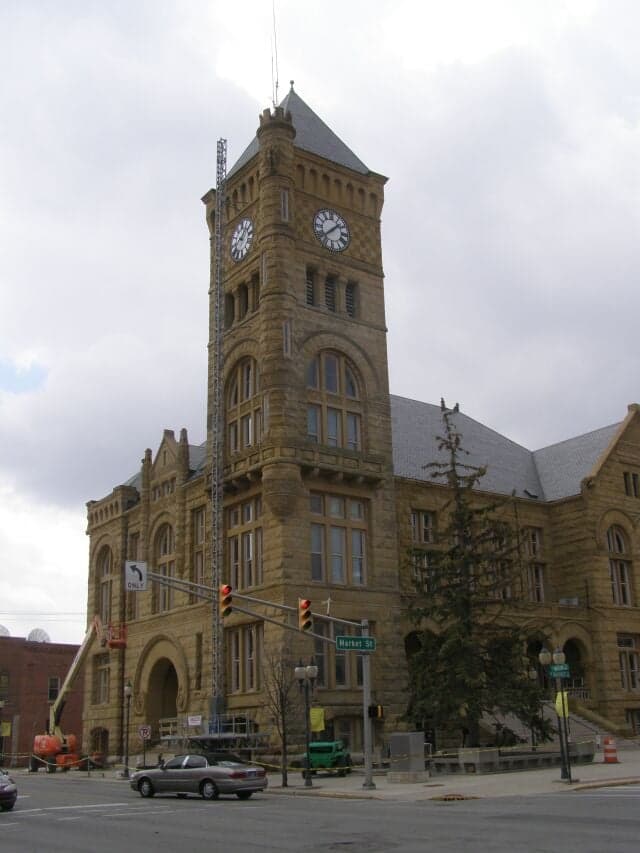
Photo: Wikipedia
Political ClimatePolitical Climate in Bluffton, IN
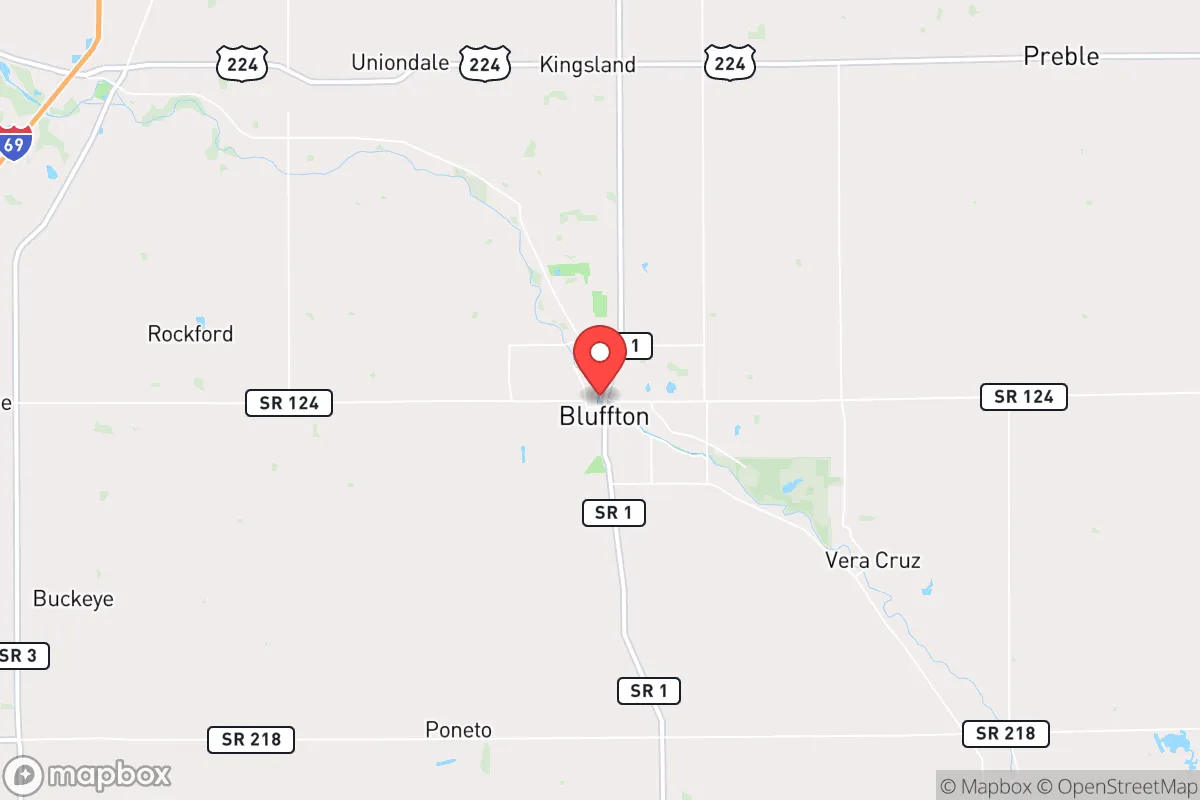
District shown is the primary district for this city’s centroid. Cities may span multiple districts.
Local Political AnalysisPolitical Analysis of Bluffton, IN
Bluffton, Indiana, is a reliably conservative community where Republican candidates typically win by comfortable margins, and that pattern has only solidified in recent years. The town sits in Wells County, which carries a Cook Partisan Voting Index of R+16, meaning the area votes about 16 points more Republican than the national average. That’s a noticeably redder tilt than Indiana as a whole, which sits at R+9, and it reflects a local political culture that has stayed steady even as the state has shifted rightward over the past decade. If you’re moving here, you’ll find a place where conservative values are the baseline, but the political temperature is generally lower-key than in more polarized suburban or urban areas.
How it compares
Bluffton’s R+16 rating puts it well to the right of Indiana’s statewide R+9, meaning the area is roughly 7 points more Republican than the average Hoosier county. That gap isn’t huge, but it’s consistent: Wells County has voted Republican in every presidential election since at least 2000, often by margins of 65-70% or more. For context, nearby Fort Wayne (Allen County) leans Republican but with a softer R+13 rating, while larger cities like Indianapolis (Marion County) tilt Democratic. Bluffton’s politics are more in line with other small-town northeastern Indiana communities like Decatur or Berne, where social and fiscal conservatism are the norm. The contrast with Indiana’s more competitive counties—like Hamilton County (R+14) or Hendricks County (R+12)—isn’t dramatic, but Bluffton’s lean is a bit more pronounced, especially in down-ballot races where local candidates rarely face serious Democratic opposition.
What this means for residents
For conservative residents, Bluffton’s political climate means their views are the default in local government, school board decisions, and community events. You’ll find churches, gun-friendly policies, and a general skepticism of big-government solutions baked into everyday life. For liberal residents, the reality is more about being in the minority—not hostile, but definitely out of step with the majority. There’s no active suppression of progressive voices, but you won’t find many like-minded neighbors, and local political activism tends to center on Republican primaries rather than general elections. The practical effect is that policy debates here are narrow: taxes stay low, zoning is minimal, and social issues are handled conservatively. If you’re moving from a blue state or a more diverse city, expect a quieter political scene where most people agree on the basics, and disagreements are more about style than substance.
Culturally, Bluffton stands apart from Indiana’s larger cities in its emphasis on local traditions, church involvement, and a slower pace of life. The town’s annual events—like the Bluffton Free Street Fair—reflect a community that values continuity over change. Politically, that translates into a preference for incumbents and a resistance to rapid policy shifts, whether from the left or the right. While Indiana as a whole has seen growing polarization between its urban and rural areas, Bluffton remains firmly in the rural conservative camp, with little appetite for the kind of cultural battles that dominate statehouse news. For newcomers, the takeaway is simple: if you’re comfortable with a community that leans right and values stability, you’ll fit in fine. If you’re not, you’ll still find polite neighbors, but you’ll likely feel like an outlier on most political questions.

State Political ClimatePolitical Climate in Indiana
State Political AnalysisPolitical Environment in the State
Indiana has been a reliably Republican state for decades, carrying the GOP in every presidential election since 2008 except for Barack Obama’s narrow 2008 win, and it currently holds a Cook Partisan Voting Index of R+9. The state’s political center of gravity is a coalition of socially conservative rural voters, fiscally conservative suburbanites, and a growing number of working-class voters who have shifted rightward on cultural and economic issues. Over the last 10-20 years, the trajectory has been a steady march rightward, with the GOP consolidating power at the state level — holding supermajorities in both chambers of the General Assembly and the governor’s office since 2005 — while the Democratic Party has become increasingly concentrated in a handful of urban and college-town strongholds.
Urban vs. rural divide
The political map of Indiana is a classic study in contrast. The state’s largest population center, Indianapolis (Marion County), is a Democratic stronghold, consistently voting blue by double digits in presidential elections. However, the surrounding suburban counties — Hamilton, Hendricks, and Johnson — are deeply Republican, with Hamilton County often delivering some of the highest GOP margins in the state. Fort Wayne (Allen County) leans Republican but is more competitive, while Evansville (Vanderburgh County) has trended redder in recent cycles. Bloomington (Monroe County), home to Indiana University, is the state’s most reliably liberal city outside of Indianapolis, while Lafayette (Tippecanoe County) and West Lafayette (Purdue University) create a purple pocket in an otherwise red region. The rural counties that make up the rest of the state — places like Knox, Pulaski, and Switzerland counties — vote Republican by margins of 70-80% or more. The result is a state where Democrats win the cities but lose everywhere else, and the GOP’s advantage in the state legislature is amplified by gerrymandered districts that lock in their supermajority.
Policy environment
Indiana’s policy environment is defined by low taxes, limited regulation, and a strong emphasis on local control. The state has a flat income tax rate of 3.05% (scheduled to drop to 2.9% by 2027), a 7% sales tax, and some of the lowest property tax rates in the Midwest. There is no statewide rent control or rent stabilization, and zoning is handled almost entirely at the municipal level. Education policy has been a major focus: Indiana has one of the most expansive school choice programs in the country, with universal eligibility for vouchers and charter schools, and the state has banned critical race theory and certain diversity, equity, and inclusion initiatives in K-12 classrooms. Healthcare policy is relatively hands-off, with no state-level individual mandate and limited Medicaid expansion (the Healthy Indiana Plan). Election laws have tightened in recent years: voter ID is required, early voting is available but not universal, and the state purges inactive voters from rolls regularly. There is no statewide ban on firearms, and Indiana is a permitless carry state as of 2022.
Recent policy direction
The last few years have seen Indiana move decisively in a conservative direction across multiple fronts. On gun rights, the state passed permitless carry (House Enrolled Act 1296) in 2022, allowing any law-abiding adult to carry a handgun without a license. On education, the state enacted a broad parental bill of rights (Senate Enrolled Act 17) in 2022, requiring schools to notify parents of curriculum changes and allowing them to opt their children out of certain materials. On abortion, Indiana passed one of the nation’s most restrictive bans (Senate Enrolled Act 1) in 2022, prohibiting abortion at all stages of pregnancy with narrow exceptions for rape, incest, and life of the mother. On medical freedom, the state banned COVID-19 vaccine mandates for public employees and contractors (House Enrolled Act 1001) in 2023. On property rights, Indiana has a strong right-to-farm law and limits on eminent domain. On taxation, the state has been steadily cutting income tax rates and eliminating the business personal property tax for many small businesses. On voting, the state has tightened absentee ballot rules and shortened the window for mail-in voting. The overall direction is toward more individual liberty in the areas of guns, education, and medical choice, while restricting abortion access and maintaining a low-tax, low-regulation business climate.
Civil unrest & political movements
Indiana has seen its share of political activism, though it tends to be less volatile than in some neighboring states. The 2020 racial justice protests in Indianapolis and Bloomington were significant, with demonstrations lasting weeks and some property damage, but they did not reach the scale of unrest seen in larger cities. The state has a robust pro-life movement, with annual March for Life events in Indianapolis drawing thousands. On the right, there is an active Second Amendment sanctuary movement, with dozens of counties passing resolutions declaring themselves sanctuaries for gun rights. Immigration politics are relatively quiet, as Indiana is not a border state and has no major sanctuary city policies — Indianapolis has a limited "welcoming city" ordinance but does not actively defy federal immigration enforcement. Election integrity has been a flashpoint, with the 2020 election leading to audits and legislative changes, though no widespread fraud was found. A new resident would notice that political signs and bumper stickers are common, especially in rural areas, but open political confrontation is rare outside of social media.
Projection
Over the next 5-10 years, Indiana is likely to remain solidly Republican, but the margins may narrow slightly as Indianapolis and its inner suburbs continue to diversify and grow. The state’s population is aging and slowly declining in rural areas, while the urban and suburban counties are gaining younger, more diverse residents. However, the GOP’s structural advantages — gerrymandered districts, a strong rural base, and a growing conservative-leaning exurban population — mean that Democrats are unlikely to win statewide office or break the legislative supermajority in the near term. The biggest wild card is in-migration: Indiana is attracting people from Illinois and California, many of whom are moving for lower taxes and a more conservative culture, which could reinforce the state’s rightward tilt. A new resident moving in now should expect to find a state that is politically stable, with predictable conservative governance, but with enough urban and college-town diversity to avoid feeling like a monoculture.
For a new resident, the bottom line is that Indiana offers a reliably conservative policy environment with low taxes, strong gun rights, school choice, and a business-friendly regulatory climate. Liberal residents will find safe havens in Bloomington, Indianapolis, and parts of Lafayette, but should expect to be in the minority in most of the state. The political climate is stable and predictable, with no major upheavals on the horizon — just a steady continuation of the trends that have defined Indiana for the last two decades.
* Values derived from national, state, county, city and local statistics and may differ in a specific area. Last updated: 2026-10-21T15:10:49.000Z
Narrative content on this page is AI-generated and may contain mistakes. Verify any details that matter before acting on them.
ReloMaps may earn a commission from affiliate links at no extra cost to you.

