
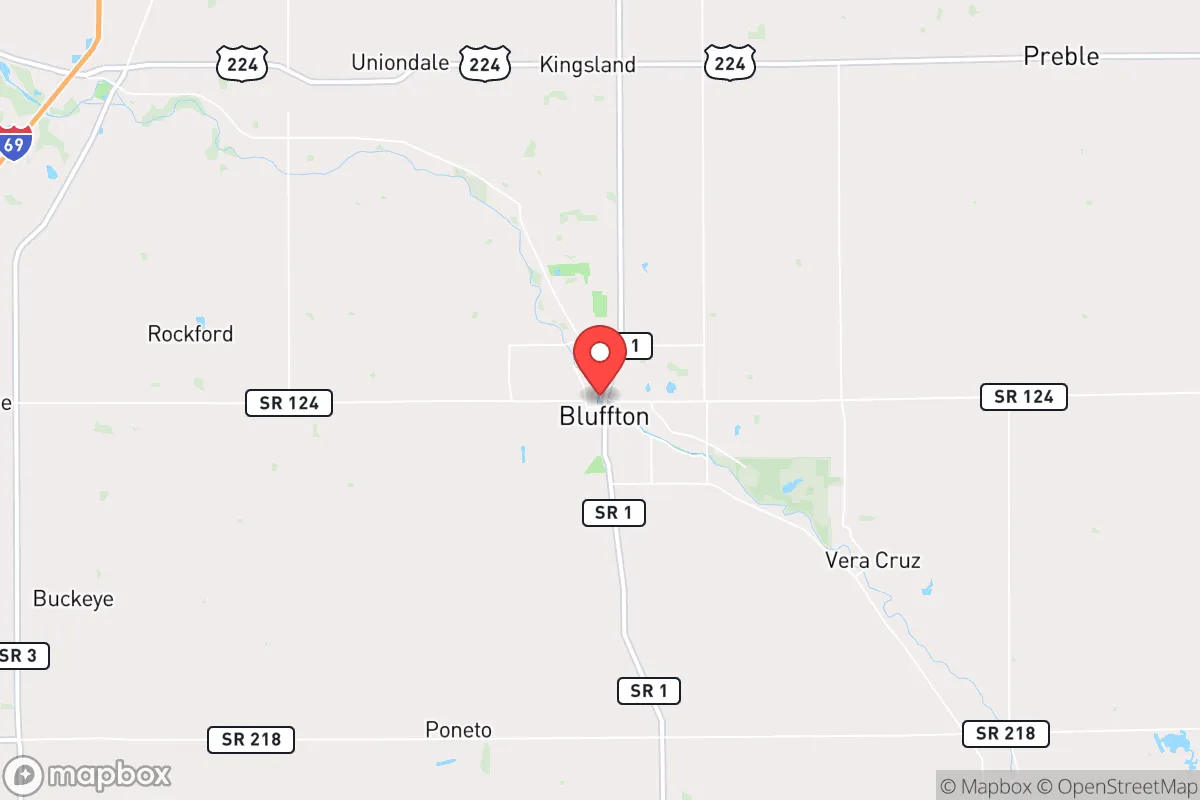
Photo: Wikipedia
Personal Sovereignty in Bluffton, IN
Viable for self-reliance. Generally workable, though some barriers may limit total independence.
What does Personal Sovereignty tell us?
Personal Sovereignty measures your capacity for self-reliance and independence with minimal government friction. Higher scores mean fewer barriers between you and the way you want to live... but it assumes you have the space you need and good neighbors.
What does this tell us?
Personal Sovereignty measures your capacity for self-reliance and independence with minimal government friction. Higher scores mean fewer barriers between you and the way you want to live... but it assumes you have the space you need and good neighbors.
State Policy
Energy independence: Importer (35% of energy produced in-state)
Personal Liberty
Homesteading

Personal Liberty Analysis
Bluffton, Indiana, offers a personal sovereignty environment shaped by the state's strong preemption laws, low tax burden, and a regulatory culture that generally favors individual decision-making over government oversight. As a small city in Wells County, Bluffton sits within a state that consistently ranks among the most fiscally conservative and legally permissive in the Midwest, meaning residents here face fewer layers of local control than in many other parts of the country. For a single person or family prioritizing autonomy, the practical question is not whether Indiana grants broad freedoms—it does—but how those freedoms play out at the local level in a community of roughly 10,000 people. The answer is that Bluffton's regulatory posture is light-touch, with local ordinances rarely adding meaningful friction to state-level permissiveness.
Tax burden and regulatory posture in Wells County
Indiana's state income tax is a flat 3.05% as of 2026, and Wells County's combined property tax rate typically falls below 1% of assessed home value, making the total tax burden one of the lowest in the Great Lakes region. There is no local sales tax beyond the state's 7% rate, and no municipal income tax in Bluffton itself, which is a meaningful advantage over many Indiana cities that layer on additional local levies. The regulatory environment for small businesses and property owners is similarly restrained: Wells County does not impose county-level building codes outside of state minimums, and Bluffton's zoning code is straightforward, with no rent control, no inclusionary zoning mandates, and no local business licensing requirements beyond a basic registration. For a reader comparing Bluffton to a state like Illinois or California, the difference is stark—fewer permits, lower fees, and a general expectation that the government's role is to enforce basic safety standards rather than manage economic outcomes.
Self-defense and gun law specifics in Indiana
Indiana is a constitutional carry state, meaning no permit is required to carry a handgun openly or concealed for any law-abiding adult 18 or older. Bluffton has no local ordinances restricting firearm possession, storage, or carry beyond state law, and the city does not maintain a gun registry or impose waiting periods. The state's "stand your ground" law, codified in Indiana Code 35-41-3-2, removes any duty to retreat before using deadly force in any place where a person has a legal right to be, and self-defense claims are evaluated under a reasonable-person standard. For a family concerned about home defense, Indiana law explicitly protects the use of force against unlawful entry, and there is no legal distinction between defending a primary residence and a vehicle or workplace. The practical effect in Bluffton is that a resident can own, carry, and use firearms for self-defense with minimal bureaucratic interference—no fingerprinting, no training requirement, and no local authority can create a patchwork of gun rules that contradicts state preemption.
Self-reliance and homesteading viability in Bluffton
Bluffton's position in an agricultural county means that even within city limits, lot sizes are generous by national standards—typical residential lots range from a quarter-acre to half an acre, and properties on the town's edges often exceed one acre. The city's zoning code permits keeping chickens, rabbits, and beehives on residential lots without a special permit, and there are no restrictions on vegetable gardens, composting, or rainwater collection. Wells County's soil is fertile and well-drained, and the growing season runs roughly from mid-April to mid-October, making serious home food production feasible. For off-grid feasibility, the picture is more mixed: Bluffton requires connection to municipal water and sewer for habitable structures within city limits, so true off-grid living is only possible on unincorporated county land, where no such mandate exists. Solar panels are permitted without special zoning approval, and Indiana's net metering policy allows homeowners to sell excess power back to the grid at retail rates, though the state's low electricity costs mean the financial incentive is modest. A family wanting to raise livestock beyond poultry or pursue a more independent lifestyle would find the best options on the county's rural parcels, where minimum lot sizes are typically one to three acres and no building permits are required for agricultural structures.
Personal liberties: parental rights, medical autonomy, and property
Indiana law strongly favors parental rights in education and healthcare decisions. The state's "parental bill of rights" statute (IC 20-33-2) gives parents explicit authority over their children's education, medical treatment, and moral upbringing, and Bluffton's local school district does not have policies that contradict this framework. Homeschooling is straightforward: parents file a one-time notification with the state and are not subject to curriculum approval, standardized testing requirements, or home visits. Medical autonomy for adults is similarly broad—Indiana has no state-level vaccine mandate for general employment or public accommodation, and the state's health freedom laws protect the right to refuse any medical treatment. On property rights, Indiana's eminent domain laws are among the most restrictive in the country for government takings, and Wells County has not pursued aggressive condemnation projects. The state also prohibits local governments from enacting rental registration schemes or landlord licensing programs that go beyond basic health and safety inspections, which protects a property owner's ability to use their land as they see fit without excessive bureaucratic oversight.
Compared to other parts of the Midwest, Bluffton offers a notably high degree of personal sovereignty, particularly for a town of its size. The combination of constitutional carry, low taxes, minimal local regulation, and strong parental rights creates an environment where the default answer from government is "yes" unless a specific harm is demonstrated. A resident moving from a high-regulation state will notice the absence of friction—no waiting periods, no special permits for common activities, no layers of local bureaucracy. For someone who values independence as a primary relocation criterion, Bluffton delivers the structural freedom to live largely as one chooses, with the understanding that the trade-off is a smaller set of public services and a community that expects self-reliance rather than subsidizing it.

* Values derived from national, state, county, city and local statistics and may differ in a specific area. Last updated: 2026-10-21T15:10:49.000Z
Narrative content on this page is AI-generated and may contain mistakes. Verify any details that matter before acting on them.
ReloMaps may earn a commission from affiliate links at no extra cost to you.

