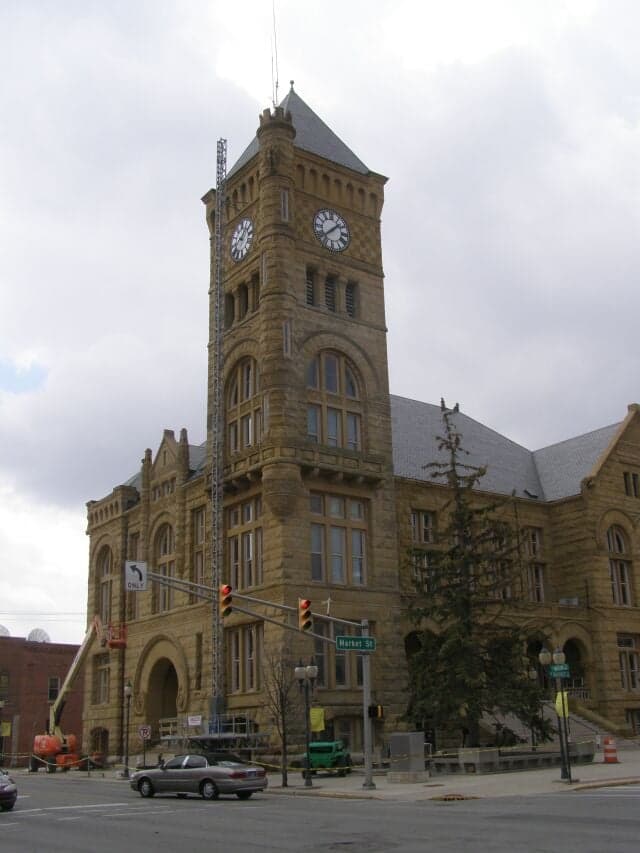
Photo: Wikipedia
Demographics of Bluffton, IN
Affluence Level in Bluffton, IN
A middle-class area roughly in line with national averages across income, home values, education, and employment.
People of Bluffton, IN
Bluffton, Indiana, is a small, predominantly white, working-class city of 10,539 residents, where the population has remained remarkably stable and culturally homogenous for decades. The city's identity is rooted in its manufacturing and agricultural heritage, with a strong sense of local community and traditional values that appeal to families seeking a quieter, more affordable lifestyle. With a foreign-born population of just 0.8% and a 89.3% white demographic, Bluffton is one of the least diverse cities in the region, a character that has been shaped by its specific industrial history and limited in-migration from outside the immediate area.
How the city was settled and grew
Bluffton was founded in 1838 along the Wabash River, its early growth driven by the construction of the Wabash and Erie Canal, which made the town a regional shipping hub. The original settlers were primarily of German and Swiss ancestry, drawn by the promise of fertile farmland and the economic opportunities of the canal. As the canal era faded, the arrival of the railroad in the 1870s spurred a new wave of growth, transforming Bluffton into a manufacturing center for wagon parts, and later, automotive components. The historic West End neighborhood, with its tightly packed homes near the old industrial corridor, was built by these early German and Swiss immigrants and their descendants, who formed the backbone of the city's skilled labor force. A smaller wave of Irish laborers arrived during the railroad construction, settling in the South Side district near the rail yards, though they largely assimilated into the dominant German-American culture within a generation. The city's population peaked at around 10,000 in the 1960s, and the ethnic composition has changed very little since that time.
Modern era (post-1965)
Following the 1965 Immigration and Nationality Act, Bluffton did not experience the diversification seen in larger Midwestern cities. The city's manufacturing base, centered on companies like Franklin Electric and Dana Incorporated, provided stable, well-paying jobs that attracted domestic migrants from rural Indiana and Ohio, but did not draw significant international populations. The Northcrest subdivision, developed in the 1970s and 1980s, became the primary landing point for these in-state families, offering newer, larger homes and a suburban feel within city limits. The Hispanic population, now at 5.0%, is the city's largest minority group, and its growth has been a recent phenomenon, with families concentrated in the East Side area near the industrial parks, often working in manufacturing or food processing. The Black population (2.2%) and the small East/Southeast Asian community (0.2%) are dispersed throughout the city, with no single ethnic enclave forming. The city's low college attainment rate (16.5%) reflects the enduring dominance of blue-collar employment, where a high school diploma and a factory job have long been the standard path for residents.
The future
Bluffton's population is projected to remain flat or decline slightly over the next decade, mirroring trends across rural Indiana. The city is becoming slightly more diverse, driven primarily by the slow but steady growth of the Hispanic population, which is expected to rise from 5.0% to perhaps 7-8% by 2035. These new residents are likely to continue settling in the East Side and the newer Woodland Park area, where affordable housing stock is available. However, the overall cultural identity of Bluffton is unlikely to shift dramatically; the city remains a place where conservative social values, church attendance, and community events like the annual Bluffton Free Street Fair are central to daily life. The biggest demographic challenge is out-migration of young adults, who often leave for college or jobs in larger cities like Fort Wayne or Indianapolis, contributing to an aging population profile.
For someone moving in now, Bluffton offers a stable, safe, and affordable environment where neighbors know each other and the pace of life is slow. It is a place that has changed very little in the last fifty years, and that consistency is its primary appeal for families seeking a traditional, low-cost lifestyle. The city is not becoming a diverse, cosmopolitan hub, but rather a steady, working-class community where the past and present look very much alike.

* Values derived from national, state, county, city and local statistics and may differ in a specific area. Last updated: 2026-10-21T15:10:49.000Z
Narrative content on this page is AI-generated and may contain mistakes. Verify any details that matter before acting on them.
ReloMaps may earn a commission from affiliate links at no extra cost to you.

