Photo: Wikipedia
Demographics of Bigfork, MT
Affluence Level in Bigfork, MT
An upper-middle-class area. Household wealth, education levels, and homeownership run ahead of national benchmarks.
People of Bigfork, MT
The people of Bigfork, Montana, today number 5,249 and form a predominantly white (84.1%) community with a notable Hispanic minority (9.3%) and a very low foreign-born population (1.4%). The town is characterized by a high educational attainment—51.0% of adults hold a college degree—and a cultural identity rooted in outdoor recreation, tourism, and a strong sense of local independence. Distinctive markers include a tight-knit, family-oriented social fabric, a visible seasonal influx of second-home owners, and a political climate that leans conservative, reflecting broader Flathead County trends.
How the city was settled and grew
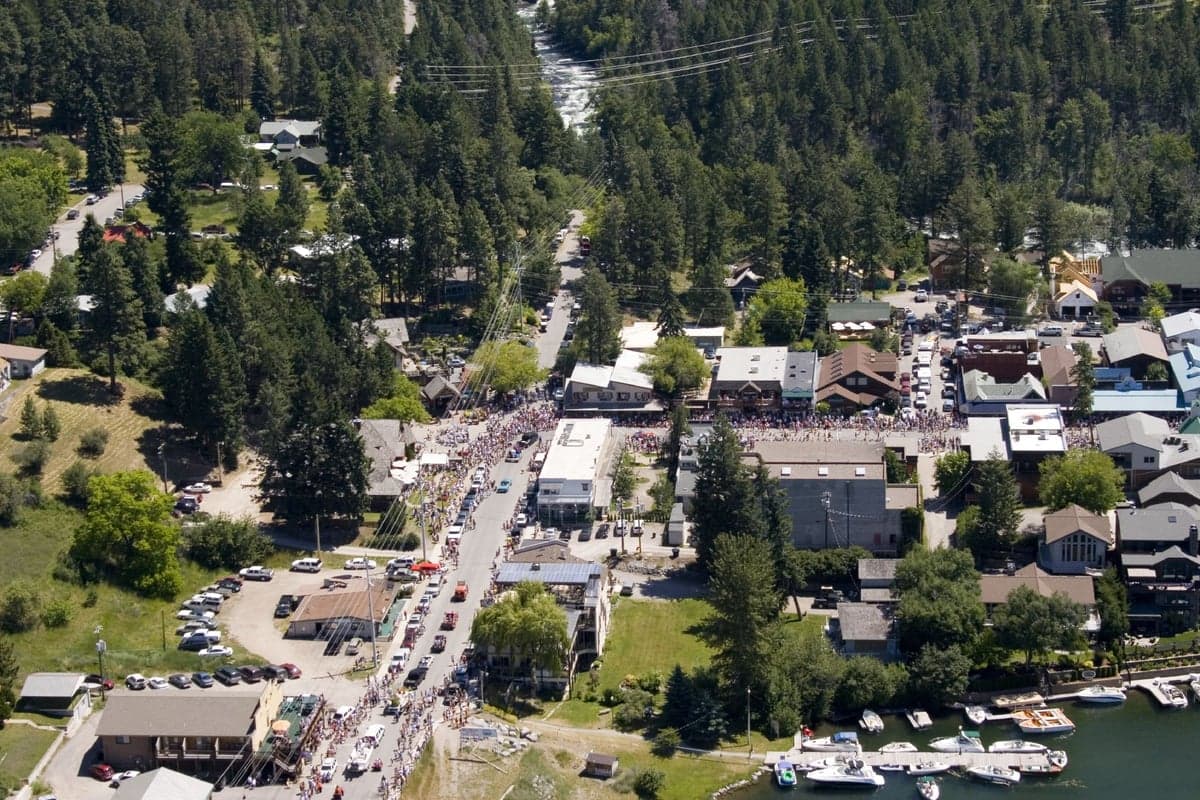
Bigfork’s human history begins with the Salish and Kootenai peoples, who used the area as seasonal fishing and hunting grounds along the Flathead River. Permanent Euro-American settlement began in the late 19th century, driven by the promise of timber and water power. The construction of a dam on the Swan River in 1902 spurred the first real wave of homesteaders and loggers, who built the original core of Historic Downtown Bigfork along Electric Avenue. These early settlers were primarily of Northern European stock—Scandinavian, German, and Irish—drawn by the opportunity to work in sawmills and establish small farms. The community remained small and isolated until the mid-20th century, with the population hovering around a few hundred. The arrival of the Great Northern Railway and later Highway 35 gradually connected Bigfork to Kalispell and the broader region, but the town’s growth was modest until the post-war era.
Modern era (post-1965)
After 1965, Bigfork began to attract a different kind of migrant: domestic in-migrants from the Pacific Northwest, California, and the Midwest seeking a slower pace and natural beauty. This wave accelerated in the 1970s and 1980s, as artists, writers, and retirees discovered the area’s scenic appeal. The Bigfork Art District around Electric Avenue became a hub for this creative influx, with galleries and studios drawing a more educated, culturally engaged population. Simultaneously, the development of Eagle Bend—a master-planned golf course community on the Flathead Lake shore—brought affluent second-home owners and seasonal residents, many from out of state. This group tended to be older, wealthier, and more politically moderate, creating a subtle cultural divide with the longer-resident, more conservative working-class population in neighborhoods like Ferndale and Woods Bay. The Hispanic population, now 9.3%, grew primarily through labor migration tied to the construction and hospitality sectors, with families settling in more affordable areas like Holt and along the Highway 35 corridor. The Black and Asian populations remain negligible (0.1% and 0.0%, respectively), reflecting the region’s historic lack of industrial or service-sector magnets for those groups.
The future
Bigfork’s population is projected to continue growing, driven by domestic migration from more expensive Western states and by retirees drawn to Flathead Lake. The town is becoming slightly more diverse, primarily through the growth of the Hispanic community, which is dispersing across the area rather than concentrating in a single neighborhood. The white share (84.1%) is likely to decline gradually as this trend continues, though Bigfork will remain overwhelmingly white for the foreseeable future. New residential development is concentrated in Eagle Bend and along the Swan River corridor, where luxury homes and townhouses are replacing older seasonal cabins. This is pushing younger families and service workers into more affordable outlying areas like Ferndale and Holt, reinforcing a geographic economic divide. The cultural identity of Bigfork is evolving from a quiet logging-and-artist enclave into a high-amenity resort community, with rising home prices and a growing tension between year-round residents and seasonal visitors.
For someone moving in now, Bigfork offers a safe, scenic, and highly educated community with a conservative-leaning culture and a strong outdoor lifestyle. The population is becoming wealthier and more transient, with a growing service-sector Hispanic workforce that adds modest diversity. The key trade-off is between natural beauty and rising costs—this is a place where newcomers are increasingly likely to be retirees or remote workers, not young families starting out.

* Values derived from national, state, county, city and local statistics and may differ in a specific area. Last updated: 2026-11-14T13:40:14.000Z
Narrative content on this page is AI-generated and may contain mistakes. Verify any details that matter before acting on them.
ReloMaps may earn a commission from affiliate links at no extra cost to you.

