
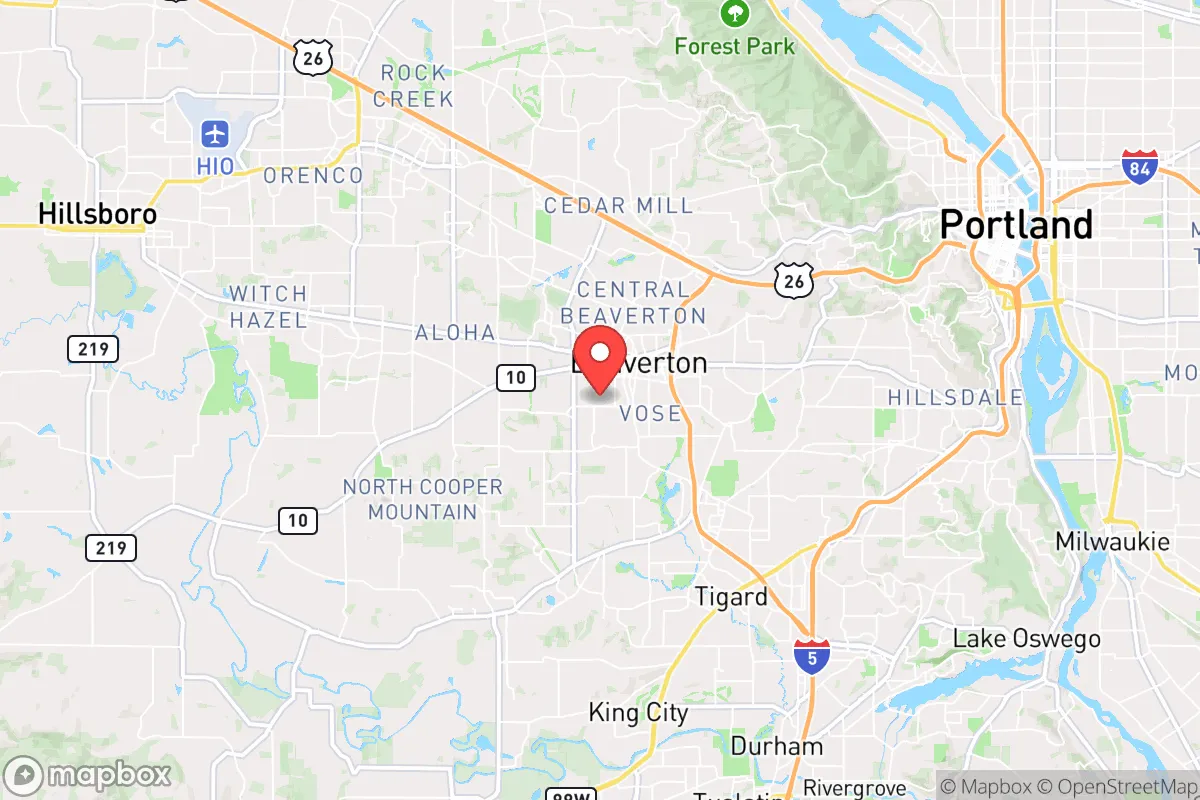
Photo: Wikipedia
Personal Sovereignty in Beaverton, OR
Viable for self-reliance. Generally workable, though some barriers may limit total independence.
What does Personal Sovereignty tell us?
Personal Sovereignty measures your capacity for self-reliance and independence with minimal government friction. Higher scores mean fewer barriers between you and the way you want to live... but it assumes you have the space you need and good neighbors.
What does this tell us?
Personal Sovereignty measures your capacity for self-reliance and independence with minimal government friction. Higher scores mean fewer barriers between you and the way you want to live... but it assumes you have the space you need and good neighbors.
State Policy
Energy independence: Importer (35% of energy produced in-state)
Personal Liberty
Homesteading

Personal Liberty Analysis
Beaverton, Oregon, presents a complex personal sovereignty environment where state-level progressive policies often override local preferences, creating a regulatory landscape that is notably heavier than in neighboring Washington or inland states like Idaho. For individuals and families who prioritize autonomy, the city offers a high baseline of personal freedoms in areas like speech and lifestyle, but imposes significant constraints on self-defense, tax burden, and property use. The net effect is a trade-off: robust civil liberties in social and medical spheres, paired with a dense web of state mandates that limit self-reliance and economic independence.
Tax burden and regulatory posture in Beaverton
Oregon’s tax structure is a defining feature of Beaverton’s sovereignty calculus. The state has no sales tax, which can be a relief for households making large purchases, but it compensates with the 8th-highest state income tax in the nation, with a top marginal rate of 9.9% on income over $125,000 for single filers. Property taxes in Washington County, where Beaverton sits, are moderate—averaging roughly 1.0% of assessed value—but are subject to the state’s Measure 5 and Measure 50 caps, which limit annual increases to 3% plus new construction. This creates predictability but also means that long-time homeowners pay far less than new buyers, a disparity that can feel inequitable. The regulatory posture is decidedly heavy-touch. Oregon’s land-use planning system, governed by statewide goals since the 1970s, strictly controls urban growth boundaries, meaning Beaverton cannot easily expand outward. This drives up housing costs and limits the kind of low-density, self-sufficient living many freedom-oriented families seek. Business regulations are also dense: the state mandates paid sick leave, has a $14.20 minimum wage (higher in the Portland metro area), and enforces strict environmental and energy codes on new construction. For a small business owner or independent contractor, the cumulative compliance burden is substantial compared to states like Texas or Florida.
Self-defense and gun law specifics in Beaverton
For those prioritizing the right to self-defense, Beaverton operates under some of the most restrictive firearm laws in the United States. Oregon requires a permit to purchase a handgun, a background check for all firearm transfers (including private sales), and a 10-day waiting period for handgun purchases. In 2022, voters passed Measure 114, which would have required a permit to acquire any firearm and banned magazines holding more than 10 rounds, but it has been blocked by court injunctions and remains in legal limbo as of 2026. Even without Measure 114 fully in effect, Beaverton’s local ordinances and state law already prohibit open carry of loaded firearms in public places, and concealed carry requires a license that involves a background check and a training course. The city itself is not a "Second Amendment sanctuary"—Washington County is generally moderate, but the Portland metro area leans heavily toward gun control. For a family that wants to keep a firearm for home defense, the process is legal but bureaucratic. For those who want to carry for personal protection outside the home, the hurdles are higher, and the legal environment is actively hostile to that choice. This is a stark contrast to states like Arizona or Montana, where constitutional carry is the norm.
Self-reliance and homesteading viability in Beaverton
Beaverton’s suburban character and Oregon’s land-use laws make traditional homesteading or off-grid living largely impractical within city limits. Typical residential lot sizes in Beaverton range from 5,000 to 10,000 square feet, with newer developments trending toward smaller lots and higher density. Zoning codes generally prohibit keeping livestock like chickens or goats without special permits, and even then, limits are strict—for example, hens are allowed in some residential zones but roosters are not, and coop placement must meet setback requirements. Off-grid living is effectively illegal: Oregon building codes require connection to municipal water and sewer systems in urban growth boundary areas, and solar panels must be grid-tied to qualify for net metering. Rainwater collection is legal but regulated, and composting toilets are not permitted as a primary sanitation method. For a family seeking to grow a substantial portion of their own food, the short growing season (roughly 150 frost-free days) and the prevalence of deer and other pests add further challenges. However, community gardens and farmers' markets are abundant, and the region’s fertile soil and mild summers do support productive vegetable gardens on small plots. The realistic picture is that Beaverton allows for moderate backyard self-sufficiency—a vegetable garden, a few fruit trees, and perhaps a small chicken coop—but not the kind of rural homesteading that defines true self-reliance. For that, one would need to look to unincorporated Washington County or farther out toward Hillsboro or Forest Grove, where lot sizes increase and zoning loosens.
Personal liberties in Beaverton: parental rights, medical autonomy, speech, and property
Beaverton’s personal liberties landscape is a study in contrasts. On the positive side, Oregon has some of the strongest protections for medical autonomy in the country. The state legalized physician-assisted suicide in 1997, has no cap on medical malpractice damages, and protects access to reproductive healthcare, including abortion, without parental consent for minors. Vaccine mandates for schoolchildren exist but allow for medical and non-medical exemptions, and the state does not require COVID-19 vaccines for employment in most sectors. Parental rights are more contested. Oregon’s 2023 law allowing students to take mental health days without parental notification and its broad sex education standards (which include LGBTQ+ content) have sparked backlash from conservative families. The state does not have a parental bill of rights, and school districts like Beaverton’s have policies that can override parental input on curriculum and student services. Free speech is broadly protected under the Oregon Constitution, which has been interpreted to provide even stronger protections than the First Amendment in some areas, such as speech in shopping malls. Property rights are constrained by the land-use system: you cannot build what you want on your land without extensive permitting, and the state’s strict environmental regulations (including the Endangered Species Act protections for salmon and spotted owls) can limit development even on private property. For a family that values the ability to make independent decisions about their children’s education, healthcare, and property use, Beaverton’s environment is moderately restrictive—better than California or New York, but far less permissive than states like Texas, Florida, or Idaho.
Overall, Beaverton offers a personal sovereignty profile that is best suited for individuals and families who prioritize social and medical freedoms over economic and self-defense liberties. The absence of sales tax and the predictability of property tax increases are genuine advantages, but the high income tax, dense regulatory environment, and restrictive gun laws create a net burden that feels heavy to those accustomed to lighter-touch governance. Compared to the Portland core, Beaverton is slightly more moderate, but it remains firmly within Oregon’s progressive policy framework. For a relocation-minded reader who values maximum autonomy, Beaverton is a compromise—a place where you can live your personal life largely as you see fit, but where the state will have a significant say in how you earn, defend, and use your property.

* Values derived from national, state, county, city and local statistics and may differ in a specific area. Last updated: 2026-06-13T10:09:38.000Z
Narrative content on this page is AI-generated and may contain mistakes. Verify any details that matter before acting on them.
ReloMaps may earn a commission from affiliate links at no extra cost to you.

