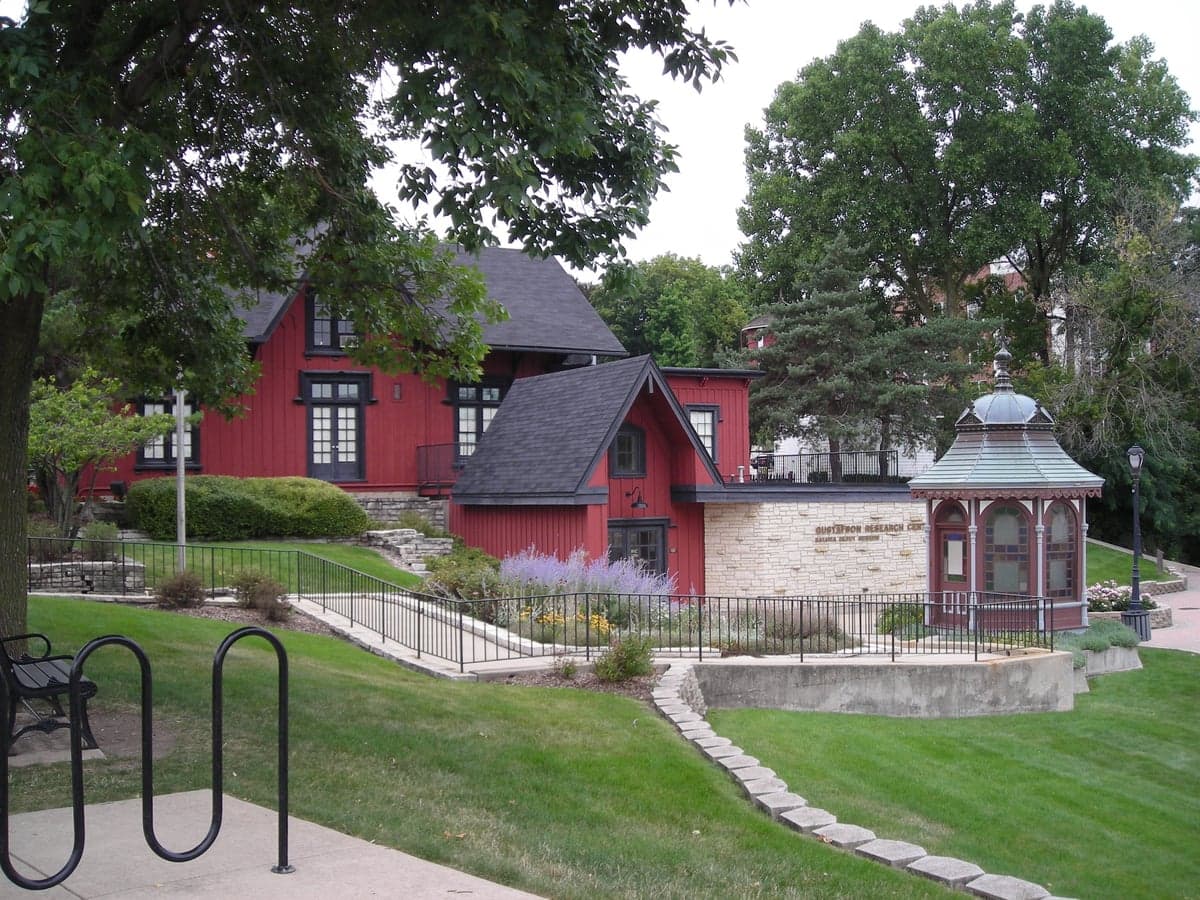
Photo: Wikipedia
Personal Sovereignty in Batavia, IL
Viable for self-reliance. Generally workable, though some barriers may limit total independence.
What does Personal Sovereignty tell us?
Personal Sovereignty measures your capacity for self-reliance and independence with minimal government friction. Higher scores mean fewer barriers between you and the way you want to live... but it assumes you have the space you need and good neighbors.
What does this tell us?
Personal Sovereignty measures your capacity for self-reliance and independence with minimal government friction. Higher scores mean fewer barriers between you and the way you want to live... but it assumes you have the space you need and good neighbors.
State Policy
Energy independence: Importer (45% of energy produced in-state)
Personal Liberty
Homesteading

Personal Liberty Analysis
Batavia, Illinois, offers a nuanced personal sovereignty environment that balances the structural advantages of a well-run small city with the constraints of a state known for its regulatory density. For a relocation-minded individual or family prioritizing autonomy, Batavia provides a notably higher degree of local self-determination than many of its Illinois peers, though it operates firmly within the broader legal framework of a state that leans toward collective governance. The city’s strong property rights culture, relatively low local tax burden compared to neighboring communities, and active civic engagement create a foundation for personal freedom that is more robust than what one might expect from a Chicago exurb, but it is not a low-regulation haven.
Tax burden and regulatory posture in Batavia compared to surrounding areas
Batavia’s tax and regulatory environment is a study in contrasts. The city’s property tax rate is competitive within Kane County, with a 2024 effective rate of approximately 2.1% of assessed value, which is lower than nearby St. Charles (2.3%) and Geneva (2.4%), though still above the national average. This is partly because Batavia maintains a diversified commercial base—including major employers like Fermilab, Aldi’s regional headquarters, and a growing tech corridor along the Fox River—that helps offset residential tax burdens. The city’s sales tax rate is 8.25%, the standard Illinois rate, with no additional municipal surcharge, a point of fiscal restraint relative to some neighbors. On the regulatory side, Batavia operates under a home-rule status (population over 25,000), which gives it local control over zoning and business licensing. This has resulted in a permitting process that is generally efficient for standard residential projects, with building permits for additions or renovations typically issued within 2-4 weeks. However, the state-level regulatory overhead is significant: Illinois’s progressive income tax (4.95% flat rate as of 2025, with a potential surcharge on high earners), combined with its estate tax threshold of $4 million (one of the lowest in the nation), creates a tangible fiscal drag for wealth-building households. The state’s regulatory climate for small businesses is ranked in the bottom third nationally by the Mercatus Center, with particular friction in environmental permitting and labor compliance. For a self-employed individual or small business owner, Batavia’s local government is cooperative, but the state-level paperwork burden is real and should be factored into any relocation decision.
Self-defense and gun law specifics in Batavia and Illinois
Self-defense rights in Batavia are governed entirely by Illinois state law, which is among the more restrictive in the Midwest. Illinois requires a Firearm Owner’s Identification (FOID) card to possess any firearm or ammunition—a process that involves a background check and can take 30-90 days for approval. For concealed carry, a separate Concealed Carry License (CCL) is required, which mandates 16 hours of training (including range time) and a $150 fee, with renewal every five years. Batavia itself has not enacted any additional local gun ordinances beyond state law, meaning there are no city-level magazine capacity bans or additional storage requirements. The city does have a municipal code prohibiting the discharge of firearms within city limits (except at licensed ranges), which is standard for suburban areas. Illinois is a “shall-issue” state for CCLs, but the process is more burdensome than in constitutional carry states. Stand-your-ground laws do not exist in Illinois; the state follows a “duty to retreat” doctrine in public spaces, though the Castle Doctrine applies inside one’s home. For a reader prioritizing self-defense autonomy, Batavia’s local environment is neutral—the city does not add extra restrictions—but the state-level framework requires significant administrative compliance. The nearest gun ranges and training facilities are within a 15-minute drive in North Aurora and Elburn, and there is an active community of sport shooters and hunters in the area, particularly among residents who own land in western Kane County.
Self-reliance and homesteading viability in Batavia’s zoning and land use
Batavia’s zoning code presents a mixed picture for those seeking a self-reliant, homesteading lifestyle. The city’s typical residential lot sizes range from 0.15 to 0.5 acres in established neighborhoods, with some larger parcels (1-2 acres) available in the western portions of the city near the Fox River. The zoning code explicitly permits backyard chickens (hens only, no roosters) on lots of 10,000 square feet or more, with a limit of six birds and a required coop setback of 25 feet from neighboring structures. Beekeeping is allowed with a permit and a 10-foot setback from property lines. However, the city prohibits the keeping of goats, sheep, or other livestock on parcels under 5 acres, which effectively rules out serious animal husbandry for most residents. Rainwater collection is permitted but limited to 100 gallons per property without a permit, and composting is allowed as long as it is contained and does not create odors. Off-grid living is not feasible within city limits: Batavia requires connection to municipal water and sewer for all habitable structures, and solar panel installation requires a building permit and must comply with the city’s aesthetic guidelines (panels cannot face the street on front-facing roofs in historic districts). For a reader seeking true self-sufficiency, the unincorporated areas of Kane County just west of Batavia—such as along Route 38 or near Elburn—offer 5-20 acre parcels with fewer restrictions, including allowance for livestock and private wells. Within Batavia proper, the environment supports a moderate level of backyard food production and energy efficiency, but not full homesteading independence.
Personal liberties in Batavia: parental rights, medical autonomy, speech, and property
Batavia’s personal liberties environment is shaped by a combination of local governance culture and state-level mandates. Parental rights are a strong point: the Batavia Public School District (101) has a history of deferring to parental authority on curriculum matters, with a school board that has resisted state-level mandates on certain health education topics. The district’s policy on parental notification for student health services is among the more transparent in the region, though Illinois state law does require schools to provide confidential access to reproductive health services for minors. Medical autonomy is more constrained: Illinois has a vaccine mandate for school attendance (with medical and religious exemptions available), and the state’s telemedicine laws are relatively permissive, allowing out-of-state providers to treat Illinois residents. The city has no local mask or business closure mandates currently in effect, and the county health department generally defers to individual choice on non-emergency public health measures. Free speech and assembly are robust in Batavia; the city’s public forums—including the Riverwalk and the Batavia Government Center—are regularly used for political and civic expression without incident. Property rights are well-protected locally: Batavia has not adopted inclusionary zoning or rent control, and the city’s historic preservation commission has a limited jurisdiction (only designated landmarks, not entire districts). The eminent domain process is rarely used and has not been controversial in recent memory. For a reader who values the ability to make decisions about their children’s education, their own healthcare, and their property without excessive interference, Batavia offers a local culture that respects these freedoms, though it operates within a state that is more interventionist on medical and educational policy than many of its Midwest neighbors.
Overall, Batavia presents a personal sovereignty profile that is best described as “high local autonomy within a moderate-state framework.” For a conservative-leaning individual or family, the city’s low local tax burden, efficient permitting, permissive backyard agriculture rules, and strong property rights culture create a more freedom-oriented environment than most Chicago suburbs. The trade-offs are the state-level tax structure, gun regulations, and medical mandates, which are non-negotiable. Compared to a city like Naperville (higher taxes, more restrictive zoning) or a rural county like DeKalb (lower taxes, fewer services), Batavia hits a middle ground that appeals to those who want self-reliance without sacrificing municipal infrastructure. For the reader who values personal independence but also wants good schools, reliable utilities, and a walkable downtown, Batavia is a pragmatic choice—not a libertarian enclave, but a place where individual initiative is respected and rewarded within a stable, rule-of-law environment.

* Values derived from national, state, county, city and local statistics and may differ in a specific area. Last updated: 2026-09-21T21:43:05.000Z
Narrative content on this page is AI-generated and may contain mistakes. Verify any details that matter before acting on them.
ReloMaps may earn a commission from affiliate links at no extra cost to you.

