
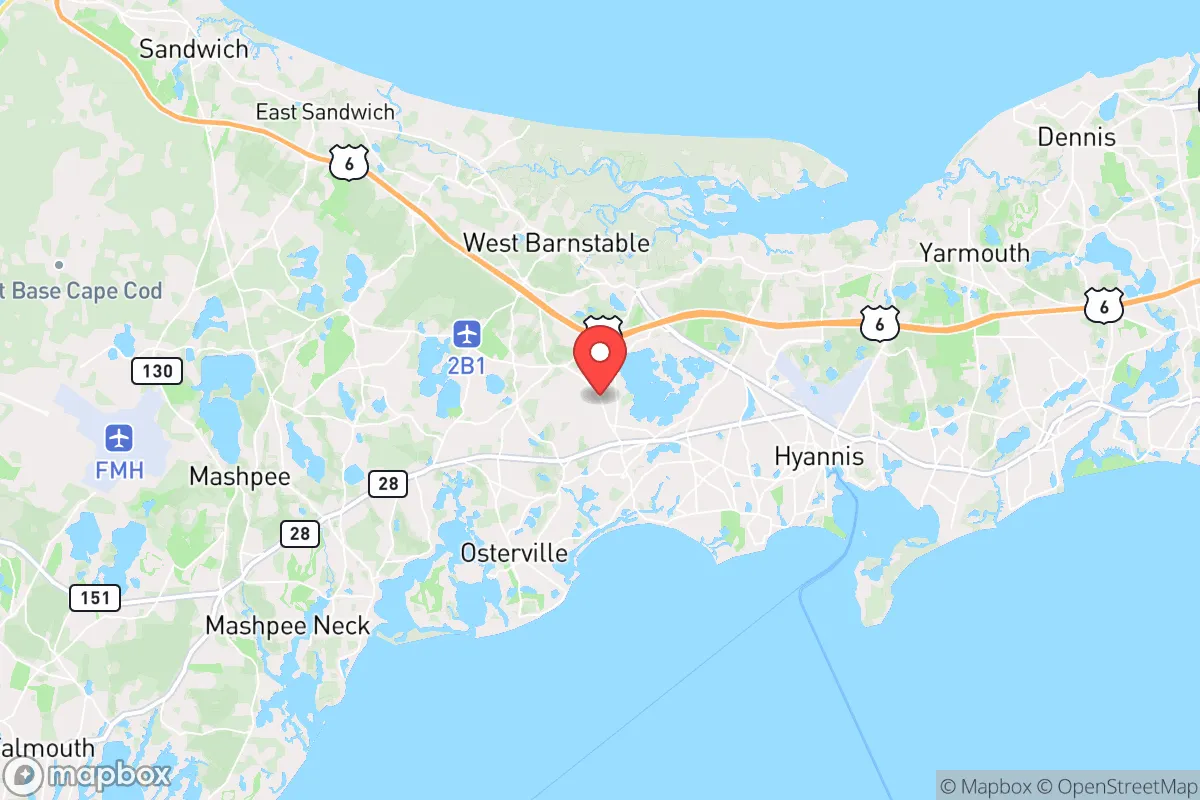
Photo: Wikipedia
Personal Sovereignty in Barnstable Town, MA
Viable for self-reliance. Generally workable, though some barriers may limit total independence.
What does Personal Sovereignty tell us?
Personal Sovereignty measures your capacity for self-reliance and independence with minimal government friction. Higher scores mean fewer barriers between you and the way you want to live... but it assumes you have the space you need and good neighbors.
What does this tell us?
Personal Sovereignty measures your capacity for self-reliance and independence with minimal government friction. Higher scores mean fewer barriers between you and the way you want to live... but it assumes you have the space you need and good neighbors.
State Policy
Energy independence: Importer (5% of energy produced in-state)
Personal Liberty
Homesteading

Personal Liberty Analysis
For individuals and families prioritizing personal sovereignty, Barnstable Town on Cape Cod presents a complex picture of constrained autonomy within a high-tax, heavily regulated state environment. While the town offers a measure of physical distance from urban centers and a slower pace of life, Massachusetts state law imposes significant limits on self-defense rights, property use, and financial independence. The overall sovereignty environment here is best described as one where personal freedoms are heavily mediated by state-level mandates, making it a location for those who can navigate—or tolerate—substantial government oversight in exchange for coastal living.
Tax burden and regulatory posture: what it costs to live freely
Massachusetts is a high-tax state, and Barnstable Town residents feel this acutely. The state levies a flat 5.0% income tax on all earned income, with no standard deduction for state purposes, meaning every dollar earned is taxed from the first dollar. Property taxes in Barnstable Town are among the highest in the state, with an effective rate around 1.2% of assessed home value—on a median home value exceeding $500,000, that translates to over $6,000 annually. There is no homestead exemption cap on property tax increases, so assessments can rise sharply with market values. Sales tax is 6.25%, and the state imposes a 0.5% surtax on annual income over $1 million (the "Millionaire's Tax," effective 2023). For a survivalist or prepper mindset, this tax structure is a direct drain on resources that could otherwise fund self-reliance—food storage, land improvements, or emergency supplies. Regulatory posture is similarly heavy: Massachusetts has strict building codes, environmental regulations (especially in coastal zones), and a statewide energy code that mandates efficiency standards for new construction and major renovations. Permitting for any significant property modification—sheds, fences, alternative energy systems—requires town approval, with the Barnstable Conservation Commission often involved due to wetland and coastal buffer zones. This creates a high barrier to autonomous property use.
Self-defense and gun law specifics: what you can and cannot do
Massachusetts has some of the most restrictive gun laws in the United States, and Barnstable Town residents must comply with all state mandates. The state requires a License to Carry (LTC) for any handgun possession, whether open or concealed. The LTC application process involves a background check, fingerprinting, a 16-hour safety course (with live fire), and a "suitable person" determination by the local police chief—a subjective standard that can be used to deny licenses. The town of Barnstable issues LTCs, but the process is not shall-issue; the chief has discretion. Magazine capacity is capped at 10 rounds for all firearms. "Assault weapons" are banned by name and feature, including many common semi-automatic rifles like the AR-15 platform. There is no state preemption for firearm laws, meaning towns can enact their own restrictions—Barnstable has not done so beyond state law, but the option exists. Stand-your-ground laws do not exist; Massachusetts imposes a duty to retreat in public spaces before using deadly force, unless inside one's home (the "castle doctrine" applies only to the dwelling itself, not curtilage). For a prepper, this means self-defense options are legally limited: no standard-capacity magazines, no commonly owned defensive rifles, and a legal obligation to retreat if possible. Ammunition purchases require a separate permit (FID or LTC), and all private firearm sales must go through a licensed dealer with a background check. The practical effect is that building a robust personal armory for worst-case scenarios is legally difficult and bureaucratically burdensome.
Self-reliance and homesteading viability: lot sizes, zoning, and off-grid feasibility
Barnstable Town's zoning and land use regulations significantly constrain homesteading and off-grid living. Minimum lot sizes vary by district but are generally 20,000 to 40,000 square feet in residential zones—larger than dense suburbs but far from rural acreage. Many lots are smaller, especially in village centers. Raising livestock is permitted in some residential zones but is subject to strict regulations: chickens are allowed (hens only, no roosters) on lots of at least 20,000 square feet, with coop setbacks from property lines. Larger animals like goats or pigs require a special permit and are typically only allowed on lots of 40,000 square feet or more in agricultural zoning districts, which are limited. Off-grid systems face major hurdles: Massachusetts requires connection to the electrical grid for any habitable dwelling, and solar panels must be grid-tied with net metering—true off-grid battery-only systems are not permitted for primary residences. Rainwater collection is allowed but must comply with state water quality standards, and well water requires a permit from the Barnstable Board of Health. Composting toilets are legal but must meet Title 5 septic system standards, which are expensive to install and maintain. The town's location on a peninsula also means limited water supply—most of Cape Cod relies on a sole-source aquifer, and new wells are tightly regulated. For a prepper seeking true self-sufficiency—growing food, harvesting water, generating power independently—Barnstable Town's regulatory environment is a significant obstacle. The coastal climate (USDA hardiness zone 7a) allows for a long growing season, but the soil is sandy and poor, requiring heavy amendment for vegetable gardens.
Personal liberties: parental rights, medical autonomy, speech, and property
Massachusetts state law heavily shapes personal liberties in Barnstable Town. Parental rights are strong in theory but limited in practice: the state mandates school attendance from age 6 to 16, with strict homeschool notification requirements (annual curriculum approval by the local school district). Parents must submit a proposed curriculum and have it approved by the Barnstable School Committee—a process that can be denied if the district deems the plan insufficient. Medical autonomy is constrained: Massachusetts has mandatory childhood vaccination requirements for school attendance (with limited religious exemptions, no philosophical exemptions), and the state's COVID-19 emergency orders (now expired) demonstrated the government's willingness to mandate masking and vaccine passports. The state also has a strict "right to die" law (physician-assisted suicide) but heavily regulates end-of-life decisions. Free speech is protected under the First Amendment, but Massachusetts has broad hate speech laws and public nuisance statutes that can be used to restrict certain expressions. Property rights are limited by the state's strong eminent domain powers and the Massachusetts Wetlands Protection Act, which restricts development near any wetland, even on private land. The Barnstable Conservation Commission has authority to deny permits for any activity within 100 feet of a wetland, which covers a large portion of the town's land area. For a conservative-leaning individual concerned about government overreach, these constraints represent a significant erosion of personal autonomy—particularly in medical decisions, education, and property use.
Overall, Barnstable Town offers a moderate level of personal sovereignty compared to other Massachusetts communities, but it remains firmly within a state that prioritizes collective regulation over individual freedom. The tax burden is heavy, gun laws are restrictive, homesteading is heavily regulated, and personal liberties are subject to state-level mandates. For a survivalist or prepper, the town's coastal location and relative isolation from major urban centers provide some strategic advantages—distance from population density, access to marine resources, and a slower pace of life. However, the regulatory environment makes it difficult to build true self-reliance. Compared to states like New Hampshire or Maine, where property taxes are lower, gun laws are more permissive, and homesteading is less regulated, Barnstable Town ranks poorly on the sovereignty scale. It is a location best suited for those who value coastal living and are willing to accept significant government oversight in exchange, rather than for those seeking maximum personal autonomy.

* Values derived from national, state, county, city and local statistics and may differ in a specific area. Last updated: 2026-05-01T11:08:36.000Z
Narrative content on this page is AI-generated and may contain mistakes. Verify any details that matter before acting on them.
ReloMaps may earn a commission from affiliate links at no extra cost to you.

