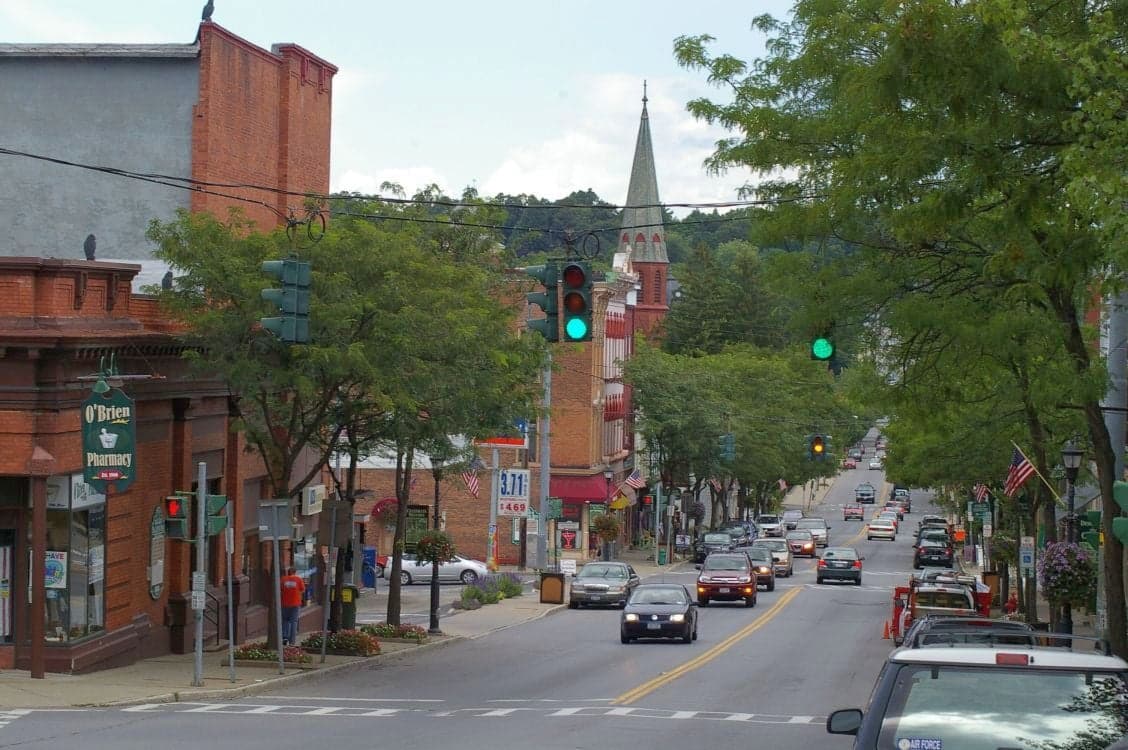
Photo: Wikipedia
Political ClimatePolitical Climate in Ballston Spa, NY
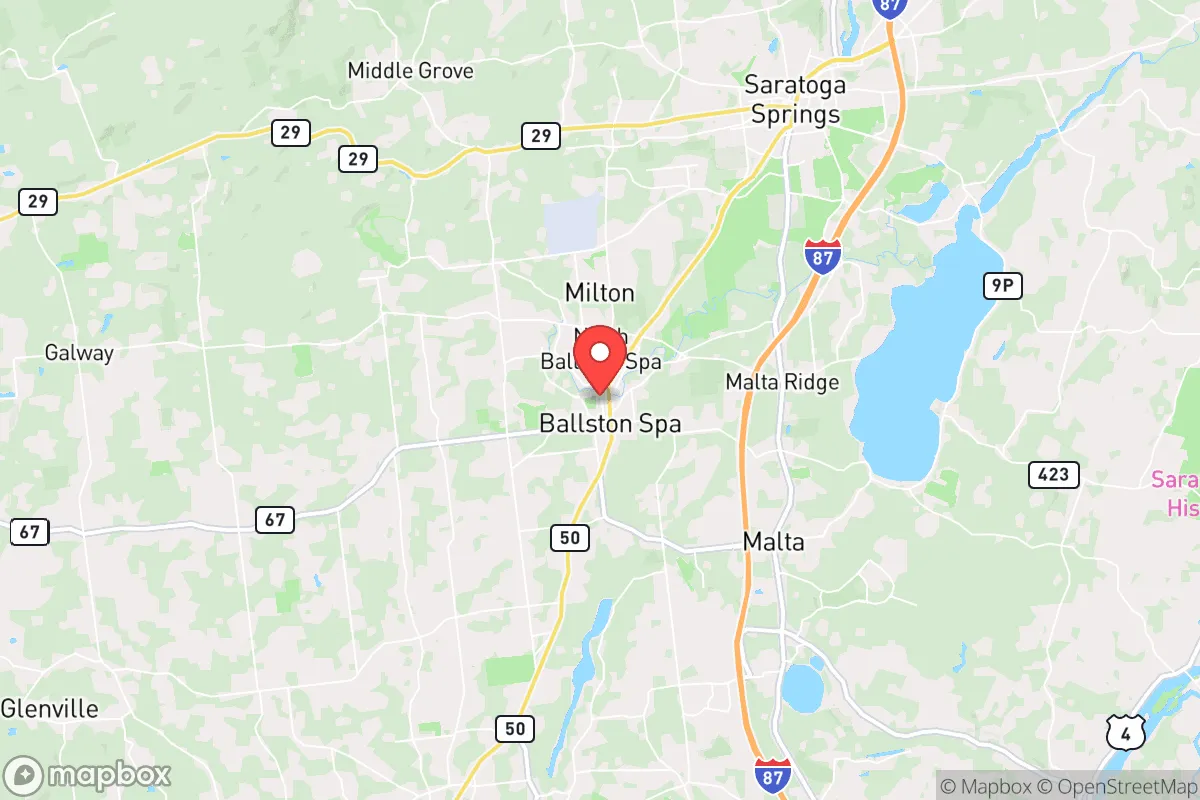
District shown is the primary district for this city’s centroid. Cities may span multiple districts.
Local Political AnalysisPolitical Analysis of Ballston Spa, NY
Ballston Spa leans Democratic, with a Cook Partisan Voting Index of D+8, making it notably more liberal than the surrounding Saratoga County but less so than New York City. The village has been trending bluer over the past decade, driven by an influx of professionals commuting to Albany and a growing arts scene, though it still retains a moderate, small-town character. In the 2024 presidential election, Saratoga County as a whole voted for Kamala Harris by a narrow margin, reflecting the area's shift from its historically Republican roots.
How it compares
Compared to New York, NY, Ballston Spa is a political outlier. While New York City is a Democratic stronghold with a Cook PVI likely exceeding D+30, Ballston Spa's D+8 rating places it closer to the national average. The village is surrounded by more conservative towns like Mechanicville and Stillwater, which voted for Donald Trump in 2024 by double-digit margins. Even within Saratoga County, the city of Saratoga Springs is more liberal than Ballston Spa, while rural areas like Galway and Charlton lean Republican. This creates a patchwork where a Ballston Spa resident might live next to a Trump voter in the town of Milton but work alongside Harris supporters in the village proper.
What this means for residents
For liberal residents, Ballston Spa offers a comfortable environment where Democratic candidates typically win local races, and progressive policies like the state's paid family leave and gun control laws are broadly accepted. Conservative residents, however, are not marginalized; they hold seats on the village board and county legislature, and the local Republican Party remains active. The practical effect is that property taxes in Ballston Spa are moderate for the region, around $2,500 per $100,000 assessed value, because the village avoids the high spending levels seen in more uniformly liberal cities like Albany. Both sides find common ground on issues like preserving the historic downtown and opposing large-scale development that would change the village's character.
Culturally, Ballston Spa is distinct from New York City in its slower pace and emphasis on local governance. The village's annual Ballston Spa Film Festival and Brookside Museum reflect a community that values the arts but without the intensity of Manhattan's scene. Policy-wise, the village has adopted a community choice aggregation program for renewable energy, a move that aligns with Democratic priorities but was supported by some local Republicans who saw it as fiscally prudent. Looking ahead, the political trajectory suggests Ballston Spa will continue to drift leftward as younger families move in, but its small size—just over 7,000 residents—means that personal relationships and local issues often outweigh party labels in determining how the village is run.

State Political ClimatePolitical Climate in New York
State Political AnalysisPolitical Environment in the State
New York State is a solidly Democratic stronghold, but that label masks a deep internal schism. The state has not voted for a Republican presidential candidate since 1984, and Democrats hold supermajorities in both legislative chambers and every statewide office. However, this is almost entirely driven by New York City and its immediate suburbs; the rest of the state is some of the most reliably Republican territory in the Northeast. Over the last 20 years, the Democratic lean has actually intensified at the state level, driven by population growth in the NYC metro and a simultaneous exodus from upstate regions, but the cultural and political divide between the five boroughs and places like Chautauqua County or the North Country has never been wider.
Urban vs. rural divide
The political map of New York is a textbook case of urban-rural polarization. New York City's five boroughs — Manhattan, Brooklyn, Queens, The Bronx, and Staten Island — cast roughly 40% of the state's total vote, and they break about 75-80% Democratic. Staten Island is the notable exception, often voting Republican in local races and serving as a conservative redoubt within the city. The inner-ring suburbs of Nassau and Westchester counties are also reliably blue, though with more moderate Democratic representation. As you move north and west, the map flips dramatically. Erie County (Buffalo) and Monroe County (Rochester) are Democratic-leaning due to their urban cores, but the surrounding rural counties — Wyoming, Livingston, Orleans — vote Republican by margins of 60-70%. The Southern Tier, stretching from the Pennsylvania border east to the Catskills, is deeply red, as is most of the Adirondack region and the Finger Lakes countryside. The Capital District around Albany is a swing area, with the city itself blue and the surrounding townships trending red. This geographic split means that a Republican living in Manhattan or a Democrat living in Steuben County will find themselves in a distinct political minority locally.
Policy environment
New York's policy environment is defined by high taxes, extensive regulation, and a strong social safety net. The state has a progressive income tax with rates up to 10.9% for top earners, and property taxes are among the highest in the nation, particularly in upstate school districts. The regulatory posture is business-friendly in name but burdensome in practice, with strict environmental rules, a high minimum wage ($16.50 in NYC, $15.50 upstate as of 2026), and expansive labor protections. Education policy is centralized, with the state controlling curriculum standards and funding formulas; charter schools are permitted but capped, and there is a robust public university system (SUNY). Healthcare is heavily regulated, with strong insurance mandates and a state-run exchange. Election laws are among the most accessible in the country, with no-excuse absentee voting, early voting, and automatic voter registration. For a conservative relocator, the tax burden and regulatory climate are the most immediate practical concerns, while the social policies may align or clash depending on personal values.
Recent policy direction
Over the past five years, New York has moved decisively left on a broad range of issues. On gun and self-defense law, the state passed the Concealed Carry Improvement Act in 2022, which significantly restricted where licensed gun owners can carry firearms, including "sensitive places" like Times Square and public transit; this law was a direct response to the Supreme Court's Bruen decision and remains a flashpoint. On parental and education rights, the state has expanded LGBTQ+ inclusive curriculum mandates and passed the "Safe Schools" law, which some critics argue limits parental notification regarding a child's gender identity. Speech and privacy are protected under the state constitution, but a 2023 law targeting online hate speech and a 2024 expansion of surveillance powers for the NYPD have raised concerns among civil libertarians. On medical and bodily autonomy, New York has become a safe harbor state, passing a 2019 law codifying abortion rights up to viability and a 2023 shield law protecting providers who prescribe abortion pills to patients in states with bans. Property rights are constrained by strict rent stabilization laws in NYC and a 2019 law that weakened landlord eviction protections statewide. Taxation has increased incrementally, with a 2021 millionaire's surcharge and a 2024 expansion of the estate tax. Voting and ballot access have been expanded, with same-day registration and no-excuse absentee voting now permanent. For a relocator, the net effect is a state that is actively legislating in a progressive direction, with little appetite for rollback.
Civil unrest & political movements
New York has a long history of political activism, and recent years have seen both left- and right-wing movements gain visibility. The 2020 Black Lives Matter protests in NYC were among the largest in the country, and the state responded with police reform legislation, including the repeal of 50-a, which had shielded police disciplinary records. On the right, the "Second Amendment Sanctuary" movement has spread through upstate counties, with over 30 counties passing resolutions declaring themselves sanctuaries from state gun laws, though these are largely symbolic. Immigration politics are a constant flashpoint: New York is a sanctuary state, and NYC's "right to shelter" law has been strained by the arrival of tens of thousands of asylum seekers since 2022, leading to political fights over funding and housing. Election integrity controversies have been relatively muted compared to swing states, but the 2020 and 2022 cycles saw scattered disputes over mail-in ballot processing in close upstate races. A new resident in Buffalo or Rochester will see a different political landscape than someone in Manhattan — the upstate cities are more focused on economic decline and public safety, while downstate politics are dominated by housing, transit, and immigration.
Projection
Over the next 5-10 years, New York's political trajectory points toward continued Democratic dominance at the state level, but with growing internal friction. Demographic trends are working against the GOP: the upstate population is aging and shrinking, while NYC and its suburbs continue to attract younger, more diverse, and more liberal residents. The state's congressional map, redrawn after the 2020 census, has already cost Republicans several seats, and further gerrymandering is likely. However, the urban-rural divide will deepen, and upstate resentment of downstate control will fuel local movements, possibly including more serious talk of secession or devolution — the "New Amsterdam" and "Upstate New York" secession proposals have gained some traction in conservative circles, though they remain fringe. For a conservative moving in, the practical reality is that state-level politics will remain hostile to their policy preferences, but local control in many upstate counties and towns will allow a degree of insulation. For a liberal moving in, the state will continue to be a policy laboratory for progressive governance, but the fiscal challenges — high taxes, pension obligations, and the cost of NYC's social programs — will create persistent budget pressures.
For a new resident, the bottom line is that New York offers two very different political experiences depending on where you land. If you choose Manhattan or Brooklyn, you will be in one of the most liberal environments in the country, with all the policy consequences that entails. If you choose a small town in the Southern Tier or the North Country, you will live in a conservative community that feels largely disconnected from Albany's agenda, but you will still pay state taxes and abide by state laws. The key is to know which New York you are moving to — the urban, coastal, globalist version, or the rural, agricultural, traditionalist one — and to understand that the two are increasingly at odds. Your vote will matter more in local races than statewide ones, and your daily life will be shaped more by your county and town than by the governor's mansion.
* Values derived from national, state, county, city and local statistics and may differ in a specific area. Last updated: 2026-09-05T03:06:35.000Z
Narrative content on this page is AI-generated and may contain mistakes. Verify any details that matter before acting on them.
ReloMaps may earn a commission from affiliate links at no extra cost to you.

