Photo: Wikipedia
Demographics of Ballston Spa, NY
Affluence Level in Ballston Spa, NY
A middle-class area roughly in line with national averages across income, home values, education, and employment.
People of Ballston Spa, NY
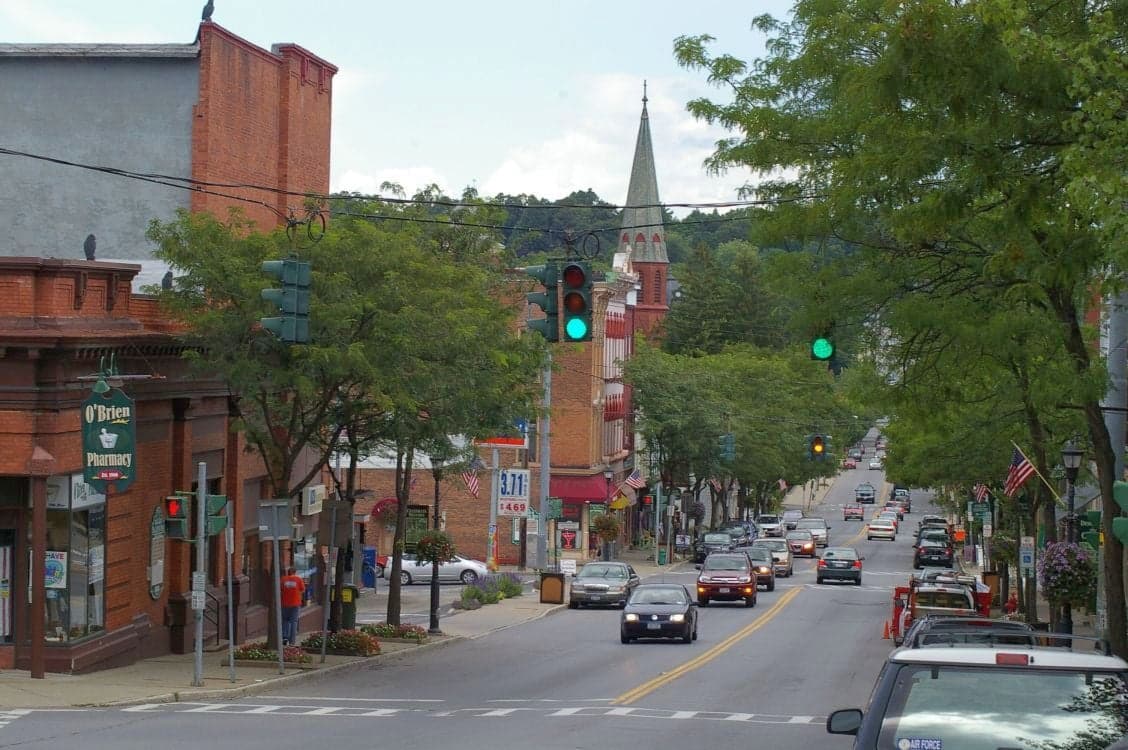
The people of Ballston Spa, New York, today number roughly 5,080, forming a tight-knit, predominantly white (90.2%) village with a notably high college attainment rate (44.1%) that reflects a professional and educated workforce. The village’s character is defined by its historic downtown, a strong sense of local identity tied to its 19th-century industrial past, and a population that is older and less ethnically diverse than the national average. Foreign-born residents make up just 2.1% of the population, and the community remains overwhelmingly non-Hispanic white, with small Hispanic (3.0%) and Black (0.9%) minorities and no measurable East/Southeast Asian or Indian-subcontinent populations. This is a place where generational roots run deep, and newcomers often find a welcoming but established social fabric.
How the city was settled and grew
Ballston Spa’s population history begins with its founding as a spa town in the late 18th century, after the discovery of mineral springs in 1771 by surveyor Eliphalet Ball. The village was officially incorporated in 1807, and its early growth was driven by the health tourism industry—wealthy visitors from New York City and Albany came to “take the waters” at the Sans Souci Hotel and other bathhouses. The original settlers were largely of English, Dutch, and German stock, many migrating from eastern New York and New England. The Old Iron Spring neighborhood, centered on the original spring site, became the village’s first residential core, with modest homes for hotel workers and tradesmen. By the mid-19th century, the village diversified industrially, becoming a hub for paper milling and the manufacture of knitting machines and paper bags. This industrial boom drew Irish immigrants in the 1840s and 1850s, who settled in the Front Street area near the mills, and later a wave of French-Canadian workers in the 1870s and 1880s, who concentrated in the Milton Avenue corridor. The village’s population peaked around 4,500 in the 1900 census, then stabilized as manufacturing declined. The High Street historic district, with its grand Victorian homes, housed the mill owners and professionals, while the Washington Street area became a working-class enclave for later arrivals.
Modern era (post-1965)
After the 1965 Hart-Cellar Act, Ballston Spa saw virtually no new immigration—its foreign-born share remains at 2.1%, far below the national average. Instead, the village’s modern demographic story is one of domestic in-migration and suburbanization. From the 1970s onward, Ballston Spa attracted families and professionals from the Albany-Schenectady-Troy metro area, drawn by its historic charm, good schools, and relatively affordable housing. These newcomers—predominantly white and college-educated—settled in newer subdivisions on the village’s periphery, such as the Malta Avenue Extension area and the Rowland Street neighborhood, which saw infill development of single-family homes. The village’s racial composition has remained remarkably stable: the white share has only declined from about 95% in 1990 to 90.2% today, with the small Hispanic and Black populations concentrated in the Milton Avenue and Front Street areas, where rental housing is more available. The 44.1% college attainment rate—well above the national average of about 33%—reflects the village’s draw for professionals working at GlobalFoundries in nearby Malta, Saratoga Hospital, and the state government in Albany. The village’s population has hovered around 5,000 since 2000, with slow growth of about 2% per decade, as limited housing stock and strict historic preservation rules constrain new development.
The future
Ballston Spa’s population is projected to remain stable or grow very slowly over the next 10–20 years, with little change in its racial or ethnic makeup. The village’s low foreign-born share and lack of Asian or Indian communities suggest it is not a destination for new immigrant streams. Instead, future growth will likely come from domestic migration—young families and retirees from the Capital District seeking a walkable, historic village with strong schools. The Malta Avenue Extension area and a few remaining infill lots near Rowland Street may see modest new construction, but the village’s historic core is largely built out. The population is aging: the median age is around 42, and the share of residents over 65 is growing. This could lead to a gradual shift toward more retirees and empty-nesters, with fewer young families unless housing becomes more affordable. The village’s cultural identity will likely remain rooted in its historic preservation ethos, local festivals like the Ballston Spa Chocolate Festival, and a civic life centered on the village government and school district. For a newcomer, Ballston Spa offers a stable, low-diversity, educated community with a strong sense of place—but one where demographic change is measured in decades, not years.
For someone moving in now, Ballston Spa is becoming an increasingly curated, preservation-minded village that appeals to those who value historic character, walkability, and a tight-knit community over rapid growth or diversity. The population is stable, educated, and aging, with little influx of new ethnic or cultural groups. This is a place for people who want to join an established community with deep roots, not for those seeking a dynamic, changing urban environment.

* Values derived from national, state, county, city and local statistics and may differ in a specific area. Last updated: 2026-09-05T03:06:35.000Z
Narrative content on this page is AI-generated and may contain mistakes. Verify any details that matter before acting on them.
ReloMaps may earn a commission from affiliate links at no extra cost to you.

