Photo: Wikipedia
Political ClimatePolitical Climate in Bainbridge Island, WA
District shown is the primary district for this city’s centroid. Cities may span multiple districts.
Inherited from parent state — no local data available.
Local Political AnalysisPolitical Analysis of Bainbridge Island, WA
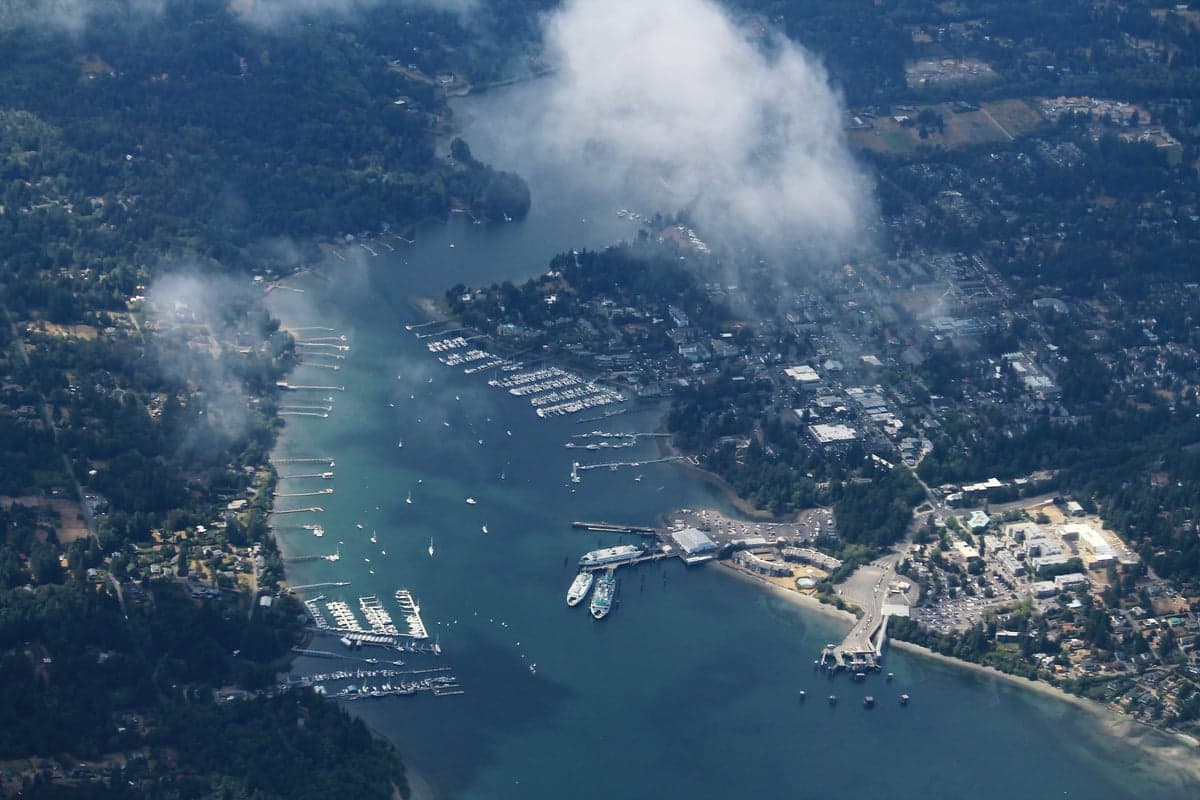
Bainbridge Island is one of the most reliably Democratic jurisdictions in Washington State, and it has only gotten bluer over the last two decades. In the 2020 presidential election, Joe Biden carried Kitsap County’s precincts on the island with roughly 80% of the vote, a margin that has held steady or grown since Barack Obama’s first run in 2008. The island’s trajectory is not a recent fluke—it’s a long-term cultural shift that accelerated as Seattle-adjacent professionals moved across the Sound—and today, registered Democrats outnumber Republicans here by a ratio of roughly 4 to 1.
How it compares
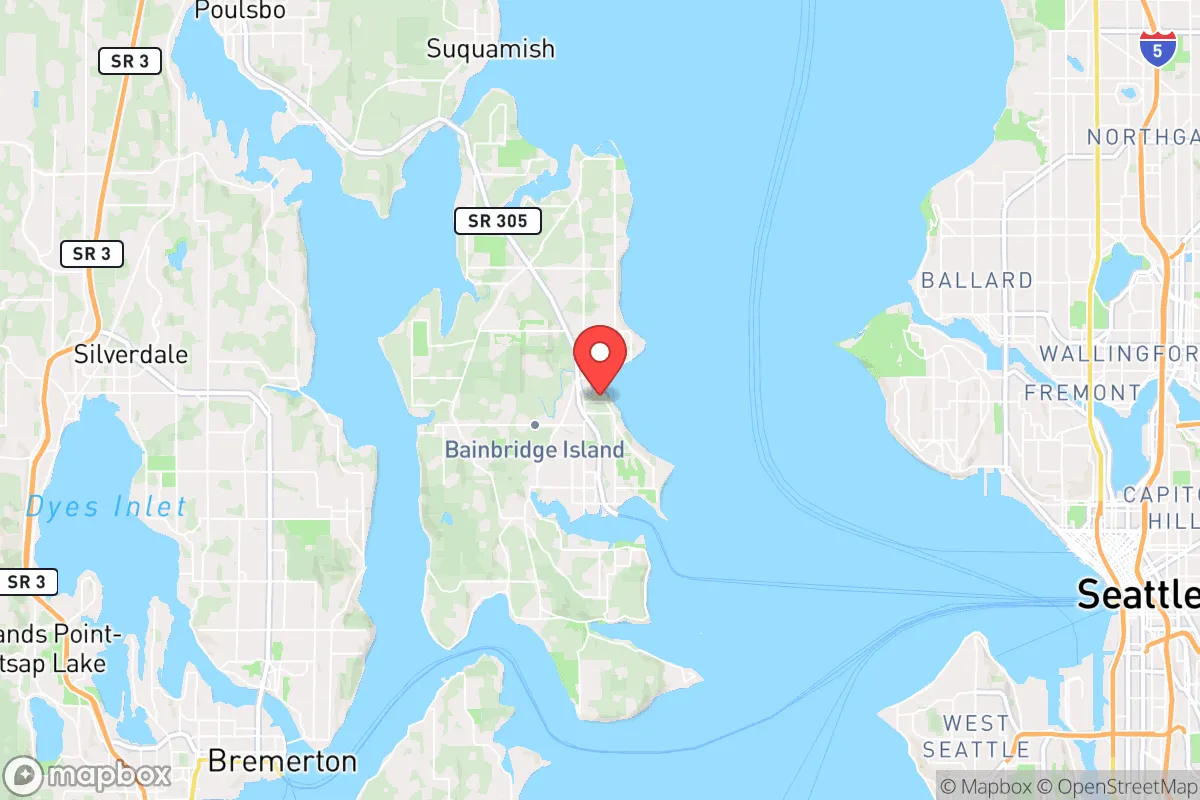
Comparing Bainbridge Island to the rest of Washington State is like comparing two different political planets. While the state as a whole is a solidly blue stronghold—Washington hasn’t voted for a Republican presidential candidate since 1984—Bainbridge sits far to the left of even the state’s average. For context, the island’s voting patterns more closely resemble Seattle’s Capitol Hill or Queen Anne neighborhoods than they do the rest of Kitsap County. Just a 35-minute ferry ride away, the city of Bremerton leans Democratic but is far more competitive, often splitting nearly evenly in local races. Head south to Gig Harbor in Pierce County, and you’ll find a reliably Republican suburb where the 2020 margin flipped to Trump by double digits. Even within Kitsap County, the contrast is stark: rural precincts in the county’s south end, around Port Orchard and Olalla, vote Republican by wide margins, while Bainbridge and parts of Poulsbo anchor the county’s blue vote. The island’s political identity is closer to that of nearby King County’s wealthy waterfront enclaves—think Medina or Mercer Island—than to its own county seat.
What this means for residents
For liberal residents, living on Bainbridge means being in the political majority almost everywhere you look. The city council, school board, and even the local parks commission are dominated by progressive candidates, and policy debates tend to center on how fast to move on climate action, affordable housing, and ferry funding—not whether to pursue them. For conservative residents, the reality is more isolating. There is no Republican presence on the city council, and local GOP events are small and often held in private homes rather than public venues. That said, the island’s political monoculture has produced a certain civility in practice; most neighbors avoid political talk at the grocery store or school pickup line, and the few vocal conservatives tend to be longtime island families who’ve learned to pick their battles. The practical effect of the island’s lean is that property taxes and local levies routinely pass, often by 70% or more, funding everything from the library to the Bainbridge Island School District’s robust arts programs.
Culturally, Bainbridge has become a place where progressive values are baked into daily life—the island was an early adopter of plastic bag bans, has a thriving local food movement, and hosts one of the state’s most active chapters of Indivisible. The political trajectory shows no sign of reversing; if anything, the island is getting more uniformly liberal as younger, tech-adjacent families replace the older, more moderate retirees who once balanced the electorate. For anyone moving here, the takeaway is simple: if you want a community where your vote is part of a dominant progressive consensus, you’ll feel right at home. If you’re looking for political diversity or a competitive two-party system, you’ll find more of that in Bremerton, Gig Harbor, or even Poulsbo—but you’ll be giving up the island’s singular small-town charm to get it.

State Political ClimatePolitical Climate in Washington
State Political AnalysisPolitical Environment in the State
Washington state has been a reliably Democratic stronghold for nearly two decades, with the party holding every statewide executive office and both U.S. Senate seats since 2013. The state’s political center of gravity sits firmly in the Puget Sound region, where the combined populations of Seattle, Bellevue, and Tacoma overwhelm the rest of the state’s electorate. Over the past 20 years, the Democratic margin in presidential elections has grown from a modest 7-point win in 2004 to a 19-point blowout in 2020, driven by explosive growth in the Seattle metro and the steady suburbanization of once-competitive counties like Snohomish and Pierce.
Urban vs. rural divide
The political map of Washington is a tale of two states. The I-5 corridor from Olympia north to the Canadian border is solidly Democratic, anchored by King County, which alone casts about a third of the state’s votes. Seattle’s tech economy has transformed the region into one of the most liberal urban centers in the country, with Bellevue and Redmond following suit as Amazon and Microsoft campuses expanded. Meanwhile, the eastern half of the state — Spokane, the Tri-Cities (Kennewick, Pasco, Richland), and the Yakima Valley — votes Republican by wide margins, with many rural counties delivering 60-70% of their votes to GOP candidates. The divide is stark: in 2020, King County went for Biden by 50 points while Lincoln County in the east went for Trump by 60 points. The suburbs of Vancouver and Olympia have drifted left in recent cycles, while the exurbs of Snohomish and Pierce counties have become genuine battlegrounds, with several state legislative districts flipping between parties over the past decade.
Policy environment
Washington’s policy landscape is defined by a few structural realities. There is no state income tax — a fact that draws many conservative relocators — but the state compensates with one of the highest sales tax rates in the nation, averaging over 9% in most cities, plus a new capital gains tax on high earners that took effect in 2022. The regulatory climate is business-friendly in some respects, particularly for tech and manufacturing, but the state has adopted aggressive climate mandates, including a cap-and-invest program that has driven up gas prices. Education policy is dominated by the state’s teacher unions, which successfully pushed for a 2022 law limiting class sizes and boosting salaries. Healthcare is heavily regulated, with the state operating its own insurance exchange and expanding Medicaid under the Affordable Care Act. Election administration is among the most liberal in the country: Washington was one of the first states to adopt all-mail voting, and it automatically registers citizens to vote when they obtain a driver’s license.
Recent policy direction
The last five years have seen Washington’s legislature move decisively left on nearly every front. On guns, the state banned assault weapons and high-capacity magazines in 2023, and requires a 10-day waiting period for all firearm purchases. On parental rights, the legislature passed a 2023 law that requires schools to notify parents if a student requests a name or pronoun change, but it also prohibits schools from disclosing a student’s gender identity without consent — a compromise that has satisfied neither side. On speech and privacy, Washington passed one of the nation’s strongest data privacy laws in 2021, but it has also criminalized “malicious harassment” more broadly, which critics say chills protected speech. On medical autonomy, the state protects abortion access and gender-affirming care, and it has passed shield laws protecting providers who serve out-of-state patients. On property rights, the state has imposed strict rent control measures in some cities and expanded tenant protections statewide. On taxation, the capital gains tax is currently being challenged in court, and a proposed state income tax remains politically toxic even among many Democrats.
Civil unrest & political movements
Washington has a visible and active protest culture, particularly in Seattle, where the 2020 Capitol Hill Autonomous Zone (CHAZ) became a national flashpoint. The state has also seen sustained demonstrations over police funding, with Seattle’s city council cutting the police budget by 50% in 2020 before partially restoring it. On the right, the state has a small but organized network of conservative activists, concentrated in the eastern counties and the rural areas of southwest Washington, who have held rallies against vaccine mandates and school mask requirements. Immigration politics are contentious: Washington is a sanctuary state, with laws prohibiting local law enforcement from cooperating with federal immigration authorities, and the city of Seattle has gone further by restricting ICE access to city facilities. Election integrity has been a recurring controversy, with Republican county auditors in several rural counties raising concerns about the all-mail system, though no widespread fraud has been documented. The state has also seen a growing secessionist movement in the east, with several counties voting to explore joining Idaho — a symbolic gesture with no legal force but a real indicator of cultural alienation.
Projection
Over the next decade, Washington’s Democratic lean is likely to deepen, not moderate. The Seattle metro continues to add residents faster than the rest of the state, and the tech workforce skews young and liberal. In-migration from California, while slowing, still brings a net influx of Democratic voters to the Puget Sound region. The rural counties will remain Republican, but their share of the electorate is shrinking — eastern Washington cast about 30% of the vote in 2020, down from 35% a decade earlier. The most interesting dynamic is the suburban swing: places like Camas and Ridgefield in Clark County, and Sammamish and Issaquah in King County’s eastern suburbs, are becoming more liberal as new residents arrive, while the exurbs of Yelm and Graham in Thurston and Pierce counties are trending conservative. A relocator moving to Washington in 2026 should expect the state to remain solidly Democratic for the foreseeable future, with the legislature likely to pass further gun restrictions, expand the capital gains tax, and tighten environmental regulations.
For a new resident, the practical implications are clear. If you lean conservative, you will find welcoming communities in Spokane, the Tri-Cities, and the rural counties, but you will be voting in a state where your voice is a permanent minority at the statewide level. You will pay no income tax but will face high sales taxes and rising energy costs. If you lean liberal, you will find a state that aligns with your values on most issues, but you will also encounter a growing backlash in the eastern half of the state and a cost of living that is among the highest in the nation. Either way, Washington rewards those who understand its geography — the political divide is real, and where you choose to live within the state matters as much as the state itself.
* Values derived from national, state, county, city and local statistics and may differ in a specific area. Last updated: 2026-10-29T04:38:01.000Z
Narrative content on this page is AI-generated and may contain mistakes. Verify any details that matter before acting on them.
ReloMaps may earn a commission from affiliate links at no extra cost to you.

