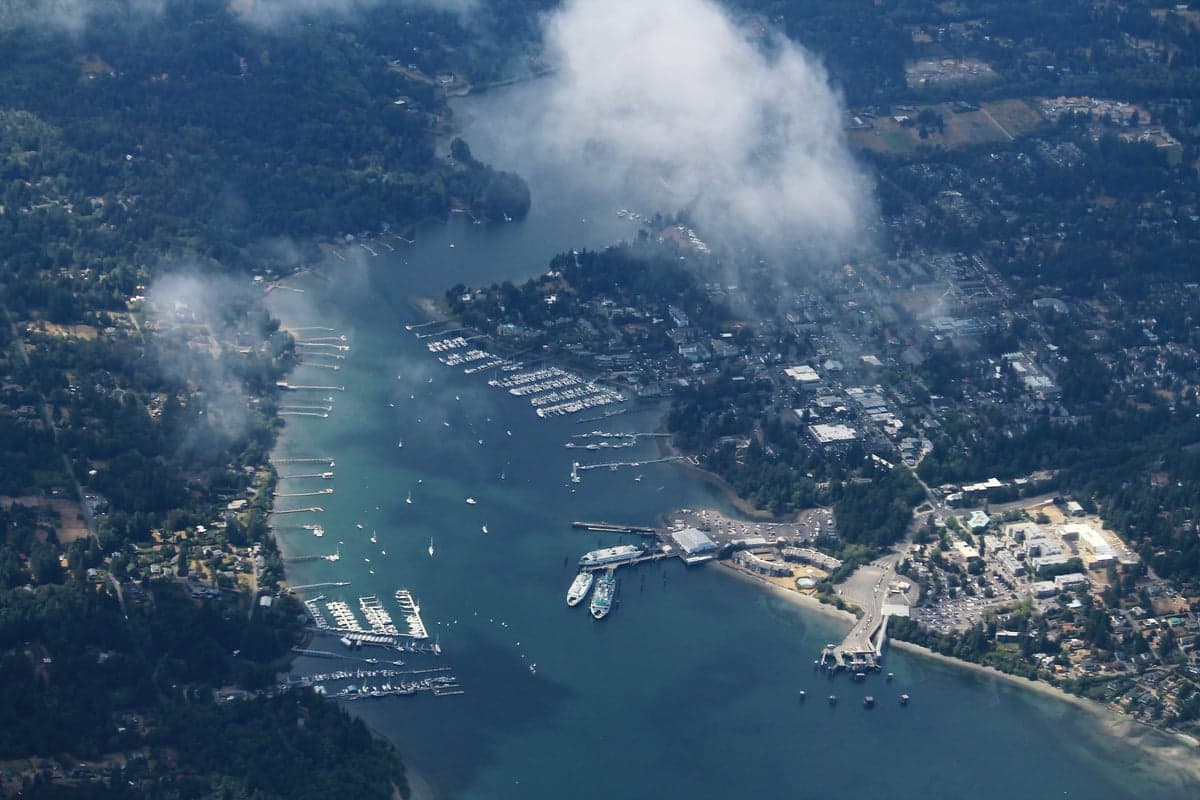
Photo: Wikipedia
Personal Sovereignty in Bainbridge Island, WA
Viable for self-reliance. Generally workable, though some barriers may limit total independence.
What does Personal Sovereignty tell us?
Personal Sovereignty measures your capacity for self-reliance and independence with minimal government friction. Higher scores mean fewer barriers between you and the way you want to live... but it assumes you have the space you need and good neighbors.
What does this tell us?
Personal Sovereignty measures your capacity for self-reliance and independence with minimal government friction. Higher scores mean fewer barriers between you and the way you want to live... but it assumes you have the space you need and good neighbors.
State Policy
Energy independence: Importer (55% of energy produced in-state)
Personal Liberty
Homesteading

Personal Liberty Analysis
Bainbridge Island, Washington, presents a complex personal sovereignty environment where high property values and a progressive local culture intersect with a state-level regulatory framework that is among the most interventionist in the Pacific Northwest. For individuals and families prioritizing personal freedom, the island offers strong natural-resource autonomy potential but imposes significant constraints on self-defense rights, property use, and tax burden. The trade-off is a tightly managed community with excellent public services and a vocal citizenry, but the net effect is a sovereignty profile that leans heavily toward collective decision-making over individual discretion.
Tax burden and regulatory posture: What to expect from local and state government
Washington State has no personal income tax, which is a major plus for earners, but Bainbridge Island residents face a heavy property tax burden to fund the highly rated Bainbridge Island School District and local services. The combined state and local sales tax rate in Kitsap County is approximately 9.1%, among the highest in the state. The regulatory posture on the island is notably dense: the city’s critical areas ordinances, shoreline master program, and tree protection code impose strict limits on what homeowners can do with their land. Clearing vegetation, building accessory structures, or even removing significant trees often requires permits and public notice. This is not a jurisdiction where one can easily add a workshop, expand a driveway, or subdivide a lot without navigating a multi-step approval process. For those accustomed to rural counties with minimal zoning, the island’s regulatory environment will feel like a significant constraint on property autonomy.
Self-defense and gun law specifics: What the Second Amendment landscape looks like
Washington State has some of the most restrictive firearm laws in the nation, and Bainbridge Island operates fully within that framework. The state requires a background check for all firearm sales, including private transactions, and has a 10-day waiting period for handgun purchases. Magazine capacity is limited to ten rounds, and the state bans certain semi-automatic rifles classified as assault weapons under state law. Open carry is legal without a permit, but concealed carry requires a license, and the issuing authority in Kitsap County generally processes applications without undue delay. However, the island itself has no gun stores, and the local culture is strongly anti-gun; the city council has passed symbolic resolutions supporting state-level restrictions. For a reader who prioritizes self-defense rights, this is a low-sovereignty environment. Carrying for protection is legally possible but heavily circumscribed, and the social climate is not welcoming to visible firearm ownership. Stand-your-ground laws do not apply in Washington; the state uses a duty-to-retreat standard in public spaces.
Self-reliance and homesteading viability: Lot sizes, zoning, and off-grid feasibility
Bainbridge Island offers genuine potential for self-reliance, but it is tightly regulated. Typical residential lot sizes range from a quarter-acre to one acre in most neighborhoods, though larger parcels exist in the island’s rural agricultural zones. The city’s zoning code allows for backyard chickens, beekeeping, and small-scale vegetable gardens as accessory uses, but keeping larger livestock like goats or pigs requires a minimum lot size of two acres and a conditional use permit. Off-grid living is effectively impossible: all residences must connect to the public water system or an approved private well, and the county health department regulates septic systems strictly. Solar panels are permitted but must meet aesthetic guidelines in many neighborhoods, and battery storage for full off-grid independence is not prohibited but is rare due to the island’s reliable grid. Rainwater collection for potable use is not allowed without a permit and treatment system. For a family wanting to grow food, raise some animals, and reduce reliance on external systems, the island is workable but requires navigating a permitting process that discourages experimentation. The regulatory posture is one of managed self-sufficiency, not frontier independence.
Personal liberties: Parental rights, medical autonomy, speech, and property
Washington State law generally respects parental rights in education, including the ability to homeschool or enroll in private schools without excessive state oversight. Bainbridge Island School District has a strong record of accommodating parental input, though the district’s progressive curriculum choices have occasionally sparked controversy. Medical autonomy is constrained by state law: Washington has no religious or philosophical exemption from vaccine mandates for school attendance, and the state’s assisted suicide law (the Death with Dignity Act) is among the most permissive in the nation. Free speech is robustly protected under the state constitution, and the island’s public forums—including the Bainbridge Island Review and local social media groups—are active and often contentious. Property rights are the most constrained area: the city’s comprehensive plan and shoreline regulations give the government broad authority to restrict land use in the name of environmental protection. Eminent domain is rarely used, but the regulatory takings threshold is low. For a reader who values the ability to control what happens on their own land, this is a significant sovereignty limitation.
Overall, Bainbridge Island offers a personal sovereignty profile that is strong in community voice and natural-resource access but weak in individual discretion over property use and self-defense. Compared to rural areas in eastern Washington or Idaho, the island is a high-regulation, high-tax environment where collective decision-making routinely overrides individual preferences. For a family that values excellent schools, walkable neighborhoods, and a politically engaged community, the trade-offs may be acceptable. For someone whose primary priority is maximum personal autonomy—especially regarding firearms, land use, and medical choices—the island will feel like a place where freedom is constantly negotiated rather than assumed. The strategic advisor’s verdict: Bainbridge Island is a good fit for those who want to participate in a tightly governed community, but not for those who want to be left alone.

* Values derived from national, state, county, city and local statistics and may differ in a specific area. Last updated: 2026-10-29T04:38:01.000Z
Narrative content on this page is AI-generated and may contain mistakes. Verify any details that matter before acting on them.
ReloMaps may earn a commission from affiliate links at no extra cost to you.

