
Photo: Wikipedia
Personal Sovereignty in Auburn, IN
Viable for self-reliance. Generally workable, though some barriers may limit total independence.
What does Personal Sovereignty tell us?
Personal Sovereignty measures your capacity for self-reliance and independence with minimal government friction. Higher scores mean fewer barriers between you and the way you want to live... but it assumes you have the space you need and good neighbors.
What does this tell us?
Personal Sovereignty measures your capacity for self-reliance and independence with minimal government friction. Higher scores mean fewer barriers between you and the way you want to live... but it assumes you have the space you need and good neighbors.
State Policy
Energy independence: Importer (35% of energy produced in-state)
Personal Liberty
Homesteading

Personal Liberty Analysis
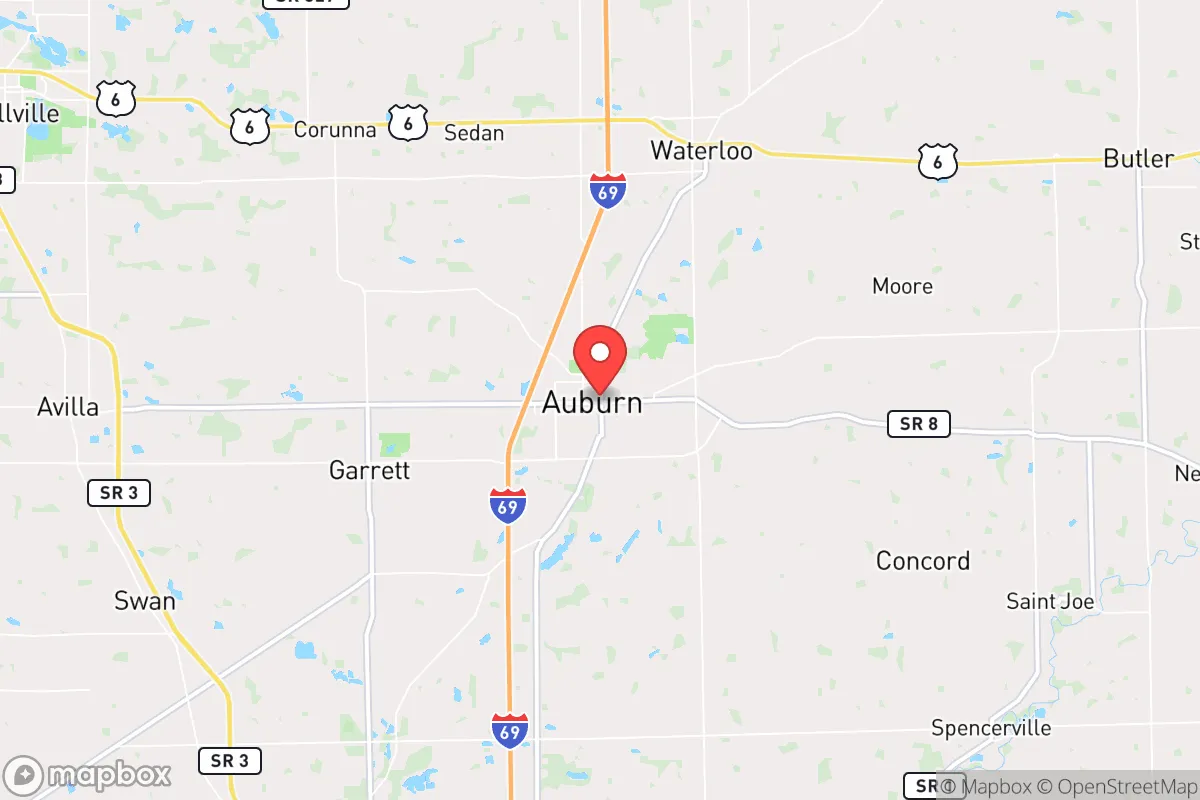
Auburn, Indiana, offers a notably high degree of personal sovereignty, grounded in Indiana’s consistently conservative state-level governance and a local culture that values self-reliance. For individuals and families who prioritize autonomy—whether in financial decisions, self-defense, or lifestyle choices—the regulatory environment here is light-touch compared to many Midwestern and coastal peers. The city’s position in DeKalb County, with its strong agricultural roots and limited municipal overreach, creates a practical environment where personal freedom is less an abstract ideal and more a daily reality.
Tax burden and regulatory posture: How Indiana’s framework shapes local freedom
Indiana’s tax structure is one of the most favorable in the nation for those seeking to keep more of their earnings. The state imposes a flat income tax rate of 3.15% as of 2026, with no progressive brackets, meaning every dollar earned is taxed equally. Property taxes in DeKalb County are among the lowest in Indiana, with effective rates typically ranging from 0.8% to 1.1% of assessed home value—well below the national average of roughly 1.1%. Auburn itself does not levy a local income tax, and the city’s sales tax is the state rate of 7%, with no additional municipal surcharges. This combination means a family earning $75,000 annually pays roughly $2,360 in state income tax, and a $250,000 home carries an annual property tax bill of around $2,000 to $2,750. The regulatory posture at the state level is equally restrained: Indiana is a right-to-work state, has no state-level minimum wage above the federal $7.25, and imposes minimal occupational licensing requirements compared to states like California or New York. For a small business owner or independent contractor, this translates to lower compliance costs and fewer bureaucratic hurdles. Auburn’s city government generally follows this philosophy, with zoning ordinances that are straightforward and permit processes that are typically completed within 30 days for standard residential projects. The overall message is clear: the system is designed to stay out of the way of productive activity.
Self-defense and gun law specifics: What Indiana’s constitutional carry means for residents
Indiana is a constitutional carry state, meaning that as of July 1, 2022, any law-abiding adult 18 or older may carry a handgun openly or concealed without a permit. This is a significant sovereignty advantage for Auburn residents. There is no state-level requirement for firearm registration, no waiting periods for purchase, and no magazine capacity restrictions. The only notable limitation is that carrying a firearm is prohibited in certain locations like schools (with exceptions for licensed security), government buildings, and private property where the owner has posted signage. Indiana also has a strong Castle Doctrine and Stand Your Ground law, codified in Indiana Code 35-41-3-2, which removes any duty to retreat before using deadly force in self-defense when lawfully present. This applies both inside the home and in public spaces. For those who prefer a permit for reciprocity purposes, the Indiana License to Carry a Handgun is issued by the county sheriff (DeKalb County Sheriff’s Office) and requires a simple background check and a $30 fee; the license is valid for five years. The local sheriff’s office is known for efficient processing, with most permits issued within 30 days. For hunters, Indiana’s deer season is generous, with archery, firearm, and muzzleloader seasons spanning from October through January, and no special permits needed beyond a standard hunting license. The practical effect for Auburn residents is that self-defense decisions are largely left to the individual, with minimal government interference.
Self-reliance and homesteading viability: Lot sizes, zoning, and off-grid feasibility
Auburn’s zoning code is notably permissive for those seeking a self-reliant lifestyle. Within the city limits, standard residential lots (R-1 zoning) typically range from 0.25 to 0.5 acres, but larger parcels of 1 to 5 acres are available in the city’s “Rural Residential” overlay districts, particularly on the eastern and northern edges. For those willing to live just outside city limits in unincorporated DeKalb County, lot sizes of 5 to 20 acres are common, with prices averaging $5,000 to $10,000 per acre for raw land. The county has no zoning restrictions on keeping chickens, goats, or even a single horse on parcels of 2 acres or more, and beekeeping is allowed without a permit. Off-grid living is legally feasible: Indiana has no state law requiring connection to the electrical grid, and many rural properties already rely on private wells and septic systems. Solar panel installation is straightforward, with no state-level permitting beyond standard electrical work permits, and net metering is available through Indiana Michigan Power (the local utility) for grid-tied systems up to 1 MW. Rainwater harvesting is legal and unregulated, though well water is the norm. The only practical constraint is that the county health department requires a septic system permit (around $500) and a well permit (around $300), both of which are routine. For a family wanting to grow a substantial portion of their own food, raise animals, and reduce reliance on municipal services, Auburn’s regulatory environment is one of the most accommodating in the Midwest.
Personal liberties: Parental rights, medical autonomy, speech, and property
Indiana has been a national leader in protecting parental rights. The state’s “Parents’ Bill of Rights” (Indiana Code 20-33-2) explicitly affirms that parents have the fundamental right to direct the upbringing, education, and health care of their children. This includes the right to opt out of any school curriculum or activity, to access all educational records, and to be notified of any medical or mental health services provided to their child. In practice, this means Auburn’s public schools (DeKalb County Eastern Community Schools and Garrett-Keyser-Butler Community Schools) are required to seek parental consent before a child can participate in any survey, counseling, or health service not directly related to emergency care. Medical autonomy is similarly robust: Indiana does not have a state vaccine mandate for adults or children, and the state’s “Medical Freedom” law (IC 16-41-18) prohibits employers from requiring COVID-19 vaccination as a condition of employment. For property rights, Indiana is a “Dillon’s Rule” state, meaning local governments only have powers expressly granted by the state legislature, but in practice, Auburn’s city council has been restrained in its use of zoning powers. There are no rent control laws, no short-term rental bans (Airbnb is allowed with a simple registration), and no tree ordinances or historic preservation overlays that restrict what homeowners can do with their property. Free speech protections are strong: Indiana has no state-level hate speech laws that could chill expression, and public protests on city sidewalks and parks are permitted without a permit as long as they do not block traffic. The overall legal climate is one where the default answer from government is “yes” unless there is a clear public safety reason for “no.”
Compared to other areas of the country, Auburn, IN, offers a sovereignty profile that ranks in the top 10-15% of U.S. municipalities for personal freedom. The combination of low taxes, constitutional carry, permissive zoning for self-reliance, and strong parental rights creates an environment where individuals and families can largely live as they see fit, with minimal government intrusion. For a reader who values autonomy over convenience, and who is willing to trade some urban amenities for the ability to make their own choices, Auburn represents a compelling option—one where the law is designed to empower, not constrain, the individual.

* Values derived from national, state, county, city and local statistics and may differ in a specific area. Last updated: 2026-10-22T15:10:08.000Z
Narrative content on this page is AI-generated and may contain mistakes. Verify any details that matter before acting on them.
ReloMaps may earn a commission from affiliate links at no extra cost to you.

