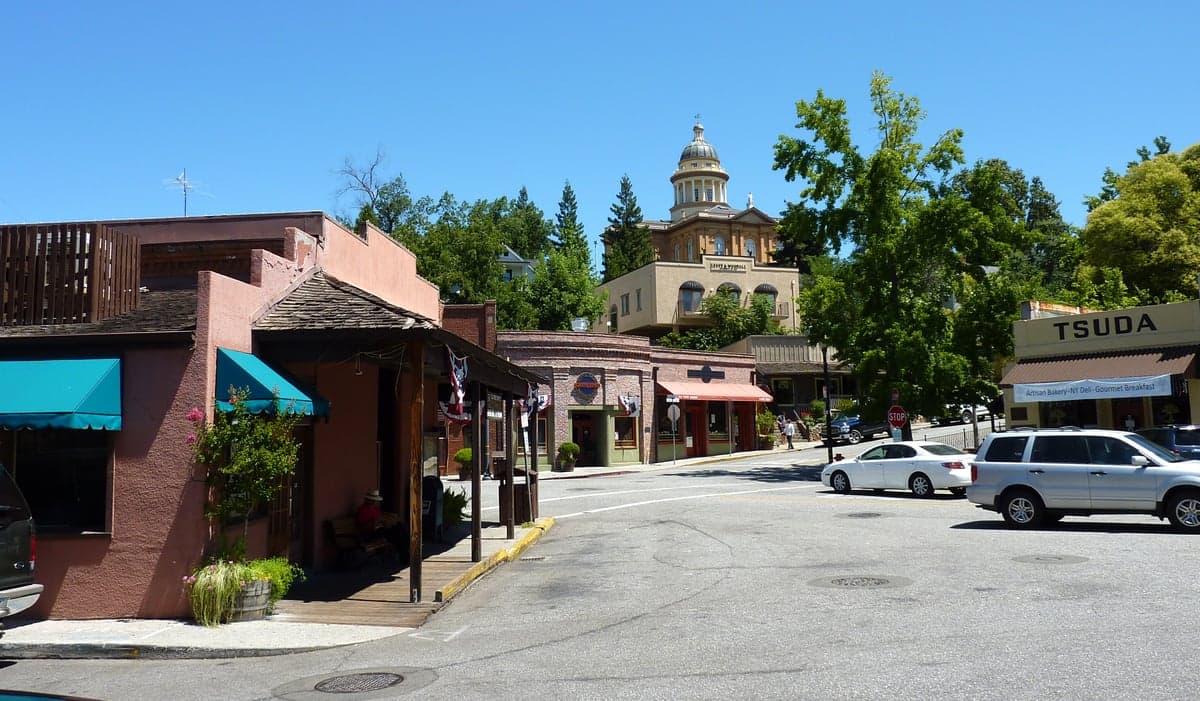
Photo: Wikipedia
Political ClimatePolitical Climate in Auburn, CA
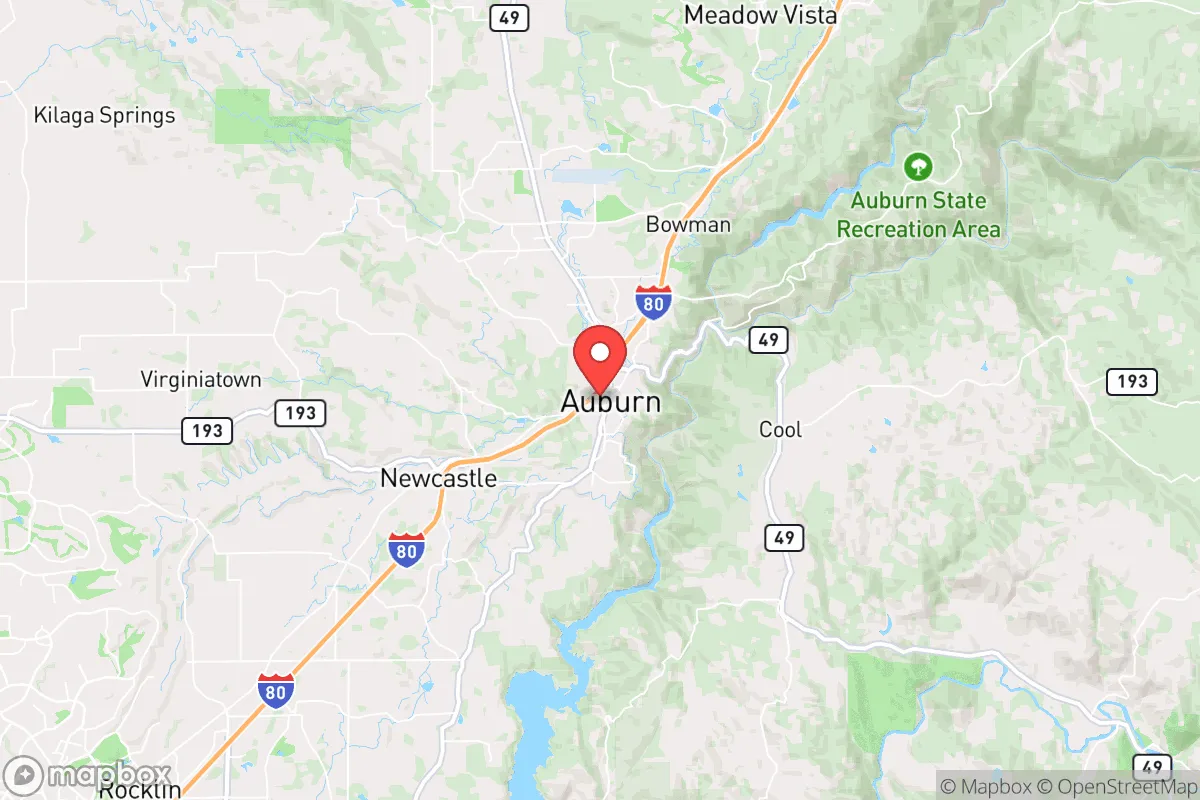
District shown is the primary district for this city’s centroid. Cities may span multiple districts.
Lean and PVI are calculated from Auburn, CA’s own 2020 and 2024 presidential results, Cook-style. Sources: state election offices; VEST 2020 precinct results (CC BY 4.0).
Political rankings in California
- Most Conservative Cities in California
- Most Liberal Cities in California
- Best Conservative-Leaning Towns on the West Coast
- Affordable Small Towns for Conservatives
- Most Affordable Liberal-Leaning Small Towns in the U.S.
- Safest Liberal-Leaning Cities in the U.S.
- Most Conservative Counties in California
- Most Liberal Counties in California
Local Political AnalysisPolitical Analysis of Auburn, CA
Auburn, California, sits in a political pocket that feels noticeably different from the state as a whole. With a Cook Partisan Voting Index of R+2, the city and its immediate surroundings lean slightly Republican, a contrast to California’s overall Democratic tilt. Over the last decade, that lean has held steady, even as the broader state has moved left. You won’t see Auburn flipping blue anytime soon, but you also won’t find the deep-red intensity of places like nearby Grass Valley or the more rural stretches of Placer County. It’s a moderate conservative area, shaped by a mix of longtime locals, commuters who work in Sacramento or Roseville, and retirees who chose the foothills for the climate and pace of life.
How it compares
Compared to California as a whole, Auburn is a political outlier. The state’s Cook PVI is not officially calculated, but its consistent Democratic supermajorities in the legislature and its 20-point margin for Biden in 2020 place it firmly in blue territory. Auburn, by contrast, sits in a county that voted for Trump by about 10 points in 2020. Drive 30 minutes south to Roseville or Rocklin, and you’ll find similar conservative-leaning suburbs. Head west to Lincoln, and the politics get even more Republican. But go 20 minutes southwest to the Sacramento city limits, and you’re in a deep-blue urban center. That proximity means Auburn residents live with a constant political contrast: their local representatives tend to be moderate Republicans, while state-level policies on housing, taxes, and energy are shaped by a Democratic majority in Sacramento. The result is a community that often feels out of step with the state’s direction, but not isolated from it.
What this means for residents
For conservative residents, Auburn offers a comfortable environment where their views are the local norm. Local government, school board meetings, and community events tend to reflect center-right values. Gun rights are respected, property taxes are relatively low by California standards, and there’s a general skepticism of Sacramento’s regulatory reach. For liberal residents, life in Auburn is more of a balancing act. You’ll find like-minded people, especially among younger families and newcomers from the Bay Area, but you won’t see many yard signs for Democratic candidates. The political discourse is generally civil, though tensions flare around hot-button issues like development, water rights, and wildfire management. Both sides share a common frustration: the feeling that decisions made in Sacramento don’t always account for the realities of life in the Sierra foothills. That shared grievance sometimes creates odd alliances, especially around local land-use issues.
One cultural distinction that sets Auburn apart is its independent streak. This is a town that values self-reliance, and that shows up in everything from the number of small businesses to the popularity of off-grid living discussions at local coffee shops. The political climate here isn’t about party loyalty as much as it is about local control. Whether you lean left or right, you’ll find that Auburn’s politics are grounded in a practical, live-and-let-live attitude, as long as you respect the town’s pace and its history. The trajectory is toward slow, steady growth, with more newcomers arriving from the coast each year. That will likely nudge the politics slightly toward the center over the next decade, but Auburn’s R+2 identity feels durable for the foreseeable future.

State Political ClimatePolitical Climate in California
State Political AnalysisPolitical Environment in the State
California is a deeply blue state where Democrats hold every statewide office and supermajorities in both legislative chambers, but the reality on the ground is far more fractured than the statewide numbers suggest. Over the past 20 years, the state has shifted from a competitive purple battleground—where Arnold Schwarzenegger won a recall and two terms as a Republican governor—to a solidly Democratic stronghold, driven largely by the Bay Area and Los Angeles County. However, that blue veneer masks a fierce urban-rural divide, a growing moderate backlash in the Central Valley, and a steady exodus of conservative-leaning residents to states like Texas and Idaho, which has actually concentrated Democratic power in the remaining population.
Urban vs. rural divide
The political map of California is essentially a story of three Californias. The coastal metros—San Francisco, Los Angeles, and San Diego—are the engine of the state’s Democratic majority, with San Francisco County routinely delivering 85% of its vote to Democratic presidential candidates. In contrast, the inland rural counties—places like Shasta County (Redding), Tulare County (Visalia), and Kern County (Bakersfield)—vote Republican by margins of 20 to 40 points. The Central Valley is the key swing region: Fresno County has trended blue in presidential races but remains purple at the local level, while Orange County, once a Republican bastion, flipped blue in 2018 and has stayed there, driven by Asian American and Latino suburban voters. A relocator looking for a conservative pocket should consider places like Temecula (Riverside County), Simi Valley (Ventura County), or El Dorado Hills (Sacramento area), where local school boards and city councils are often conservative-leaning even as the surrounding county votes blue.
Policy environment
California’s policy environment is defined by high taxes, heavy regulation, and a robust social safety net. The state has a progressive income tax with a top marginal rate of 13.3% (the highest in the nation), a state sales tax that can exceed 10% in some cities, and some of the highest gas taxes in the country. Property taxes are capped at 1% of assessed value plus inflation under Proposition 13, but reassessment upon sale means newcomers often face significantly higher bills than long-term owners. The regulatory posture is aggressive: California has its own environmental review process (CEQA), its own emissions standards (CARB), and some of the strictest labor and employment laws in the country, including a $16.50 minimum wage (2025) and mandatory paid sick leave. On education, the state funds K-12 at above-average levels per pupil but ranks near the bottom in test scores, and school choice is limited—charter schools exist but face increasing restrictions. Healthcare is heavily regulated, with a state-run insurance exchange (Covered California) and a path toward a single-payer system that has been debated but not enacted. Election laws are among the most accessible in the nation: all registered voters receive a mail-in ballot automatically, same-day registration is available, and voting by mail is the norm.
Recent policy direction
Over the past five years, California has moved decisively left on most fronts, but with some notable exceptions. On gun and self-defense law, the state has passed some of the nation’s strictest measures: a 2023 law (SB 2) effectively bans carrying firearms in most public places, including parks, hospitals, and public transit, and a 2024 law (AB 1598) requires microstamping technology on all new handguns sold. On parental and education rights, the state has moved in the opposite direction from red states: a 2024 law (AB 1955) prohibits school districts from requiring teachers to notify parents if a child changes their gender identity or pronouns, and the state has expanded ethnic studies and LGBTQ+ inclusive curriculum mandates. On speech and privacy, California has a strong consumer privacy law (CCPA/CPRA) that gives residents control over their data, but it has also passed laws (like AB 587) requiring social media platforms to disclose their content moderation policies, which critics argue could chill speech. On medical and bodily autonomy, California has become a “sanctuary state” for abortion and gender-affirming care, passing laws (SB 345, AB 2098) that protect providers and patients from out-of-state legal actions. On property rights, the state has tightened rent control (AB 1482 caps annual rent increases at 5% plus inflation) and expanded tenant protections, but has also preempted local bans on accessory dwelling units (ADUs) to boost housing supply. On taxation, a 2024 ballot measure (Proposition 19) increased property tax portability for seniors and disaster victims but also tightened inheritance tax loopholes. On voting and ballot access, the state has expanded mail-in voting and same-day registration, but a 2024 law (AB 421) requires counties to accept ballot drop boxes 24/7, which has raised security concerns among some conservatives.
Civil unrest & political movements
California has a long history of political activism, from the 1960s Free Speech Movement at UC Berkeley to the 2020 George Floyd protests, which were among the largest and most destructive in the state, particularly in Los Angeles and Oakland. The state is home to organized movements on both sides: the progressive wing is dominated by labor unions (SEIU, UAW), environmental groups (Sierra Club), and immigrant rights organizations (CHIRLA), while the conservative side is fragmented but active in areas like the Central Valley and inland empire, with groups like the California Republican Party and local “parents’ rights” organizations that have gained traction in school board races in places like San Diego and Orange County. Immigration politics are a constant flashpoint: California is a “sanctuary state” under SB 54, which limits local law enforcement cooperation with federal immigration authorities, and the state has sued the Trump administration multiple times over immigration policies. Secession rhetoric—the “Calexit” movement—peaked after the 2016 election but has faded, though a 2024 poll found 20% of Californians still support secession. Election integrity controversies have been relatively muted compared to other states, but conservative activists have raised concerns about ballot harvesting and the state’s universal mail-in voting system, particularly in close legislative races in the Central Valley.
Projection
Over the next 5-10 years, California’s political trajectory is likely to remain blue, but with increasing internal tension. Demographic shifts are working against the Democratic coalition: the state’s population has declined for three consecutive years (2020-2023), driven by out-migration of lower-income and middle-class families, many of whom are Latino and Asian American—key Democratic constituencies. The remaining population is older, wealthier, and more educated, which could push the state toward a more moderate, tech-centric liberalism rather than the progressive populism of the past decade. The housing crisis is the wild card: if the state fails to build enough housing, continued out-migration could flip a few Central Valley and Inland Empire seats to Republican, but not enough to change the overall balance of power. A relocator moving in now should expect that California will remain a high-tax, high-regulation state with strong protections for abortion, LGBTQ+ rights, and immigrants, but that the political conversation will increasingly focus on affordability, public safety, and education outcomes rather than culture war issues.
For a conservative-leaning relocator, the bottom line is that California offers a high quality of life in specific pockets—good weather, strong job markets in tech and healthcare, and world-class outdoor recreation—but you will be living in a state where your political views are in the minority and where state policy will often conflict with your values on taxes, guns, education, and parental rights. If you can afford the cost of living and are willing to engage in local politics (school boards, city councils, county supervisor races), you can find community in places like Bakersfield, Huntington Beach, or Murrieta. But if you want a state where your vote consistently aligns with the majority, you are better off looking at Texas, Florida, or Tennessee. California is a beautiful, complicated, and expensive place to live—and it is not getting any cheaper or more conservative anytime soon.
* Values derived from national, state, county, city and local statistics and may differ in a specific area. Last updated: 2026-11-21T22:14:00.000Z
Narrative content on this page is AI-generated and may contain mistakes. Verify any details that matter before acting on them.
ReloMaps may earn a commission from affiliate links at no extra cost to you.

