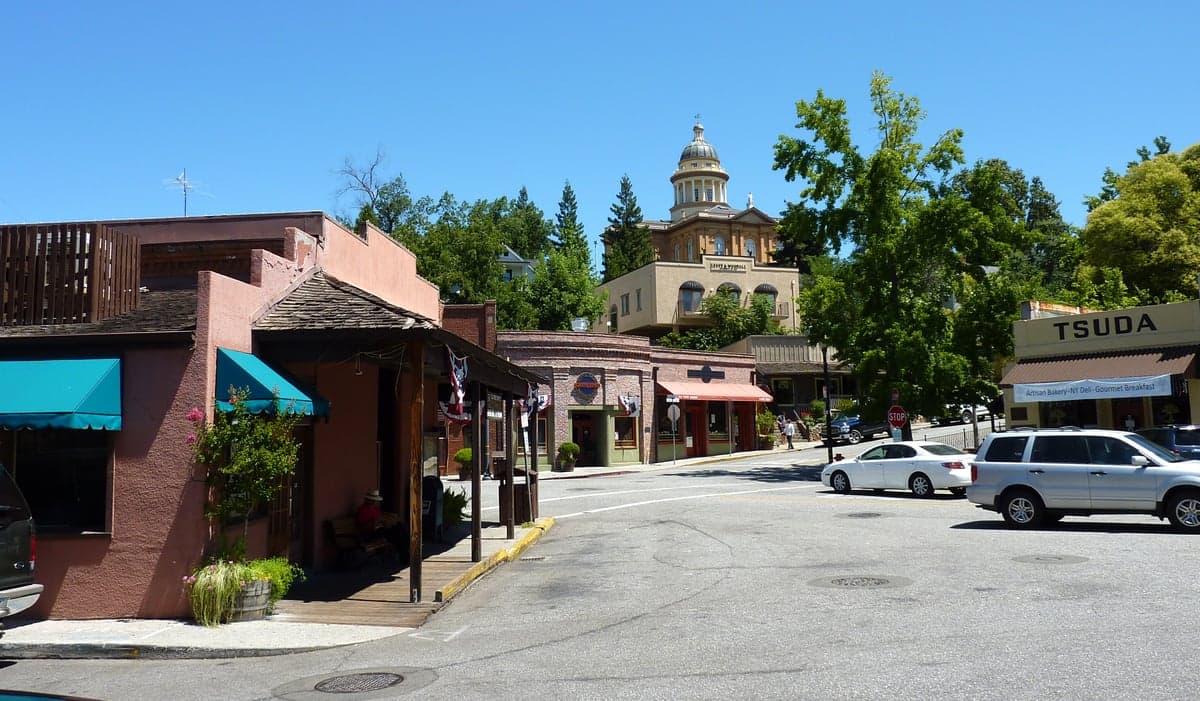
Photo: Wikipedia
Personal Sovereignty in Auburn, CA
Viable for self-reliance. Generally workable, though some barriers may limit total independence.
What does Personal Sovereignty tell us?
Personal Sovereignty measures your capacity for self-reliance and independence with minimal government friction. Higher scores mean fewer barriers between you and the way you want to live... but it assumes you have the space you need and good neighbors.
What does this tell us?
Personal Sovereignty measures your capacity for self-reliance and independence with minimal government friction. Higher scores mean fewer barriers between you and the way you want to live... but it assumes you have the space you need and good neighbors.
State Policy
Energy independence: Importer (25% of energy produced in-state)
Personal Liberty
Homesteading

Personal Liberty Analysis
Auburn, California, situated in the Sierra Nevada foothills of Placer County, offers a notably high degree of personal sovereignty relative to much of coastal California, driven by a combination of local political culture, state-level legal frameworks, and geographic realities. While residents must contend with California’s statewide tax burden and regulatory density, Auburn’s local governance leans conservative, and the area’s physical layout and zoning patterns create tangible opportunities for self-reliance that are rare in the state’s major metro areas. For a relocation-minded individual or family prioritizing autonomy, Auburn represents a pragmatic middle ground: you are still subject to Sacramento’s authority, but the local environment actively supports a more independent lifestyle than what is available in the Bay Area or Los Angeles.
Tax burden and regulatory posture in Placer County
California’s statewide tax burden is among the highest in the nation, and Auburn residents are not exempt. The state’s top marginal income tax rate of 13.3% applies to high earners, and the base state sales tax rate of 7.25% is supplemented by Placer County’s local add-ons, bringing the total to roughly 7.75% in Auburn. Property taxes, however, are a relative bright spot due to Proposition 13: the effective rate on assessed value is capped at 1% plus local voter-approved bonds, and annual increases are limited to 2% until the property is sold. This means long-term homeowners in Auburn face a predictable, low-growth property tax burden that is significantly more stable than in states without such caps. On the regulatory side, Placer County is known for a more business-friendly posture than the state average. The county’s general plan and zoning codes are less restrictive than those in the Bay Area, and the local building department is generally described as pragmatic rather than adversarial. That said, California’s statewide environmental review process (CEQA) still applies to larger projects, and the California Air Resources Board’s regulations affect everything from wood-burning stoves to vehicle choices. The net effect is a regulatory environment that is lighter than the state’s coastal regions but heavier than what you would find in Texas or Nevada.
Self-defense and gun law specifics in Auburn
California’s firearm laws are among the most restrictive in the United States, and Auburn residents must comply with all of them. The state requires a 10-day waiting period for all firearm purchases, a background check through the California Department of Justice, and a Firearm Safety Certificate. The state’s roster of handguns approved for sale is limited, and magazines capable of holding more than 10 rounds are prohibited. Assault weapon bans are in effect, and the state’s red flag law allows for temporary firearm seizure based on a court order. However, Placer County is a stronghold for Second Amendment advocacy, and local sheriff’s offices are generally supportive of lawful gun ownership. The Placer County Sheriff’s Office is known for issuing concealed carry permits (CCWs) in a “shall-issue” manner, meaning that if you meet the statutory requirements—including a firearms training course and a clean criminal record—you will typically receive a permit. This stands in contrast to many coastal California counties where CCW issuance was historically rare before the Bruen decision. For practical self-defense, Auburn residents can own and carry handguns, shotguns, and rifles (within state limits), and the local culture is one of responsible firearm ownership. The nearest gun ranges and training facilities are within a short drive, and the community is active in firearms education and safety. If your priority is the broadest possible self-defense rights, California will feel restrictive; but within that framework, Auburn offers the most accommodating local environment available in the state.
Self-reliance and homesteading viability: lot sizes, zoning, and off-grid feasibility
Auburn’s geography and zoning create genuine opportunities for self-reliance that are difficult to find in California’s urban centers. The city itself has a mix of lot sizes, but the surrounding unincorporated areas of Placer County offer parcels ranging from one to forty acres, often zoned for agricultural or residential use with allowances for livestock, gardens, and outbuildings. The county’s zoning code permits accessory dwelling units (ADUs), barns, and workshops on most residential parcels, and there is no blanket prohibition on keeping chickens, goats, or even larger livestock on appropriately zoned land. Off-grid living is legally challenging in California due to state building codes and health department requirements. The California Building Standards Code requires that all habitable dwellings have access to approved water and wastewater systems, which typically means a well and a septic system. Solar power is permitted and widely used, but full disconnection from the grid is rare because utility companies often require an interconnection agreement for net metering. Rainwater catchment is legal and encouraged, but it cannot be the sole source of potable water. Wood stoves are allowed but must comply with EPA emissions standards, and some areas may have burn bans during high fire risk periods. For a family seeking a semi-self-sufficient lifestyle—growing food, raising animals, generating solar power, and reducing reliance on grocery stores and utility grids—Auburn’s foothill environment is viable. The growing season is moderate (roughly 200 days), and the soil in the American River canyon area is workable with amendment. The key constraint is water: wells can be expensive to drill (often $15,000–$30,000 depending on depth), and drought conditions periodically affect groundwater availability. Overall, Auburn offers a realistic path to a self-reliant homesteading lifestyle, provided you work within California’s regulatory framework rather than trying to bypass it entirely.
Personal liberties: parental rights, medical autonomy, speech, and property
California’s statewide policies on personal liberties are a mixed bag for a conservative-leaning audience. Parental rights are protected under state law, but California also has some of the strongest LGBTQ+ nondiscrimination laws in the country, which can create tension in school districts over curriculum and parental notification policies. Placer County school boards have been the site of active debates on these issues, and the local political climate generally supports parental involvement and transparency. Medical autonomy is limited by California’s vaccine mandates for school attendance and healthcare workers, though exemptions exist for medical reasons. The state has legalized medical and recreational cannabis, which some residents view as a personal liberty issue, while others may find the widespread availability at odds with their values. Speech is broadly protected under the First Amendment, and California’s anti-SLAPP statute provides strong protections against lawsuits intended to silence criticism. Property rights are a significant concern in California due to the state’s housing crisis and environmental regulations. The California Environmental Quality Act (CEQA) can be used to delay or block development, and the state’s coastal commission has broad authority over land use in coastal zones (though Auburn is inland, so this is less relevant). The California Public Utilities Commission regulates utility rates and can impose fees on new construction. On the positive side, Placer County’s zoning is relatively permissive for rural residential use, and the county’s general plan supports agricultural and resource-based land uses. The net effect is that personal liberties in Auburn are strongest in the areas of property use and self-reliance, moderate in parental rights and speech, and most constrained in medical autonomy and firearm ownership. This is a realistic assessment for anyone considering relocation from a freer state.
Compared to other regions in California, Auburn stands out as a place where personal sovereignty is actively supported by local governance and community culture, even as state-level constraints remain in place. The tax burden is high by national standards but manageable under Prop 13, the regulatory environment is lighter than the coast, and the opportunities for self-reliant living are real and accessible. For a family or individual who values independence and is willing to navigate California’s legal landscape, Auburn offers a degree of autonomy that is rare in the state. If your priority is maximum personal freedom with minimal government involvement, you would be better served by Nevada or Texas. But if your circumstances require you to stay in California—for family, work, or other reasons—Auburn is one of the strongest options for preserving your personal sovereignty while still enjoying the benefits of the state’s natural beauty and economic opportunities.

* Values derived from national, state, county, city and local statistics and may differ in a specific area. Last updated: 2026-11-21T22:14:00.000Z
Narrative content on this page is AI-generated and may contain mistakes. Verify any details that matter before acting on them.
ReloMaps may earn a commission from affiliate links at no extra cost to you.

