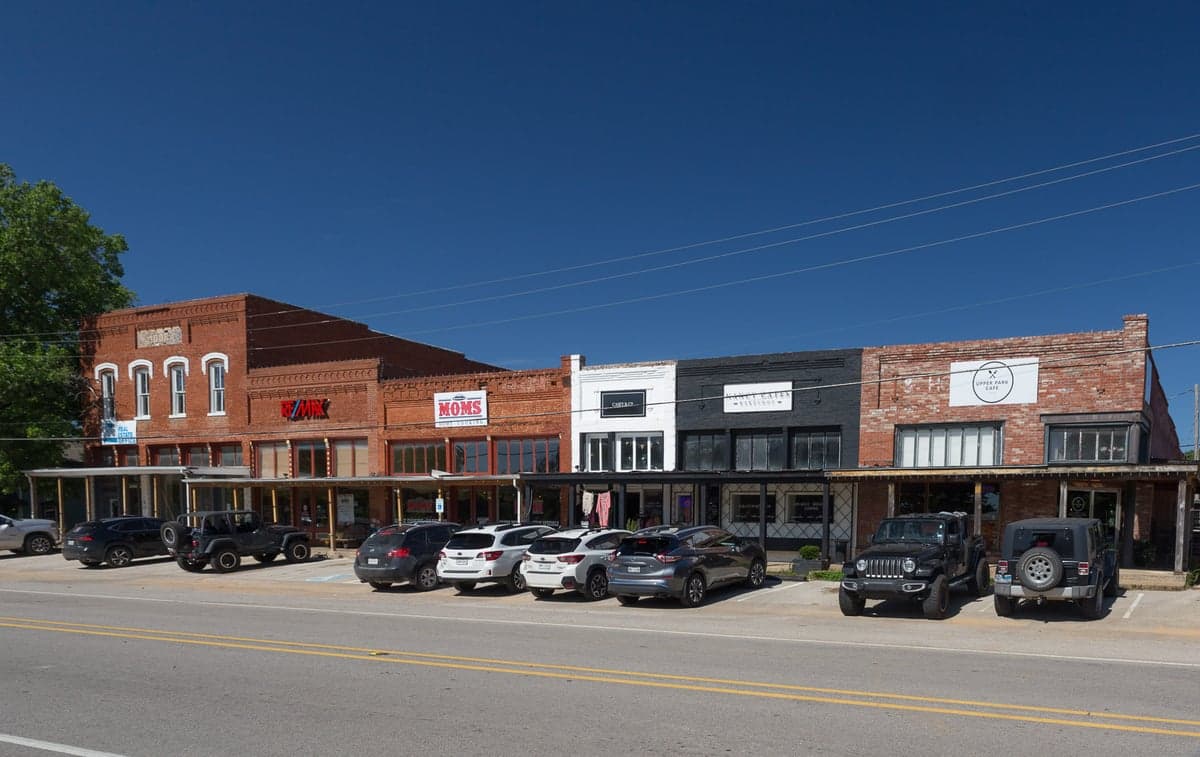
Photo: Wikipedia
Personal Sovereignty in Aubrey, TX
Strong independent fundamentals that actively favor personal liberty and low regulation.
What does Personal Sovereignty tell us?
Personal Sovereignty measures your capacity for self-reliance and independence with minimal government friction. Higher scores mean fewer barriers between you and the way you want to live... but it assumes you have the space you need and good neighbors.
What does this tell us?
Personal Sovereignty measures your capacity for self-reliance and independence with minimal government friction. Higher scores mean fewer barriers between you and the way you want to live... but it assumes you have the space you need and good neighbors.
State Policy
Energy independence: Net exporter (220% of energy produced in-state)
Personal Liberty
Homesteading

Personal Liberty Analysis
Aubrey, Texas, located in the fast-growing corridor between Dallas and the Oklahoma border, offers a personal sovereignty environment that is heavily shaped by the state’s broad preemption laws and a local culture of self-reliance. The town’s autonomy profile is defined by a low tax burden, permissive self-defense laws, and a regulatory posture that generally favors individual decision-making over government oversight, though recent population growth is introducing some tension between traditional independence and suburban-style governance. For a relocation reader prioritizing personal freedom, Aubrey represents a strong but evolving option within the broader North Texas region.
Tax burden and regulatory posture in Aubrey and Denton County
Texas’s lack of a state income tax is the foundational advantage for anyone moving to Aubrey. The state funds its operations through a combination of property taxes, sales taxes, and business franchise fees, meaning residents keep 100% of their earned income at the state level. In Aubrey, the total property tax rate for 2025-2026 is approximately 2.45% of assessed value, which is slightly above the national average but typical for fast-growing Texas suburbs. This rate is composed of the Denton County levy (about 0.24%), the Aubrey Independent School District (around 1.35%), and the city’s own rate (roughly 0.55%). The effective tax burden on a $400,000 home would be roughly $9,800 annually, a figure that is competitive with other North Texas towns like Celina or Prosper but higher than more rural options farther north.
Regulatory posture in Aubrey is light-touch by design. The city does not impose a local income tax, and there is no municipal-level business license requirement for most home-based enterprises. Zoning is present but not aggressively enforced in the older, unincorporated-style neighborhoods; however, newer subdivisions (e.g., those near the US-380 corridor) come with homeowners’ association covenants that can restrict everything from vehicle parking to home occupation types. The city’s building codes follow the 2021 International Residential Code with Texas-specific amendments, but permit fees are modest—typically under $500 for a standard single-family addition. For a reader who values minimal government interference, Aubrey’s regulatory environment is favorable, but the growing influence of HOAs in newer developments is a factor to investigate before purchasing.
Self-defense and gun law specifics in Aubrey and Texas
Texas is a constitutional carry state, meaning that as of September 1, 2021, any adult who is not prohibited from possessing a firearm under state or federal law may carry a handgun in public without a license. This applies fully in Aubrey, which is not a home-rule city with its own firearm ordinances. The city does not have any local restrictions on the carrying of firearms in parks, streets, or other public spaces, as Texas’s preemption statute (Texas Local Government Code § 229.001) prohibits municipalities from enacting their own gun control measures. Open carry of handguns is legal for licensed individuals, and unlicensed open carry is also permitted under the same constitutional carry framework, though it is less common in practice.
Self-defense law in Texas follows the “Castle Doctrine” and “Stand Your Ground” principles. Under Texas Penal Code § 9.31 and § 9.32, a person is justified in using deadly force if they reasonably believe it is necessary to prevent imminent death, serious bodily injury, or certain violent felonies. There is no duty to retreat in any place where the person is lawfully present. This applies to both the home and public spaces. For a reader who prioritizes the right to self-defense, Aubrey offers one of the most permissive legal environments in the country. The nearest gun ranges and training facilities are within a 15-minute drive, and the Denton County Sheriff’s Office processes license-to-carry applications efficiently, with typical turnaround times of 30-45 days.
Self-reliance and homesteading viability in Aubrey
Aubrey’s rural roots are still visible in its older residential areas, where lot sizes of 1 to 5 acres are common, especially east of FM-2931 and north of US-380. These properties are zoned for agricultural use and allow for livestock, including chickens, goats, and horses, without special permits as long as the animals are kept for personal use. The city’s zoning code permits “urban homesteading” activities such as beekeeping, composting, and rainwater harvesting on residential lots of one acre or more, though newer subdivisions with HOAs often prohibit these practices. For a reader interested in off-grid feasibility, Aubrey is a mixed bag: the city is served by the Denton County Municipal Utility District, which provides reliable water and electricity, but solar panel installation is permitted without additional fees as long as it complies with the 2021 International Energy Conservation Code. Rainwater collection is legal and encouraged under Texas House Bill 3391, which prohibits HOAs from banning it, though some HOAs may still impose aesthetic restrictions.
Gardening and food production are straightforward on larger lots. The growing season in USDA Hardiness Zone 8a runs from mid-March to mid-November, and the soil in the Aubrey area is a mix of sandy loam and clay, suitable for vegetables, fruit trees, and native forage. The city does not require a permit for a garden shed under 200 square feet, and there is no local ordinance against front-yard vegetable gardens. For a reader seeking a self-reliant lifestyle, Aubrey’s older neighborhoods offer genuine homesteading potential, but the newer developments are increasingly suburban in character, with smaller lots and stricter covenants.
Personal liberties in Aubrey: parental rights, medical autonomy, speech, and property
Texas law provides strong protections for parental rights, particularly in education. Under the Texas Parental Bill of Rights (Texas Family Code § 151.001), parents have the right to direct the education, medical care, and moral training of their children. Aubrey Independent School District has adopted policies that align with state law, including a requirement for parental consent before any student health clinic services (except in emergencies) and a policy that prohibits classroom instruction on sexual orientation or gender identity in grades K-3, as mandated by the 2023 Texas law. Parents in Aubrey have the right to opt their children out of any curriculum or activity that conflicts with their religious or moral beliefs, and the district maintains a transparent curriculum review process.
Medical autonomy in Texas is more limited than in some states. The state does not have a broad medical freedom law, but it does protect the right to refuse medical treatment under the Texas Advance Directives Act. Vaccination requirements for school attendance follow state law, which allows for medical and conscientious exemptions (the latter through a signed affidavit). Telehealth and direct-primary-care arrangements are legal and available in the region. Speech and assembly rights are fully protected under the First Amendment, and Aubrey has no local ordinances restricting political signage or public gatherings beyond standard time, place, and manner regulations. Property rights are strong: Texas has no state-level property tax on personal property (vehicles, boats, etc.), and the state’s homestead exemption protects up to $100,000 of a home’s value from creditors. For a reader who values these liberties, Aubrey’s legal environment is supportive, though it operates within the broader constraints of Texas law.
Overall, Aubrey offers a personal sovereignty profile that ranks among the strongest in the Dallas-Fort Worth metroplex. The combination of no state income tax, constitutional carry, strong parental rights, and viable homesteading on larger lots creates an environment where individual autonomy is the default. The primary trade-offs are the rising property tax burden and the increasing prevalence of HOA-governed subdivisions, which can erode some of the freedoms that drew people to the area. For a relocation reader who prioritizes personal freedom and independence, Aubrey is a compelling choice, particularly in its older, unincorporated-style neighborhoods, but it requires careful property selection to avoid the creeping restrictions of suburban governance.

* Values derived from national, state, county, city and local statistics and may differ in a specific area. Last updated: 2026-10-27T13:34:42.000Z
Narrative content on this page is AI-generated and may contain mistakes. Verify any details that matter before acting on them.
ReloMaps may earn a commission from affiliate links at no extra cost to you.

