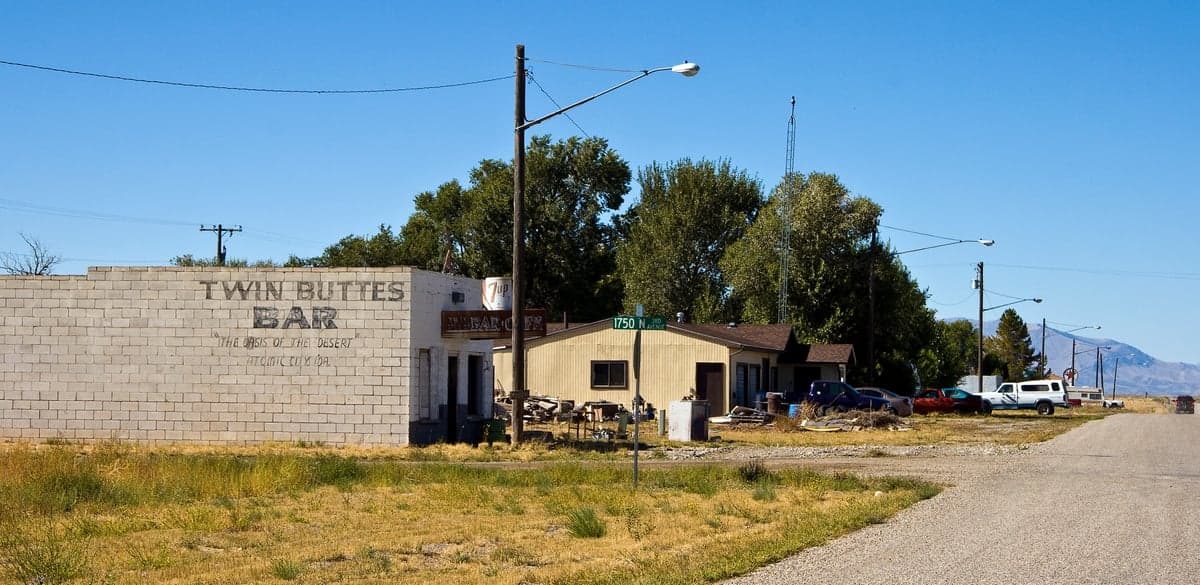

Photo: Wikipedia
Political ClimatePolitical Climate in Atomic City, ID
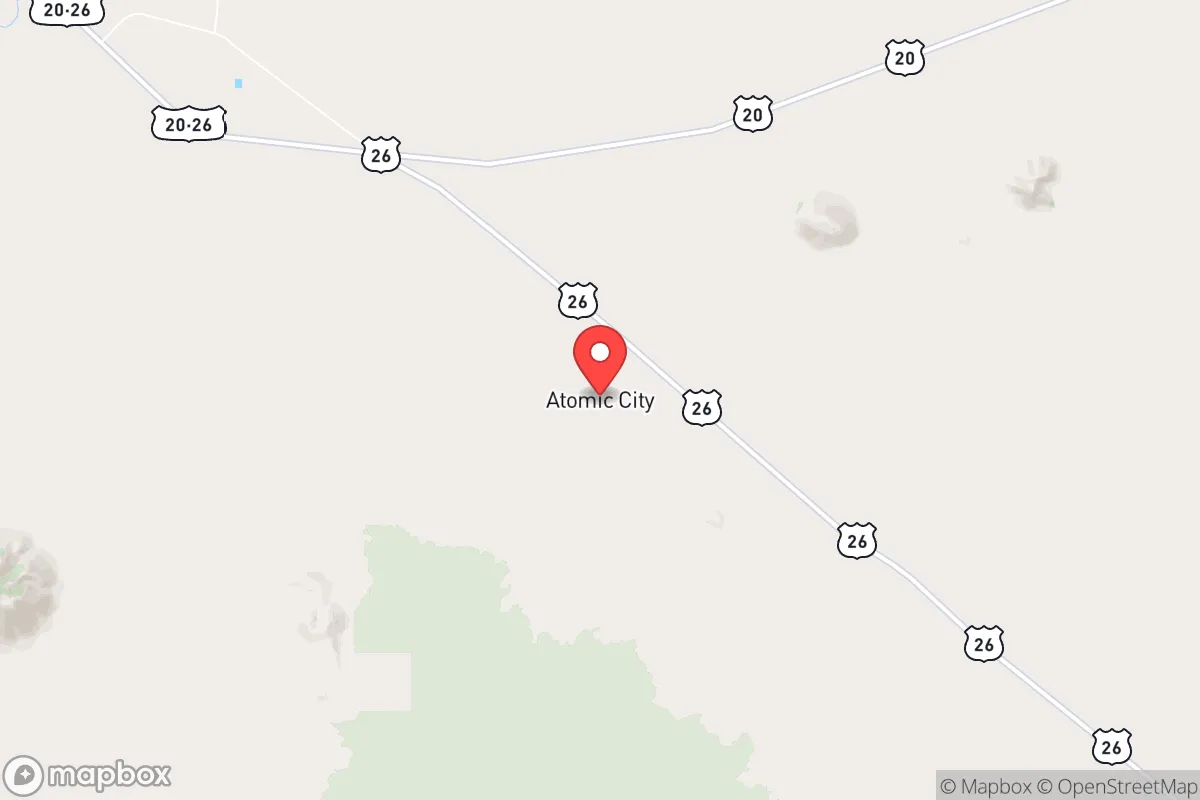
District shown is the primary district for this city’s centroid. Cities may span multiple districts.
Local Political AnalysisPolitical Analysis of Atomic City, ID
Atomic City sits in a deeply Republican corner of Idaho, but it’s not quite as red as the rest of the state. The area carries a Cook PVI of R+13, while Idaho as a whole is R+18 — a five-point gap that reflects a slightly more independent streak than the statewide average. In practice, that means you’ll see plenty of Trump and “Let’s Go Brandon” flags on pickups, but you’re also more likely to run into a libertarian-leaning rancher or a fed-up former Californian who votes Republican but grumbles about government overreach just as loudly as any Democrat.
How it compares
That R+13 vs. R+18 split is the whole story in a nutshell. Idaho’s deep-red reputation is driven by the booming, heavily Mormon suburbs of Boise and the conservative farming valleys of the south. Atomic City, by contrast, sits in the high desert near the Idaho National Laboratory, and that changes the political chemistry. The lab brings in a steady stream of engineers, scientists, and contractors from out of state — many of whom are conservative on fiscal issues but far more moderate on social questions than the rural baseline. Drive 20 minutes west to Arco, and you’ll find a more traditional, older-school Republicanism rooted in ranching and farming. Head an hour north to the Sun Valley area around Ketchum, and you’ll hit the bluest pocket in the region, a resort town where Democrats actually win precincts. Atomic City is neither of those — it’s a pragmatic, energy-sector Republicanism that votes red but doesn’t get worked up about culture-war purity tests.
What this means for residents
For conservative residents, the practical reality is comfortable: local offices, county commissions, and the state legislature are all reliably Republican, and the policy agenda on taxes, gun rights, and land use aligns with their priorities. You won’t find much friction in daily life. For liberal residents, it’s a different but not hostile experience. You’ll be in a clear minority, and you’ll hear opinions you disagree with at the grocery store or the post office, but the lab’s presence means a surprising number of your neighbors are college-educated transplants who keep their politics low-key. There’s no real progressive infrastructure — no active Democratic precinct committee worth mentioning — but there’s also little of the aggressive, performative conservatism you’d find in smaller farming towns further south. Most people just want the lab’s contracts to keep flowing and the roads to stay plowed.
What this means for residents
Looking ahead, the trajectory is toward more of the same, with a twist. The Idaho National Laboratory is expanding, and that’s drawing younger, more educated workers who tend to be socially moderate even when they vote Republican. That could nudge Atomic City’s politics slightly toward the center over the next decade, much like what happened in Idaho Falls, which has become noticeably less culturally conservative than the surrounding countryside. But don’t expect a blue wave — the area’s rural character, low population density, and strong attachment to the Second Amendment and limited government will keep it solidly red for the foreseeable future. The more interesting shift is internal: the old divide between lifelong ranchers and new lab employees is slowly blurring, and the politics are becoming less about ideology and more about keeping the local economy humming. That’s a dynamic you won’t find in most of Idaho, and it gives Atomic City a slightly more pragmatic, live-and-let-live feel than its voting record might suggest.

State Political ClimatePolitical Climate in Idaho
State Political AnalysisPolitical Environment in the State
Idaho is one of the most reliably Republican states in the nation, carrying a Cook PVI of R+18, meaning it votes about 18 points more Republican than the country as a whole. The state hasn't backed a Democrat for president since Lyndon Johnson in 1964, and the last time a Democrat won the governorship was Cecil Andrus in 1990. Over the last 20 years, the shift hasn't been toward the center—it's been a steady march rightward, driven by a mix of native conservative culture and a massive influx of out-of-state transplants who are often fleeing blue states for exactly the policies Idaho now champions.
Urban vs. rural divide
The political map of Idaho is a tale of two distinct geographies. The Treasure Valley, anchored by Boise, Meridian, and Nampa, holds roughly 40% of the state's population and is the only region with any real Democratic presence. Ada County, home to Boise, has been a genuine battleground—it voted for Obama in 2008, went for Trump in 2016 and 2020, and then swung back to a narrow Biden win in 2020 before flipping to Trump again in 2024. That volatility makes Ada County the single most important political prize in the state, and it's why both parties pour resources there.
Outside the Treasure Valley, the map is a sea of red. Idaho Falls and Pocatello in the east are reliably conservative, with Pocatello's university influence creating a small but persistent liberal pocket. Coeur d'Alene in the north has seen a fascinating shift—it was historically a working-class Democratic area tied to the timber and mining industries, but it has transformed into a staunchly Republican stronghold over the past two decades, fueled by an influx of retirees and remote workers from California and Washington. The rural counties—Lemhi, Boundary, and Owyhee—routinely vote 80-90% Republican, and it's these areas that give Idaho its deep-red character.
Policy environment
Idaho's policy environment is built around a simple philosophy: low taxes, minimal regulation, and maximum local control. The state has no corporate income tax on pass-through entities, a flat 5.8% individual income tax that's been steadily cut over the past decade, and a property tax system that heavily favors homeowners over commercial interests. The 2023 legislative session passed a $600 million tax cut package, the largest in state history, which moved Idaho toward a flat 5.8% rate with a path to 5.2% by 2026.
Education policy has become a flashpoint. The state's school choice movement scored a major win in 2024 with the passage of a $50 million education savings account program, making Idaho one of the more aggressive states in the West on parental choice. However, the state still ranks near the bottom nationally in per-pupil spending, and teacher pay remains a persistent complaint in rural districts. Healthcare is a mixed bag—Idaho expanded Medicaid in 2020 via ballot initiative, but the legislature has spent years trying to attach work requirements and other restrictions to the program. The state also passed a near-total abortion ban in 2020, modeled on Texas's heartbeat law, which took effect after the Dobbs decision in 2022.
Recent policy direction
The last five years have seen Idaho move aggressively on a broad front of liberty issues. On guns, the state passed a Second Amendment Preservation Act in 2021 that prohibits state and local law enforcement from enforcing federal firearms laws that Idaho deems unconstitutional—a direct challenge to federal authority that's still being litigated. Constitutional carry became law in 2016, and in 2023 the legislature added a "stand your ground" expansion that removes the duty to retreat in any place where a person has a right to be.
On parental and education rights, Idaho passed the "Parental Rights in Education" law in 2022, which requires schools to notify parents of any curriculum changes and prohibits instruction on gender identity and sexual orientation in grades K-3. The state also banned transgender girls from competing in school sports in 2020, one of the first states in the nation to do so. On medical freedom, Idaho passed a law in 2023 prohibiting any government entity from mandating COVID-19 vaccines, and it's one of the few states with a law on the books that explicitly protects the right to refuse any medical treatment.
Property rights have been a major theme. The state passed a "private property protection" law in 2021 that requires governments to compensate landowners for any reduction in property value caused by regulation—a direct shot at zoning and environmental rules. On voting, Idaho has some of the most accessible election laws in the West: same-day voter registration, no-excuse absentee voting, and a 2023 law that requires hand-counting of ballots in all counties, a move that has drawn both praise for transparency and criticism for cost and accuracy concerns.
Civil unrest & political movements
Idaho has a visible and organized activist scene on both ends of the spectrum, though the right is far more prominent. The Idaho Freedom Foundation, a conservative think tank, has become the de facto policy engine for the legislature's most aggressive proposals, and its influence has grown every session. The state has also been a hub for the broader "constitutional sheriff" movement, with several county sheriffs publicly stating they will not enforce federal gun laws they consider unconstitutional.
On the left, the Boise area has seen recurring protests on abortion rights, racial justice, and LGBTQ issues, but they remain small relative to the state's overall population. The most visible flashpoint in recent years was the 2022 "library wars" in Idaho Falls and Coeur d'Alene, where conservative activists successfully pushed for the removal of books they deemed inappropriate from public libraries, leading to a statewide law in 2023 that allows parents to challenge any material in school libraries. Immigration politics have been relatively quiet compared to border states, but the legislature passed a law in 2024 requiring local law enforcement to cooperate with federal immigration authorities, and several counties have declared themselves "sanctuary county" opponents.
Projection
Looking ahead five to ten years, Idaho's political trajectory is likely to continue rightward, but with a twist. The state is growing faster than almost any other in the nation—it added over 100,000 residents between 2020 and 2024—and a significant portion of those newcomers are coming from California, Washington, and Oregon. Many are conservatives fleeing high taxes and regulation, which reinforces the red lean. But a meaningful minority are liberals drawn by the outdoor lifestyle and low cost of living, and they're concentrating in Boise and Moscow, home to the University of Idaho.
The real question is whether the Treasure Valley's growth will eventually turn Ada County into a permanent swing district or even a Democratic-leaning county. If that happens, Idaho could see its first competitive statewide race in decades, though the rural vote is so dominant that a statewide Democratic win remains a long shot. More likely, the state will continue to pass increasingly aggressive conservative legislation, with the legislature becoming more assertive in challenging federal authority on guns, education, and healthcare. The hand-counting law and the Second Amendment Preservation Act are likely to face years of litigation, and the outcomes could shape how far Idaho is willing to push its sovereignty claims.
For a new resident, the bottom line is this: Idaho is a state where conservative policies are not just the default—they're the driving force of governance. If you're moving here for lower taxes, fewer regulations, and a government that's skeptical of federal power, you'll find a state that's actively moving in your direction. If you're moving here for the mountains and the lifestyle but lean left, you'll find a welcoming community in Boise and Moscow, but you'll also find a legislature that's increasingly willing to preempt local ordinances and pass statewide laws that may not reflect your values. The state is growing, changing, and politically energized—and that energy is almost entirely flowing in one direction.
* Values derived from national, state, county, city and local statistics and may differ in a specific area. Last updated: 2026-10-26T02:17:23.000Z
Narrative content on this page is AI-generated and may contain mistakes. Verify any details that matter before acting on them.
ReloMaps may earn a commission from affiliate links at no extra cost to you.

