Photo: Wikipedia
Personal Sovereignty in Atomic City, ID
Moderate friction. Expect trade-offs in some aspect of personal liberty and independence.
What does Personal Sovereignty tell us?
Personal Sovereignty measures your capacity for self-reliance and independence with minimal government friction. Higher scores mean fewer barriers between you and the way you want to live... but it assumes you have the space you need and good neighbors.
What does this tell us?
Personal Sovereignty measures your capacity for self-reliance and independence with minimal government friction. Higher scores mean fewer barriers between you and the way you want to live... but it assumes you have the space you need and good neighbors.
State Policy
Energy independence: Importer (25% of energy produced in-state)
Personal Liberty
Homesteading

Personal Liberty Analysis
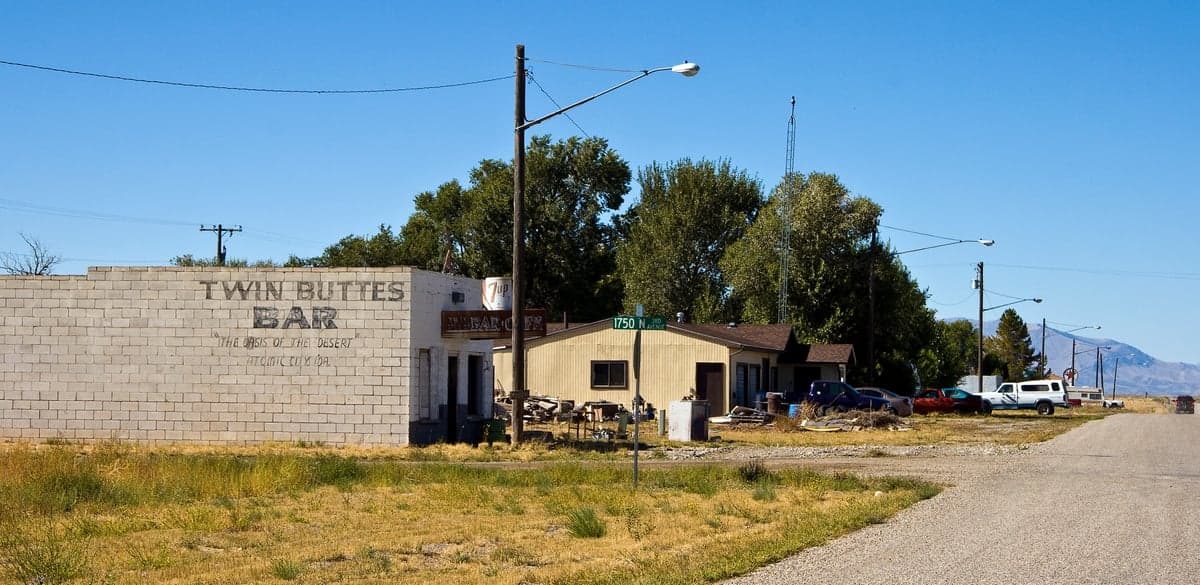
Atomic City, Idaho, offers one of the most genuinely hands-off personal sovereignty environments in the lower 48, largely because it is a tiny, unincorporated community in Bingham County with minimal local government presence. For a relocation reader prioritizing autonomy, the key takeaway is that this is a place where the state's constitutional framework—not local ordinances—sets the ceiling on your personal freedom. With a population hovering around 30 residents and no municipal police force, zoning board, or city council to answer to, the regulatory friction here is dramatically lower than in nearby Blackfoot or Idaho Falls, making it a serious contender for those who want to live by their own rules.
How the tax burden and regulatory posture compare to the rest of Idaho
Idaho's tax climate is already favorable for sovereignty-minded individuals, and Atomic City sits squarely within that framework. The state levies a flat income tax rate of 5.8% (as of 2025), which applies equally to all earners—no progressive brackets, no special carve-outs for high earners. Property taxes in Bingham County are comparatively modest, with the average effective rate hovering around 0.68% of assessed home value, well below the national average of roughly 0.99%. There is no state-level sales tax on groceries, and the combined state and local sales tax rate in Bingham County is 6%, which is on the lower end nationally.
The regulatory posture is where Atomic City truly distinguishes itself. Because it is unincorporated, there is no local planning commission to approve or deny your building project, no local business license requirement, and no municipal code dictating property aesthetics. The primary regulatory bodies you will interact with are Bingham County and the State of Idaho, both of which operate with a light-touch philosophy. Idaho is a right-to-work state, has no state-level occupational licensing for over 100 common trades (one of the few states to have rolled back licensing requirements), and has no state income tax on Social Security benefits. For a single individual or family, this means the administrative overhead of daily life—permits, fees, filings—is substantially lower than in most Western states.
Self-defense law and gun rights specifics in Bingham County
Idaho is a constitutional carry state, meaning no permit is required to carry a concealed firearm for anyone legally allowed to possess one. This applies in Atomic City and throughout Bingham County. The state also has a "stand your ground" statute (Idaho Code § 19-202A), which removes any duty to retreat before using force in self-defense, including deadly force, if you are in a place where you have a lawful right to be. Idaho does not require registration of firearms, does not ban any class of commonly owned weapons, and has no magazine capacity restrictions.
For those who want to carry across state lines, Idaho has reciprocity agreements with the majority of states, and a standard Idaho Enhanced Concealed Carry Permit—which requires an 8-hour training course—unlocks recognition in roughly 35 other states. Bingham County Sheriff's Office issues these permits, and the process is straightforward, typically taking under 30 days. Notably, Idaho also has a "red flag" law prohibition: state law explicitly forbids local jurisdictions from enacting extreme risk protection orders, meaning your Second Amendment rights are protected at the state constitutional level from local encroachment.
Self-reliance and homesteading viability: lot sizes, zoning, and off-grid feasibility
Atomic City's entire reason for existing is self-reliance—it was founded in the 1950s as a support community for the nearby Idaho National Laboratory, and its remote character has only deepened since. The surrounding area is zoned primarily for agricultural and rural residential use, with Bingham County's zoning ordinance allowing for large parcels—typically 5-acre minimums in rural districts—which gives you room for gardens, livestock, and outbuildings without neighbor complaints.
Off-grid living is not just feasible here; it is practically the norm. The area has no municipal water or sewer system, so residents rely on private wells and septic systems, which the county permits with minimal paperwork. Idaho law explicitly protects the right to harvest rainwater on your own property, and the state has no net-metering cap that would prevent you from installing solar panels and selling excess power back to the grid. The county does not enforce any building codes on agricultural structures, and for residential dwellings, the only requirement is that the structure meets basic International Residential Code standards for safety—there is no aesthetic review, no setback-from-road mandate beyond the county's 50-foot standard, and no requirement to connect to any utility grid.
For the homesteader, Bingham County is also one of the few places in the West where water rights are relatively accessible. New domestic-use wells (for household and garden use up to 13,000 gallons per day) do not require a water right permit from the Idaho Department of Water Resources, which is a significant advantage over states like Colorado or Utah where water access is heavily bureaucratized. The growing season is short—about 100 days—but the volcanic soil of the Snake River Plain is fertile, and the dry climate reduces pest pressure compared to wetter regions.
Personal liberties: parental rights, medical autonomy, speech, and property
Idaho has positioned itself as one of the most protective states for parental rights. The Idaho Parental Rights Act (Idaho Code § 33-1603) gives parents explicit authority over their children's education, healthcare, and moral upbringing, and the state has no mandatory vaccination requirements for school attendance—parents can claim a personal belief exemption without a notarized form. Homeschooling is entirely deregulated: there is no requirement to notify the state, no curriculum approval, and no standardized testing mandate. For families, this means you can educate your children exactly as you see fit without government oversight.
Medical autonomy is similarly robust. Idaho does not mandate COVID-19 vaccines or masks, and state law prohibits employers from requiring vaccination as a condition of employment unless specific exemptions are met. The state has also passed the "Idaho Health Freedom Act," which prohibits discrimination based on vaccination status. For those interested in alternative medicine, Idaho is one of the few states that allows naturopathic physicians to practice without a license, and there are no state-level restrictions on the sale of raw milk or dietary supplements.
On property rights, Idaho is a strong "private property" state. The Idaho Constitution explicitly states that "the exercise of the right of eminent domain shall never be abridged," but in practice, the state has some of the strongest protections against regulatory takings in the nation. Bingham County does not have a county-wide zoning ordinance that applies to all unincorporated land—only specific overlay districts—so your ability to use your property as you see fit is broad. Free speech is protected at the state constitutional level, and Idaho has no hate speech laws that would criminalize offensive but lawful expression.
Compared to other Western states, Atomic City and its surrounding Bingham County region rank near the top for personal sovereignty. The combination of no local municipal government, constitutional carry, stand-your-ground self-defense law, minimal property regulation, and explicit statutory protection for parental and medical autonomy creates an environment where the state's role is limited to basic public safety and infrastructure. For a single individual or family that wants maximum personal freedom with minimal bureaucratic interference, this is one of the few places in the country where the legal framework and the practical reality align almost perfectly.

* Values derived from national, state, county, city and local statistics and may differ in a specific area. Last updated: 2026-10-26T02:17:23.000Z
Narrative content on this page is AI-generated and may contain mistakes. Verify any details that matter before acting on them.
ReloMaps may earn a commission from affiliate links at no extra cost to you.

