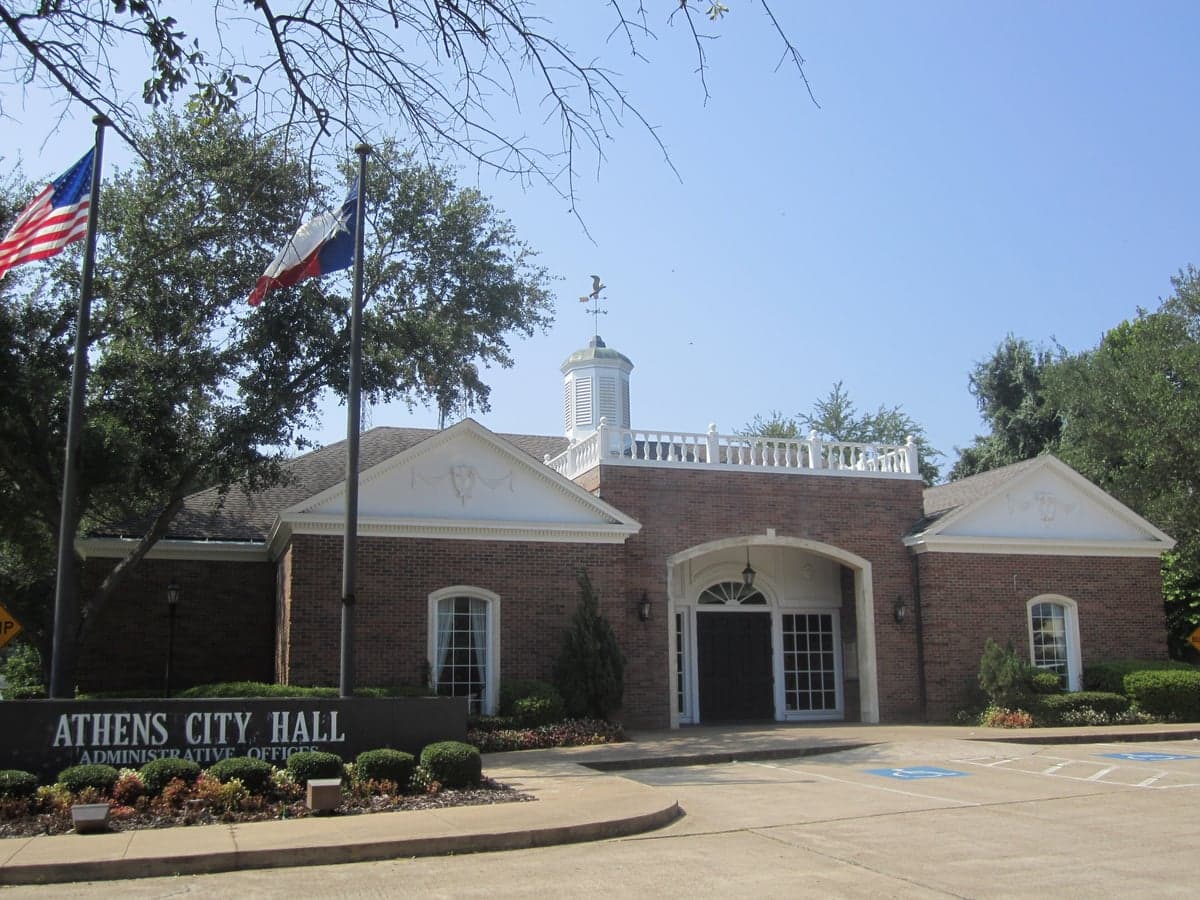
Photo: Wikipedia
Political ClimatePolitical Climate in Athens, TX
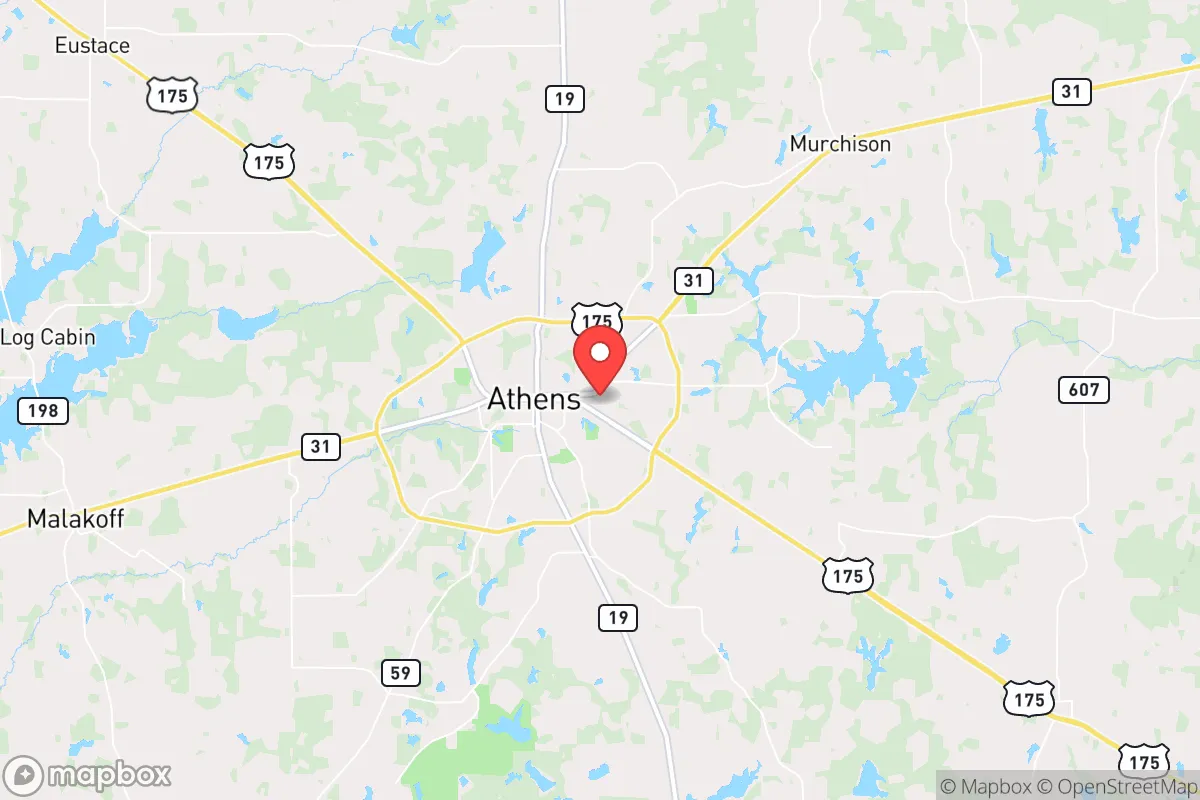
District shown is the primary district for this city’s centroid. Cities may span multiple districts.
Local Political AnalysisPolitical Analysis of Athens, TX
How it compares
Comparing Athens to the state of Texas as a whole is a bit of a mixed bag, mostly because Texas itself is a big, politically divided place. The state’s Cook PVI is technically unknown in the standard datasets, but statewide results tell the story: Texas has voted Republican in every presidential election since 1980, though the margins have narrowed in urban metros like Dallas, Houston, and Austin. Athens is not those places. It’s closer in spirit to nearby towns like Palestine, Jacksonville, and Tyler — all of which lean similarly conservative — and a world away from the politics of Austin, roughly 160 miles southwest, or even Dallas, about 70 miles north. In Henderson County, Republicans routinely win local races by 20 to 30 points, and the 2024 presidential margin here was comfortably in the double digits. The practical difference between Athens and the state average is that Athens is more uniformly conservative; you won’t find the deep-blue urban pockets that drag the statewide numbers toward the center.
What this means for residents
For conservative residents, living in Athens means your politics are the default setting. Local officials, county commissioners, and school board members are almost all Republicans, and conservative viewpoints dominate public meetings, church pulpits, and coffee shop conversations. If you lean right, you’ll feel culturally at home, and your vote carries real weight in local primaries — which, in a place this red, are often the election that actually decides things. For liberal residents, the reality is different but not hostile. You’ll be in the minority, and you’ll likely hear opinions you disagree with on a regular basis, but Athens isn’t a place where political differences turn into personal feuds. Most folks here are neighborly first and partisan second. That said, progressive candidates rarely bother campaigning here, and if you want to find like-minded people, you’ll often end up driving to Tyler or even Dallas for meetups and events. The practical takeaway: your vote won’t change the outcome locally, but your voice can still be heard in community settings if you show up and engage respectfully.
Culturally, Athens wears its politics on its sleeve in ways that go beyond elections. The county is dotted with churches, the local VFW and American Legion posts are active, and the annual Black-Eyed Pea Festival is a celebration of small-town Texas identity rather than any partisan cause. Gun rights are taken seriously here — you’ll see “Come and Take It” stickers on trucks — and the local economy leans on agriculture, small manufacturing, and the nearby Lake Athens recreation area, all of which reinforce a self-reliant, limited-government mindset. The trajectory, as best I can read it, is more of the same. Henderson County is growing slowly, mostly with retirees and families from the Dallas suburbs looking for cheaper land, and those newcomers tend to be conservative too. If anything, the area is getting slightly more Republican as it grows, not less. For anyone moving here, the honest advice is simple: if you’re conservative, you’ll feel like you never left home. If you’re not, you’ll adapt — Athens is a friendly place, but it’s not going to change its politics to accommodate you.

State Political ClimatePolitical Climate in Texas
State Political AnalysisPolitical Environment in the State
Texas is a solidly Republican state, but the nature of that majority has shifted dramatically over the past two decades. The GOP has held every statewide office since 1994, and Donald Trump carried the state by 5.6 points in 2024 — a margin that, while comfortable, is the narrowest for a Republican since 1996. The coalition is a mix of rural and exurban voters, evangelical Christians, and a growing base of Hispanic voters in the Rio Grande Valley, while Democrats have consolidated their strength in the state's four largest metros: Austin, Houston, Dallas, and San Antonio.
Urban vs. rural divide
The political map of Texas is essentially a story of islands of blue in a sea of red. The urban cores — Travis County (Austin), Harris County (Houston), Dallas County, and Bexar County (San Antonio) — are Democratic strongholds that have grown bluer with each cycle. Harris County alone delivered over 700,000 votes to Democrats in 2024, enough to offset GOP margins in dozens of rural counties. But the real action is in the suburbs and exurbs. Places like Collin County (north of Dallas), Fort Bend County (southwest of Houston), and Hays County (south of Austin) have shifted from reliably red to competitive or even blue in the last decade, driven by an influx of college-educated professionals and minority families. Meanwhile, the rural west and the Panhandle — Lubbock, Amarillo, Abilene — remain deeply Republican, often voting 80-90% for the GOP. The Rio Grande Valley, once a Democratic bastion, has been the most surprising shift: counties like Starr and Zapata that voted for Hillary Clinton by 40 points in 2016 flipped to Trump by double digits in 2020 and 2024, driven by a mix of social conservatism, oil-and-gas employment, and frustration with Democratic immigration messaging.
Policy environment
Texas has no state income tax, which is the single biggest fiscal draw for relocators. The trade-off is a reliance on property taxes and sales taxes that run higher than the national average — the effective property tax rate is around 1.6% of home value, among the highest in the country. The regulatory posture is famously light-touch: no state-level occupational licensing for many trades, a business-friendly tort system capped at $250,000 for non-economic damages in medical malpractice cases, and a right-to-work law that has kept unionization rates below 5%. Education policy is dominated by school choice: the 2023 legislative session created education savings accounts (ESAs) worth up to $8,000 per student, though implementation has been slow. Healthcare is a mixed bag — Texas has the highest uninsured rate in the nation at roughly 14%, having declined to expand Medicaid under the Affordable Care Act, but it also has some of the most advanced medical centers in the world in the Texas Medical Center in Houston. Election laws are restrictive by national standards: voter ID is required, mail-in voting is limited to those 65 and older or with a qualifying disability, and counties are limited in how many drop-off locations they can offer.
Recent policy direction
The last three legislative sessions have pushed Texas decisively to the right on nearly every front a relocator might weigh. On guns, Texas became a permitless carry state in 2021 — anyone 21 or older who can legally possess a firearm can carry it openly or concealed without a license or training. On abortion, Texas passed SB 8 in 2021, the first state law to ban the procedure after roughly six weeks via private civil enforcement, and then a near-total ban in 2022 with no exceptions for rape or incest. On parental rights, the 2023 session passed laws requiring school libraries to get parental consent for certain materials and banning transgender students from competing on sports teams matching their gender identity. On property rights, Texas has no state income tax but does have a robust homestead exemption — $100,000 off the assessed value for school property taxes as of 2023. On privacy and surveillance, Texas passed a law in 2023 banning TikTok on government devices and has been a leader in restricting Chinese-owned apps. On voting, the 2021 SB 1 law banned 24-hour and drive-thru voting, added new ID requirements for mail ballots, and gave poll watchers more freedom to observe — all of which were upheld by the courts. The direction is unambiguous: Texas is legislating as if it expects to be the national laboratory for conservative governance.
Civil unrest & political movements
Texas has been a flashpoint for political conflict, but the character of that conflict has changed. The 2020 protests in Austin and Houston over George Floyd's death were large and occasionally violent, with the Austin Police Department reporting over 100 property damage incidents. The state legislature responded with a 2021 law that shields police officers from being defunded and creates criminal penalties for rioting. On immigration, Texas has been the most aggressive state in the nation: Operation Lone Star, launched in 2021, has deployed thousands of National Guard troops to the border, and SB 4, passed in 2023, makes illegal entry a state crime — a law currently tied up in federal court. The state has also bused over 100,000 migrants to sanctuary cities like New York and Chicago, a move that has made Texas the center of national immigration politics. Secession rhetoric exists but is largely performative — the Texas Nationalist Movement has never gotten a referendum on the ballot, and polling shows support for independence hovering around 20%. Election integrity remains a live issue: the 2020 audit of Harris County's results, ordered by the state, found no evidence of widespread fraud but did uncover administrative errors, which Republicans used to justify the 2021 voting restrictions. A new resident will notice the visible presence of border patrol checkpoints within 100 miles of the border, and the occasional convoy of National Guard vehicles heading south.
Projection
Over the next five to ten years, Texas is likely to remain Republican but with a shrinking margin. The state is growing by roughly 1,000 new residents per day, and the bulk of that growth is in the blue-leaning metros and the purple suburbs. The Hispanic population, now over 40% of the state, is not voting as a monolith — the Valley shift toward the GOP suggests that demographic change may not automatically benefit Democrats. The Republican Party is also consolidating its structural advantages: the 2021 redistricting added two congressional seats in the Dallas-Fort Worth suburbs, and the state legislature has shown no appetite for loosening voting rules. However, the suburban drift toward Democrats in places like Collin and Fort Bend counties suggests that if the GOP nominates another polarizing statewide candidate, the margin could tighten to 3-4 points by 2030. A new resident moving in now should expect a decade of close statewide races, continued legislative dominance by Republicans, and a political culture that is increasingly defined by the tension between the state's libertarian self-image and its interventionist social policies.
For a new resident, the practical takeaway is that Texas rewards political engagement but punishes complacency. If you're conservative, you'll find a state government that is actively implementing your priorities — but you'll also see your suburban neighbors getting bluer every election cycle. If you're liberal, you'll find islands of like-minded community in Austin, Houston, and Dallas, but you'll be living under a state government that is openly hostile to many of your values. The state's low taxes, light regulation, and economic dynamism are real and tangible; the political climate is a constant negotiation between the state's rural past and its urban future. Come for the opportunity, but understand that Texas is not a static place — it's a state in the middle of a demographic and political transformation that will define the next decade.
* Values derived from national, state, county, city and local statistics and may differ in a specific area. Last updated: 2026-10-21T10:06:11.000Z
Narrative content on this page is AI-generated and may contain mistakes. Verify any details that matter before acting on them.
ReloMaps may earn a commission from affiliate links at no extra cost to you.

